
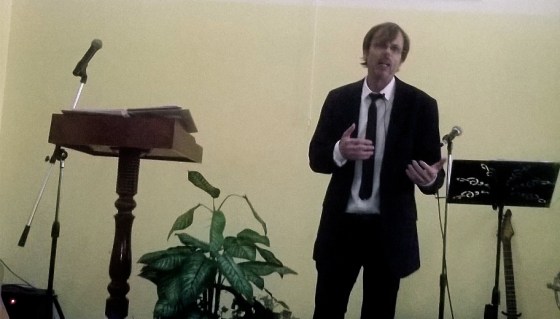
On Tuesday September 2nd located in ICF, Udon Thani, Thailand 45 minutes south of the Laos –Thai border crossing at Nong Khai I commenced a two-week course on ethics.
After a bit of a shake up in Laos I had only seven students in total, four earning their BA. Most students were Hmong from hill tribes in Laos and all relatively new Christians seeking to prepare themselves for ministry. The subject I agreed to teach was on ministerial ethics. Since there are no separate ethics for any particular class of people, and because all are called to minster, I set about to apply the ethical insights I developed in my new book, “Suffering the Tension Between the Seen and the Unseen” to ministry. In total our discussion ran about 45 hours. During this time the students, using our very capable interpreter and the principle/founder of the school, Ben McClure, expressed themselves ensuring that communication was occurring. Their input and responses kept the class interesting but no time more than on the last day.

On the last day I asked the students to present their papers. Part of the assignment was to share some of their pre Christian religious experiences and reflect on them in light of the insights taught in the course. The Hmong people have practiced Spirit Worship for centuries, maybe millennia. All my Hmong students shared personal experiences about their involvement in these practices having participated in them growing up in their families and tribes before they became Christian. For this reason they resonated with one discussion more than others. In order to appreciate the students’ responses I indulge the reader in the lesson in question that I opened up during one of our classes. Understanding this lesson a little will help one appreciate the students’ response and the story retold below on the last day.
In my book I have a chapter entitled “Don’t Get Your Exercise Jumping to Conclusions.” In this chapter I show that from times eternal humans encountering events remarkably good or bad tended to jump to far-flung spiritual conclusions. For instance, Hitler having escaped an attempt on his life by underground conspirators, because a thick wooden table shielded the explosion of a bomb placed under a desk near him concluded that his survival proved God’s favor rested on his work. My argument is that faith imposes a form of blindness on us — we cannot look at events on earth (the things that are seen) and correlate them correctly and directly to the movements of the unseen God in heaven. Time to time life as we experience it directly and immediately ‘heats up’ and when this occurs we are more often then not, seduced into jumping to false conclusions.
‘Sight’ without faith, (faith that anchors one in the ‘hiddeness’ and mystery of God) tempts antimony. The physical is thought to mirror the metaphysical. True faith interferes with this ‘spiritual’ correlation. Faith respects God’s ‘hiddeness’ in the earthly sensual, physical realm not only in terms of the invisibility of God’s eternal being but God’s day-by-day activity, God’s doing. Later with faith glasses we can see a little and at least say that what has happened was made purposeful by God (Romans 8:24) but up close in the moment we surely cannot say for sure what is happening and where or how God is in what is happening. Faith means to respect the ‘hiddeness’ of God. If we don’t live by faith we trespass and get our exercise jumping to conclusions. Here the street value of faith, on account of the fact that it grounds us spiritually to a greater unseen reality and the spiritual truth of that reality, is that it prevents us from being sucked into and under our immediate experience. It gives us a measure of distance from the charm and terror of our experience.
The Apostles and Prophets via word and Spirit reveal the reality of God, the relation God has to us and the kind of life God is backing and promising. And precisely because this revelation is different than that which direct immediate experience suggests is true we can cool and minimize the impact direct experience has on us when it ‘heats up.’ Experience without faith renders us fully exposed to the emotional, psychological and ‘spiritual’ impact of the phenomena we are confronted with. Experience with faith intact downsizes and qualifies this impact and anchors the soul in something greater.
This lesson intersects with the students’ stories on the last day. At class time each Hmong student told a spirit worship story. I chose to include this one. My youngest student, 18 years old, told us about what happened when his brother died. Immediately his father offered a chicken on the family alter replete with chanting in a non-literate ‘language’ to appease angry spirits. Unsure whether this would suffice his parents went to the Hmong shaman. Because their religion teaches that death always comes in twos they wanted to be sure their sacrifice would avail. Confident that the spirits had turned against the family the shaman made his judgment. The premature death of their young son revealed that the spirit’s displeasure with their family was very great. The antidote he concluded must be commensurate with the gravity and severity of the spirit’s anger – the sacrifice of a cow! The sacrifice of a cow would likely protect them and appease the spirits’ anger.

The trouble with this prescription was that the family was not well enough off to sacrifice a cow. Offering a cow would ruin them financially. For this reason they turned to a friend who suggested another possible solution – go to a Christian minister in a near by village and seek help. Under financial duress they opened their mind to things they were heretofore closed. After hearing out the matter the pastor assured the parents that there was no link between the death of their son and malicious spirit activity. Essentially the pastor said “don’t get your exercise jumping to conclusions” illness and death are related to real life and health not spirits. Not convinced the parents brushed aside the pastor’s attempt to disentangle spirit activity with illness and pressed the pastor for protection from another death strike on their family. This is what he wanted and expected.
Because the belief that physical life is the playground of fickle spirits is so deep in the Hmong’s psyche he did not expend too much energy trying to convince them otherwise. He pointed them to the unseen God who was greater than all spiritual and earthly powers and introduced this God as benign, just, good, merciful and loving. This unseen God, alone above all and before all was their refuge. Worship and trust this God and your life will abide under his care.
This helped a little. The pastor was mixing spirit with truth, truth with and into the spiritual realm and engendering faith. He was painting and coloring the spiritual realm in such a way that it ultimately took on a new shape in their minds and they imagined things differently. The truth of the existence of one God, good, faithful, merciful and caring whose power was greater than all earthly and spiritual powers began to disenchant their minds and lower their anxiety.
This coloring of the Unseen metaphysical /spiritual realm differently indeed helped, but only when the pastor broke out of the language of pure metaphysics and began to tell them this worldly Gospel story about how an anointed one came from God, sent from God (i.e. messiah) to earth and triumphed over evil and death did the fear of spirits begin to loosen their grip on them. The Gospel’s flesh and blood history, portrayed in a drama of defeat and triumph on earth where a real person, in real time and events, occurred in a real place provided the crucial stepping stone out of the spirit world morass they were caught in. The ‘physicality’, simplicity of the story transpiring in real time, combined with its spiritual interpretation broke the charm of the seamless erratic spirit world they were caught in. No cow was sacrificed and in time they became Christian and with them their entire family became Christian. Conversions from spirit worship to Christ among the Hmong people are rarely individual. The whole family transitions together under the leadership of the father.

The unseen of the spiritual shaped and informed by the gospel and the nebulous unseen of the world of spirit worship competed for their minds but the power of the former compelled faith and freedom while the power the latter, real or imagined, seduced them, making them fearful. Using the help of the other Hmong students and their stories I have taken the freedom to shape the pastor’s way of leading the parents to faith. The irony is that we are not really that different. A faith that is able to resist the seduction of awesome phenomena needs the word of the Gospel of Christ. In this world, this world reality, a victory has occurred. The gospel of Christ alone gives faith in the unseen teeth!
My next stop is Phenom Penh. In an up coming post I will share the details this project.
 existence and faith