
Teaching in Harbin, China
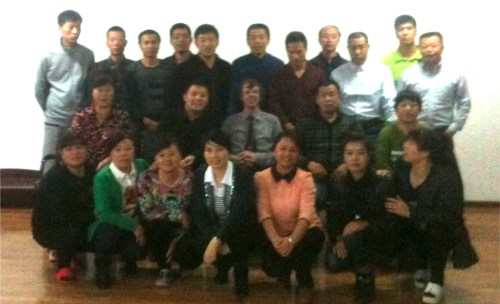
I spent 2 weeks in close quarters with my Harbin students pictured above. The school is inside an industrial complex about 30 minutes outside of the city. Evidently, a wealthy businessman who was operating out of one of the industrial complexes secured an additional building next to his for the seminary, which operates incognito. There are two levels, undergraduates and masters students. The undergrads board at the school over the academic year while the masters students, all missionaries, pastors, and teachers earn their degrees piecemeal coming and going for two-week intensive stints. My interpreter, ‘Tony,’ flown in from Shanghai turned out to be one-third Barnum and Bailey clown, one third used car salesman and one-third evangelist. Zeal he had indeed but I left unsure of the degree he had faithfully attended to the task of translating. Noticing that from time-to-time he was taking too long to translate all the while hamming it up made me suspicious he was up to something. Fortunately, I had one student who understood English told me that my translator’s translations were really his own sermonettes. With this evidence in hand I issued him an ultimatum “wake up and smell the coffee and translate what I am saying or pack your bags”.
For two weeks we studied Christian ethics. My impression is that much of underground Chinese Christianity is burdened with, not legalism, but nomism. “Nomism” refers to law based righteousness, i.e. when moral rules and laws define a believer’s righteous duty. Top down moral imperatives were more often than not the horizon of righteousness in the Chinese morality I was exposed to. My thesis was that Christian ethics is a bottom up, inside out phenomenon. The ethic we are to put into play way with others first has its source in God’s ethic with us. This statement captures my thesis for the course in one sentence. In and through the Gospel of Christ God gives us three things – faith, hope, and love – nothing more nothing less. Each of these reach us as a gift which we are enabled but not forced to receive by the Spirit ridding in the carriage of the Word of the Gospel. Once received these take spiritual residence within a person. From inside this existentially alive location a new ethical impulse is awakened. These three, faith, hope and love, empower a new ethical way to live and relate in the world. From a superficial reflection this reduction may seem to render Christian morality, not only too simple, but weak. Rather than a milk toast easy pleasey kind of ethic, I set out to show just the opposite. Hope and the “God of hope” is the mother of restraint, shortening the reach of the greed and swollen desire that easily infects us. And these tame our actions from being driven beyond their rightful boundaries by anxiety. Without the trust and patience that are seeded in us by faith and hope we try to make the good things in this life into the best things – the be all and end all. Faith in things unseen is the mother of reverence, not only for the hidden God but respect for all things that God has designed impregnating them with subtly and ‘hiddeness’. And love, rather than an impossible spiritual imperative, when first received, not first as something we must do but something God has done for us and is to us, empowers freedom. This is the freedom to turn from the preoccupation with self to lift up others. None of the students had ever thought of Christian ethics as consistently grounded and informed in this way. Nevertheless they took to it – and some of them with great enthusiasm, realizing the power and freedom it carried.
Teaching at Union Seminary in Wenzhou, China

When I arrived at the Union Seminary in Wenzhou where I have been many times, there was a huge pile of boulders and rocks just inside the rear and front gates. I thought there must have been construction going on. The huge stones prevented passage of any vehicle of any size was possible coming in or out of the school. But the reason for their existence is to be found elsewhere. This school of all the schools I have served in China has enjoyed great relations with the local government. Unlike other schools the government knows they exist and the local magistrate is on friendly terms with the principal (who he has tea with from time-to-time). This school is different because it has a cozy relationship with a local, government approved, Three Self Church, using its church and facilities. Union Seminary, a non-government seminary that has no permission to exist, has a great working relationship the Three Self Church and everything has been working fine for many years. But now the city of Wenzhou, once the envy of religious liberty in China, has suddenly become the object of hostility from Beijing and the top brass there who supervise religion and culture. The central government (not the local government) decided to tear down all the crosses from the Three Self Churches in Wenzhou regardless of the fact that they are under their control.
The more visible a church is the greater danger it is of being violated even destroyed! Beijing does not want crosses and Christian churches doting the public landscape. Things have now become worse. Fearing that even the Three Self Churches are slipping from their control, Beijing has cooked up a new set of five guidelines necessary to control Three Self Churches, one of which is doctrinal. Imagine the government deciding whether your church has the right to exist after giving you permission dictating your doctrine. The huge rock pile blocks heavy equipment vehicles from quick easy access to the church building, which bears a cross that can be seen from a distance. They like to strike fast with stealth to prevent, if possible, protests from forming. The Communist architects of culture are grieved with Christianity at a seminal level. The outsider applauding the government’s openness to the church should be sure of one basic fact – where the church is not perceived as supporting and furthering Beijing’s cultural values and design they will be persecuted. Last year I introduced the Barman Declaration and next year I will teach it A-to-Zed. Barman faced off with Hitler’s attempts to take control of the church in Germany.
 existence and faith
Greetings Dan!
What is behind the name “Three Self Church”?