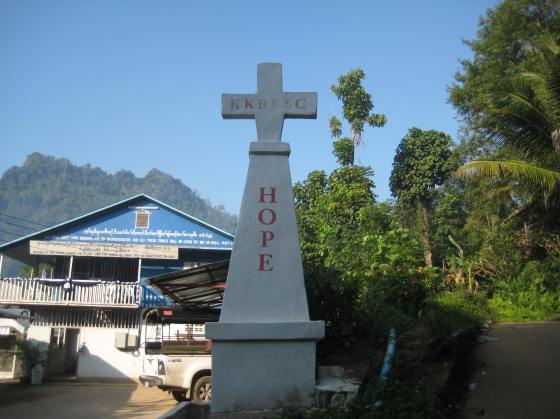
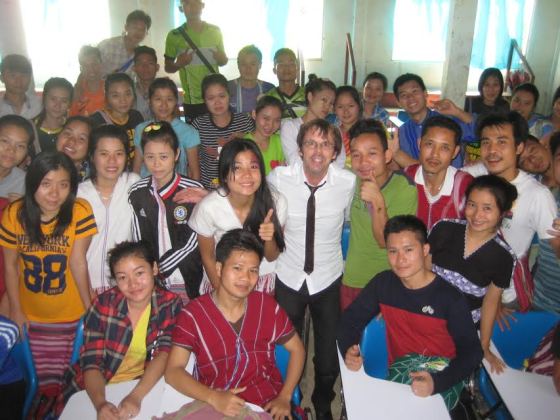
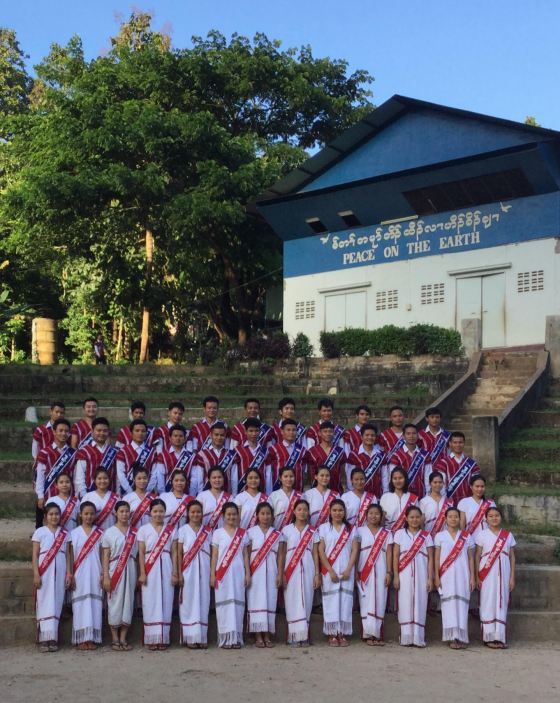
While Donald Trump was ascending to his glory, at the very moment the decisive count was being tabulated I was at the center of the universe, well that is a slight exaggeration, not the center of the universe but the world, our world – planet earth. Without question KKBBSC was for me, at that moment in time, the center of the world because since the world is round the center is wherever one is located. I was located at The Mae La Refugee Camp an hour and a half north into the mountains by the Line Bus from Mae Sot, western Thailand. I was in Section A in the camp, teaching a course on The Relation of the Christian Church to Political Power to junior and then senior students of The Kawthoolie Karen Baptist Bible School and College, one of the coolest schools on the planet!
When the score was finalized and the Electoral College votes tabulated it was midday the 9th of November and my afternoon class was approaching. To assuage my grief I held a memorial service to the campaign to become the 45th president of the United States. This memorial campaign, which had just exhaled its last gasp of fowl air before giving up the ghost, deserved in my judgment, to be eulogized. The nasty, nauseating, mud slinging, soul destroying, bellicose campaign, with all its wild and wooly claims, extending from little hands to a new great wall that will divide the Americas had come to an end. While something else was born the campaign was then and there, at that moment in time, over, finished, dead and gone. It seemed fitting therefore to immediately hold a memorial service in this tropical climate where everything rots quickly and disappears into the abyss of nature’s ferment.
Without reflection the only commentary on the life of this campaign could be none other than Bob Dylan’s refrain, or a close facsimile thereof, “something has happened here Mr. Jones but I don’t know what it is.” And this is what I did – I reflected out loud about what had happened. Setting my lecture notes aside I spoke extemporaneously for about 2 hours and mused over the campaign, sometimes using Christian and Biblical understandings as my tools, sometimes experience and reason. In fact, the truth be told, the students suborned me into this task, requiring me to say some final words for they too were confused.
The memorial service of sorts, which I did indeed publically name as such at the beginning of the class, came about sort of like a scene from an old western movie where a compatriot dies in a mountain shoot out. Instead of just riding off, someone in the gang with a conscience says “we cannot just leave ‘em lay here to rot we gotta bury ‘em”. And when they do cover the dead guy with a heap of rocks with a make shift stick cross wedged between them then they realize somebody has to say a word even if its ever so banal and terse. I was that guy. They forced it on me. The students made me do it. Their insistence however, it must be noted, was born mostly from a true affection for the USA. Karen students do not have a mere sentimental affection toward the USA born from rock and roll and the movies. More than any other country in the world it has been the USA who has welcomed Karen Refugees driven from their Burma/Myanmar homeland, held in camps inside the Thai border now for 25 years. Many students viewed the USA as their friend and a potential new homeland. Trump’s anti-immigrant Make America Great Again rhetoric echoed in these far off mountains and caused these students concern and confusion. “Will the real America we have believed in please stand up.” This is what many were saying during the campaign, and then November 9th arrived and by some luck of the draw I was there with them, and together before us the identity of the new America rose to its feet and it was a grim presentation. Not only were they confused and concerned – I was too! Here follows one of my reflections the best I can reclaim my words and thoughts.
Scripture tells us the struggle of human existence comes down to an outward versus and inward focus. Sin and agape love dual for the mastery. The primary sense of sin that comes to the fore in Scripture is that of a toxic propensity that temps us humans to turn inward to ourselves and our needs, our security and desires and to turn away from others especially others in real need. Over against this propensity there is a counter power – the Spirit from above, God’s Spirit, who pulls us out to embrace the way of love and the ethic of justice that agape love calls us to. Following this pull the self becomes downsized and ventures a turn outward where it finds it’s life in service to others in need to the glory, not of self, but of God. While the turn inward is supremely acquisitive, the turn outward is radically distributive because it turns its helps out to those in need in the posture of service and ministry. Curved in or turned out this is the struggle which Jesus and Paul made the explicit self-conscious struggle of every individual. And whilst this struggle is essentially a personal struggle carried by the individuals empowered by the Spirit and by the groups and congregations that body individuals, this struggle transcends individuals and their parochial groups and enters the worlds, cultures and polities that individuals and groups create.
While agape love cannot, and should not be directly translated to the affairs of the nation state, as if it were an ethical code that could be translated, the outward versus the inward voyage elemental to Agape is not lost. Its presence in the world does not belong to the realm of ‘good ideas’. Its presence in the world is not correlated to the life span of ephemeral spiritual ideas and pious virtues. This side of Easter it is the destiny of this outward turn to challenge and, if possible, penetrate every body and institution whether economic, familial, and political and upon penetrating its consciousness compromise, its consistent inward preoccupation. All individual and social realities must struggle with this revolution because the messiah has already come and given this revolution a historical career. It is the future of humanity, and this side of Easter it is not only coming, as in the age of the Prophets, it is present and coming to fulfillment. And while it cannot be instituted like a law or policy the power and genius of this turn outward can and must be discerned, and reflected in our bodies, not only body selves, but familial, economic, ecclesial, and national bodies the best we can. The self stands deep in these bodies, shapes and is shaped by them.
The inward focus centers all the attention on the explicit promotion and greatness of self. In this turn self narrows and becomes anxious. In fact it was Luther who wrote of this turn calling it the essence of sin. Sin he wrote in Latin is “Incurvatus in se“, “the self curved inward on itself.” From the lens of this inward focus every resource and person (or people) around it is seen in relation to the direct enhancement of oneself or threat against oneself. Self-focus, self-concern, self-protection, the security of self, as well as the promotion and preeminence of self, becomes studied, purified, streamlined into policies and baptized as a new ideology of strength. “Today on November 9,” (Asia is a day ahead in time) I told the students, “America officially and openly embraced a consistent inward focus whilst calling into open question and disparagement all of its outward, other centered endeavors. Like an immune system that becomes confused and attacks and destroys its own vitality, America turned against its own liberal magnanimity – the soul and secret of its vitality. The verve and nerve to turn outward toward needs and concerns beyond its own, to the extent such ex-centricity still existed, received a great wound. Jettisoning its outward focus and embracing a full throttle toxic inward focus the new leadership and their followers said “Let the world go to hell in a hand basket we must now shift all our attention explicitly on the nation self.” “From henceforth our platform will be about only those things that are explicitly, directly, simply, fusslessly, and immediately good for us.”
Never mind the deeper question that underlies everything else, namely whether this new ethic really attends to the subtly, complexity, liberality and humanitarian wisdom embedded in enhancing the greatness of oneself or one’s nation. Here it’s the explicit shift to make the national self’s greatness a simple, direct, unambiguous goal, as if that were possible to begin with. On the contrary, outward focus requires one to sit loose with one’s greatness, real or imagined, and to beware of the swelling and inflammation of self interest, and act out of a wide spectrum of interests where another’s good, need and plight enter into decision making and action.
Take justice for instance. Under the new Make America Great Again ethic the outward turn is viewed as an ultraistic ephemeral spirituality, fit for pious church people, but an ethic that has any business being woven deeply into the fabric of the nation state and its polity it is not. Justice – coming alongside the down and out in an effort to help restore the means of life – must now be interpreted as weakening the nation self. In fact almost every social benefit or relief can be viewed as a drain on the collective self’s economic strength. Embracing ethnic and religious differences, making room for them, and according them dignity and social space as a matter of principle, becomes interpreted as weakening the power of a more or less homogenous democratic majority (more or less – every year less). The mind set that believes that the funds from the public purse must not be used to put justice into play, in the myriad of ways it faces the nation is the opposite of greatness. It is anxiety driven and its driven by the ‘haves’ who fear their privilege will be compromised by the have nots. It is Incurvatus in Se, the national self curved in on itself.
America as a vanguard and sentinel for human rights and freedom in the world, a voice for exploited, abused and enslaved peoples, people without rights and a say in their future, is viewed as runaway liberalism, as elitist, as cultural imperialism. And most importantly it is seen as contributing nothing directly to making us great, muscularly great, nationally great and economically great and or militarily great, because it is in these measurements of greatness that the rubber meets the road in this ‘new ethic’.
November 8 decided it. The time had come for America to pull back, curve inward, and quit “saving the world” (the libel of its nay sayers). It is time, America said, to tend to our own needs and greatness. Its time to go back home and stay home and make America great again. Time to withdraw from the global struggle for rights and justice and freedom, except of course where our security is concerned. It is time to reign in the liberal notion that every difference is to be baptized and given free social commerce. These differences – do they not weaken us? This is what the majority of States ( not people/citizens) said on November 8 led as they were by one who was well qualified, perhaps qualified far above anyone else, to lead the revolt against the outward turn. For has anyone in America mastered incurvatus in se better than this new leader has, took it deeper and further than he has, practiced it with such awesome radical consistency as he. Is he not much more than merely president (one who is fit or unfit to preside over the affairs of state) but really far more the new man, exemplar man for all men and women where incurvatus in se is personified and the election of 47 percent, a collective act of erotic love.
By November 9 in the wee hours of the morning led by their new leader a sufficient majority of the states gained the mandate and said “we must now commence to circle the wagons and protect ourselves, the greatness of our country has come under many threats. We will now cease the outward venture and turn inward!” On November 9 the primacy of me, myself and I, the miserable ethic of Cain, morphed from the secret guilt of self -centered individual souls to a shameless boastful slogan of a new toxic nationalism.
Build a wall, a great wall and cast out all that weakens and threatens our greatness. Nothing captures what happened better than the great wall. It of course may never be built as it has been advertised but in my opinion it was never intended to be built as advertised. Real or imagined the wall was from the get go a metaphor for the new exclusivity that America was wrapping around itself. America had gone out as far as it was going to go and now it was time to turn inward, it was time to purge America of weakness and concentrate its strength and greatness and then protect it from contamination.
One must pause here, indulge a brief moment of reflective irony. Is not whatever greatness one person or nation approaches, sort of like the proverbial dog running up a shallow stream with a fish in his mouth. Upon seeing his reflection in the water the poor dog becomes mesmerized and confused and then thoroughly bemused, then suddenly drops the fish and lunges for the reflection losing both the fish and the reflection. I have already witnessed it, many here in the South East Asia have already realized the fish is gone from the dog’s mouth, the illusive mystery and wonder of America has gone flat! Even junior and senior college students wearing Karen ethnic wraps, living in thatch shelters made from leaves and branches perched under the cleft of a great desolate mountain out in nowhere in the rugged terrain in Tak Province in Northwest Thailand six miles from the Burma border know the mystery has gone flat – America has curved inward.
Hope is the key word all around. Hope here and now, means we Americans and friends of America renew hope that all of the peoples, agencies and religious organizations that have been turned out to the greater good, the common good, domestic and international, will not flinch but strengthen their resolve. Hope here and now means that the cries of oppressed peoples such as those in KKBBSC and the Mae La Camp, in Syria and the Syrian Refugee Diaspora and in Burma/Myanmar with the plight of the Rohingya Muslims and legends of other oppressed groups in South and Central America will be heard and real help will reach them. Hope here and now alas means that all in positions of power and wealth, including the 45th president elect and his suite of advisors and helpers, will be converted to true greatness – the greatness of turning away from swollen self interest and anxiety and out to those in need, the many real faces of need in search of friendly eyes.

 existence and faith