In my last teaching hitch for 2018 I returned to Mae La Camp (KKBBSC) on the Thai Burma Border. In this post I share a few pictures and notes on my work. During my time I lectured on Matthew 5:13, here follows my pictorial show and tell.

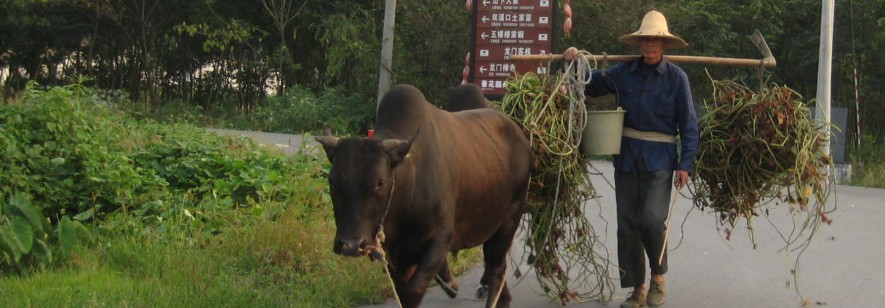
Here I am heading back to Mae Sot to return to KKBBSC for the 10th time since 2011
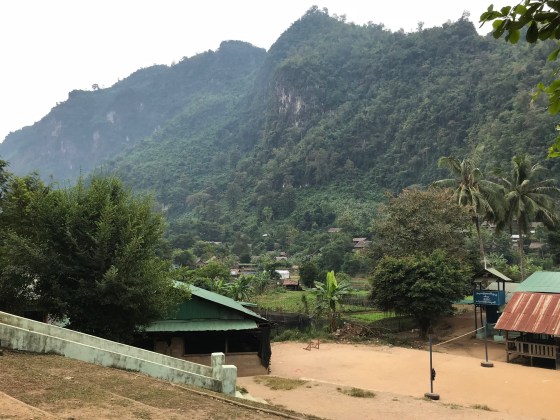
Under the shadow of a great great mountain in the remote region of Tak Province in N W Thailand, just a few miles away from the Burma Border, there is a large refugee camp, the Mae Camp. There are 50,000 Karen in this camp who approximately 25 years ago fled their homeland across the border in Burma / Myanmar when the military turned against them burning their villages, slaughtering tens of thousands of them, violating women and confiscating the land inhabited by their ancestors for hundreds of years.
In Section A, B & C there are approximately 11 churches and one college of over 500 students. Repentance is gracious. It is gift and task. Change is not at our beck and call, an easy extension of our will. Gracious opportunities for change arrive at our door step and if ignored suddenly fly away like a bird on a limb. The Burmese military in 2012 enjoyed such an opportunity and began to commit themselves to change but like a drunk who swears he has changed, then goes on a binge, they returned to their ways with the Rohingya. The Karen are now talking to the Military again in hopes of change but now their land has been over run.

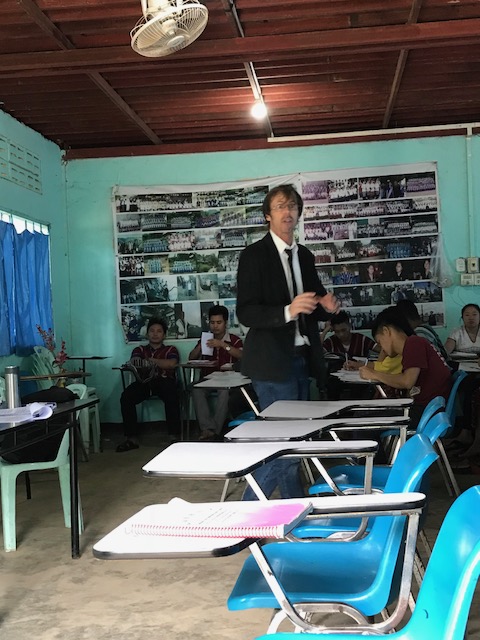
In the picture above I am lecturing to the senior class (some of whom are visible in the photo). My theme for the week was “You are the salt of the earth but if the salt has lost its savor…” Jesus Christ VS the Church and the World. Jesus entrusted to his followers the salty difference of his way and truth, this salt is radically different than the way of the world. If the church loses this difference it melds into the way of the world and Christ, the great chef, cannot use it in his work. We plumbed the truth in this text looking at it and listening to it every which way.
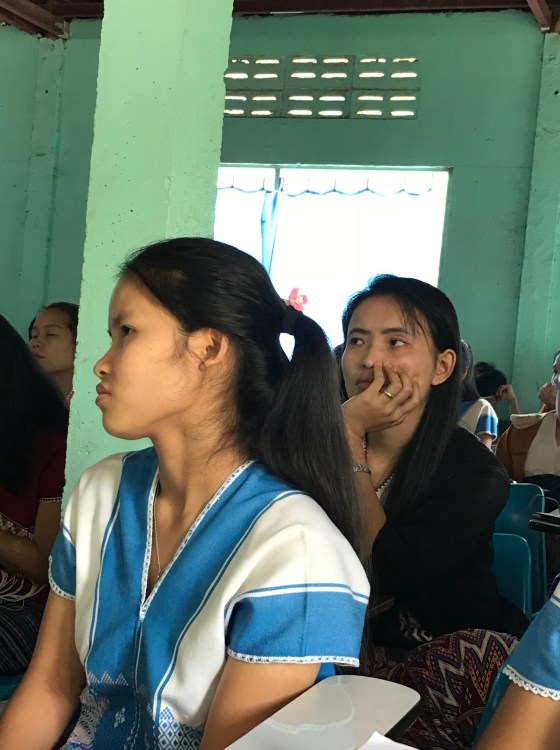
This is a picture of one of my students captured by another student who I lent my phone. Most every student was attentive. Because they are living far away from the main currents of civilization, sort of like I did in my secondary education growing up, they are hungry to understand what is going on in the church at large and also the relationship of the church with what is going on in the world. Up until Fall 2016 many students applied for and received sanctuary in the USA. Now the gates are locked & their applications are not being processed.
They are curious about the changes going on in our country and the relation of church to politics. I taught them that while the church is public in its witness to truth (” you are the salt of the earth...the light of the world“) and while this unique truth of Christ shines light on every sphere of human existence, individual and national, the church is not political. As Scripture teaches the church is the bride of Christ and belongs to him alone and exists to carry out his mission on the earth and even if it wanted to it cannot wed itself to political parties left or right. Even so the ‘heat’ generated in culture and the nation’s political theatre threatens to suck parts of the church into its orbit (left and right) and if and when this happens the church loses its salt.
Here in this picture I am explicating “The Impossible Possibility” ( Luke 18:18-23). After the Rich Young Ruler came to Jesus for a meeting about how to enter the kingdom he commenced to listen to him. At first it seemed to him he was in good stead to enter the kingdom. But Jesus upped the ante and he then turned away. When Jesus called him to unload his great wealth and become his disciple it was one bridge too far. The Gospel record of the story tells us that he turned and “went away sorrowful”. After the RYR left Jesus said to his disciples “it is hard for a rich man to enter the kingdom of heaven.” To this statement, Peter retorted, “who then can be saved?” Responding to this question Jesus spoke of the impossible possibility. In this class I developed the significance of these discussions, first between the Rich Young Ruler and Jesus, then between Jesus and Peter. The substance of my lecture focused on the 2 questions: why its hard for people laden with wealth to enter the kingdom and then how it is possible for such people to enter. There is a little hope in one direction.
After exploring the text the discussion turned to the naïveté lodged in the original DNA of the modern world toward wealth first set forth by the Scotsman Adam Smith, a pioneer of modern economic theory. Smith, which posited a laissez-faire economic theory was confident that any and everyone who plunged in and found a way to create personal wealth, no matter how great, would be doing the common good a favor (his theory was in my estimation not too far removed from the crass motto ‘greed is good.’ With Christmas nearing my refugee student seniors, themselves poorer than church mice, began to think about the lesson at hand and asked the question who is really laying in the manger in this 21st Century World where both East and West) have embraced Christmas with all its frenetic buying and selling frenzy––Adam Smith or Jesus Christ? And with this question another “has the witness of the church on this matter lost its salt?” One student blurted out “I think some one switched the baby”. It seemed to them that a great hiatus had irrupted between the Jesus Christ that comes to light in the Gospels and the Christ of Christmas in the 21st Century.

On the final day with my class, after I finished my lesson, the seniors asked me to be seated and carried out a little ceremony saying prayers and making little speeches to express their gratitude and at that time they gave me a Karen shirt to show they accepted me as one of them.
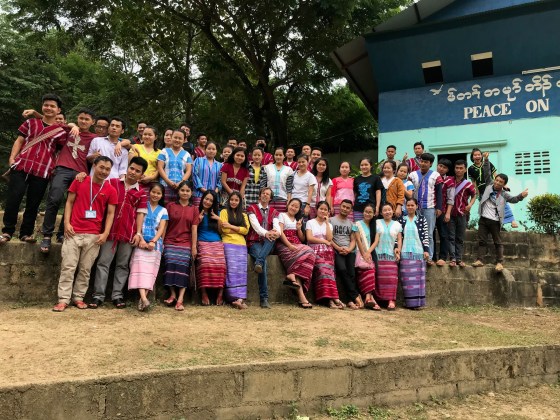
This picture was taken on the last day of my classes this year. This year I was given the entire senior class, approximately 60+ students. I am seated in the middle of the front row.
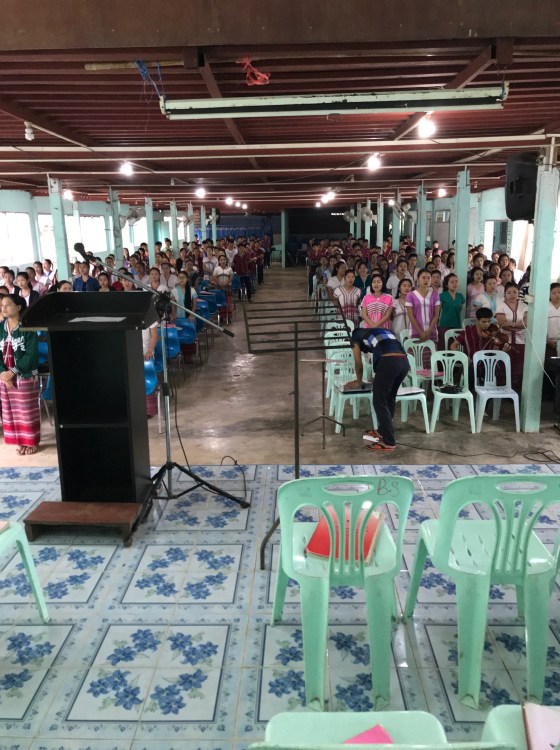
Everyday I traveled one and a half hours on an open bus through the mountains to the Mae La Camp passing through two military checkpoints. Shortly after I reached the camp it was time for chapel. I took this picture the last day I was with the school from the platform where I was seated. Shortly after this picture I spoke to the student body speaking from Ephesians 3:16-19 emphasising the words found in the passage about the need to be “rooted and grounded in the Father’s love”. The thesis of the message I presented argued that there is an all important relation between the seen and the unseen. If our lives are not “rooted and grounded” in the invisible love, that is far greater than any visible earthly love, we will be tempted to reach too far beyond ourselves in order to possess these earthly visible loves. And we will also try too hard to connect to them and will be tempted to draw too deeply from their comforts and pleasures. When the visible loves that God the creator put in this world for our good and enjoyment become too important, and when in their absence we stretch beyond ourselves to reach them, and partake of all we ‘need’ and desire from them, then it is that our humanity is spoiled and harmed. One definition of transgression reads as follows, “sin occurs when humans put the good things in the room that only the best things belong.” Only if and when we through the power of the word and Spirit come to see and recognize that the invisible love of God is the root and ground of our existence are we able to moderate the importance of earthly created loves so their presence does not become too great or their absence tempt us to reach beyond ourselves to possess them.
 existence and faith