
Introducing a New Series on Existence & Faith
Seeking a restart to my existenceandfaith.com blog, I have found it right here in this Exodus story and my handwritten notes prepared for the seminal discussions that occurred with the senior KHTS students the last half of July 2023.
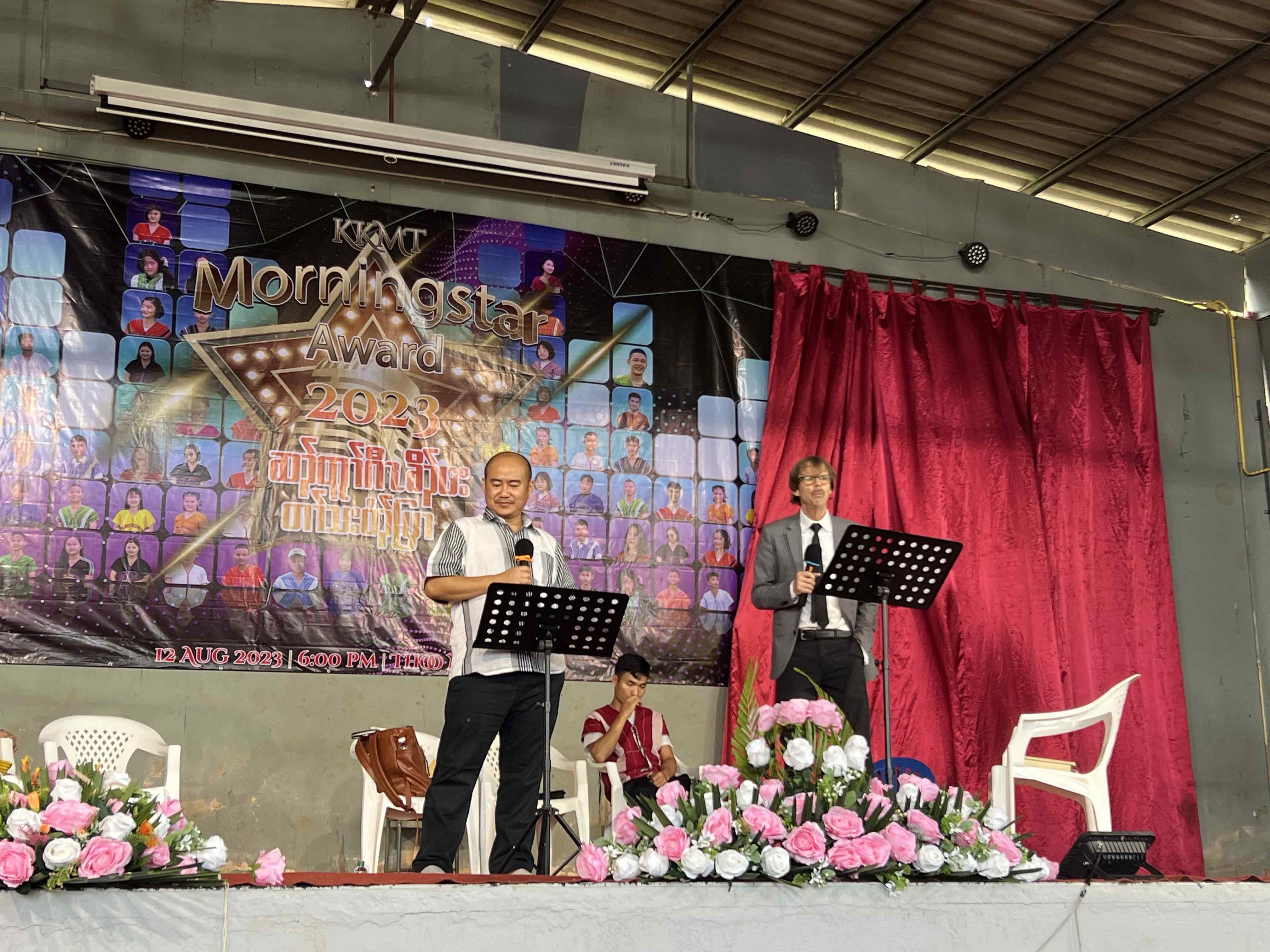
On the evening of July 16, 2023, I arrived in Phop Phra, Thailand, along the western border with Myanmar. The following day, I commenced two weeks of lectures entitled “Let My People Go.”
Each class was devoted to a lesson developed from a seminal piece of the story of the Israelites’ deliverance from bondage, as recorded in Exodus chapters 1 to 20. Kathoolei Hope Theological Seminary’s (KHTS) President, Dr. Saw Wado, along with the Academic Dean, Wapangrenba Imchen, had invited me to deliver the Exodus lectures, which also included a Sunday preaching service and two evening lectures to the SPHERE Institute. (The SPHERE is an entirely separate corollary educational endeavor put into play by Dr. Wado solely devoted to preparing students for the challenge of building healthy social, economic, and political communities).

I accumulated a relatively thick stack of hand-written notes from these two weeks. Rather than attempting to word process and post entire lectures or my preaching work, my aim is to share some disparate fragments from this stack of notes, all of which share an interrelated theme. In this maiden posting (posting retart) I open up what this interelated theme. I’ve chosen to circle and explore peradventure so that I might stumble on greater clarity. In the following, the reader will almost certainly conclude I have drifted away or lost the point I set out to make, but the truth be known, I have chosen the scenic route to get where I am going rather than the expressway.
It was my 12th teaching excursion to the schools (my first visit was in 2011), including colleges and seminaries created in the wake of the Karen diaspora from their “Karen State” inside Burma/Myanmar. This diaspora began in earnest about 35 years ago when the Burmese Military, who had gained a stranglehold on political power, turned viral toward the Karen people burning their villages, raping their women, massacring tens of thousands, and laying land minds the wretched consequences I saw with my own eyes. In response, the Karen fought back but also largely vacated their land and fled across the border into Thailand, where they gathered in refugee camps such as the Mae La Camp (Mae La to this day numbers approximately 50K people) situated in the cliffs and mountains of the northern part of Tak Province. Almost immediately upon settling these camps, the Karen formed churches and schools. There have been many camps and many schools over the years. KHTS, however, is brand spanking new.

KHTS opened its doors during the COVID-19 plague and is now sporting several fine buildings perched on a hillside in the village/district of Phop Phra that faces west toward their homeland a mere four miles away. While grounded in the Christian Baptist tradition and beliefs, KHTS has come into existence at this time and place with a new passion for Justice born out of the long Karen struggle with military rule. Sewn into their historic faith, there is now a self-conscious affirmation of their God-given proper dignity, which has been violated and must cease being violated. Henceforth, the Karen refuse to wear the subjugation and inferiority of their people, not that they were ever cowed by their enemies’ animus and estimate of them. They have always been known as fierce warriors and a strong people. But now, a new taste for Justice has emerged with greater self-conscious awareness.
The Karen see a new future for themselves that exceeds the days before the diaspora. In this future, the Karen people must be reverenced, their ancient land restored to them. The freedom to rebuild and govern themselves must cease to be usurped by the Tatmadaw, and no Karen voice must be denied their natural God-given right to have a say in shaping this new future. These are merely the basic things of Justice, freedom, dignity, equality, and fraternity needed to protect and nurture the life-giving blessing given to all. But when they are taken away, for those for whom they are taken away, the project of regaining them restarts in earnest with new thought, attention, and more self-conscious passion.
Indeed, this plight belongs not only to the Karen but to this world in travail, especially the peoples violated and trampled on. This vision of liberation for oppressed and enslaved peoples was born in antiquity by the story of Exodus, carried forward by the Hebrew Prophets and Jesus’ earthly ministry to many in Judea and Galilee captive to guilt, disease, and hopelessness. If any are waiting for the real historical Jesus to please stand up waith no further. Luke has provided the critical piece needed to decifer this riddle. Before commencing his ministry Jesus went into the wilderness and was tempted when he came out of this 40 days desert fast he went home to Nazereth and on the Sabbath day he went to the synagogue. This is where his ministry received its job description and was inaugerated. Consider the following text from the Gospel of Luke chapter 4.
16 And he came to Nazareth, where he had been brought up; and he went to the synagogue, as his custom was, on the sabbath day. And he stood up to read; 17 and there was given to him the book of the prophet Isaiah. He opened the book and found the place where it was written,
18 “The Spirit of the Lord is upon me,
because he has anointed me to preach good news to the poor.
He has sent me to proclaim release to the captives
and recovering of sight to the blind,
to set at liberty those who are oppressed,
19 to proclaim the acceptable year of the Lord.”
20 And he closed the book, and gave it back to the attendant, and sat down; and the eyes of all in the synagogue were fixed on him. 21 And he began to say to them, “Today this scripture has been fulfilled in your hearing.”
Jesus’ deeds of mercy were accompanied by his preaching of the coming Kingdom of God where justice would triumph once and for all. But the history of Jesus and justice in Scripture does not end with his words and deeds. It was not long before Jesus’ ministry stirred up the animus of religious and political leaders of the day who collaborated to shame this messianic charlatan by orchestrating a public humiliation – the final solution to put down this maverick charismatic rabbi who had begun to worry the religious authorities in earnest. Reputedly, Jesus was brewing up a violent revolt against the Romans; this was the religious leaders’ spin sold to the Roman governor Pontius Pilot as well as Herod.
God has a bias toward those under the heel of malignant powers. The Jews of the day who walked among the people as teachers of the Law and Prophets should have known this. This witness is everywhere in the Torah, the Prophets, and the Psalms. Fastening Jesus to a wooden crossbar and then lifting it and resting it on an upright stake on a hillside so he could be visible far and wide was a punishment perfectly architected by the Romans to shame messianic mavericks and political revolutionaries by publicly incarnating their impotence before the people.
This charismatic kingdom preacher and doer of Justice to the oppressed trekking around Judea and Galilee indeed answered to the Hebrew Prophets’ vision of the future. Within the space of three and half years, he had drawn many people into his orbit, especially those excluded, disenfranchised, oppressed, and once hopeless. The antidote used to break his influence over the people and return them to reverential submission to those leaders whose divine calling was to keep things the way they were was nothing less than the cross. Helplessly hanging on the crossbar fixed to an upright stake, Jesus’ influence with the people would surely be broken.
If this were where the story ended, indeed, the future would have been guaranteed. But God’s plot is deeper than men and women’s devices. The Apostles’ Gospel of God’s resurrection of the crucified Jesus follows on the heels of this lynching a mere 50 days. The Apostolic Gospel declared that the Passover crucifixion gave way to Easter Sunday and that it must not only be understood in light of God’s past of lifting up the oppressed, starting with the enslaved people in Egypt, the first decisive act of God’s Justice, but God’s promised future. Easter Sunday, the Apostles declared, was the debut of God’s promised future in microcosm, the first act in the final drama whereby Justice is restored for the oppressed and all things made new. Their witness was that Easter was and is the breaking in of the new promised future in the midst of this old crooked world.
I did not start my teaching endeavors in the Karen diaspora by first reading the room and adapting to it. I did not find out what was going on there and then conform to it so that I could fit in as best I could. I did not come to listen to Wado, and the colleagues gathered with him to sing a new song and then, as best I could learn their tune. For a long time, going back to my Ph.D. Thesis, I had been shaping a similar tune. (My Ph.D. Thesis – Beyond Fixity and Freedom: The Relation of Protestantism to the Development of Modernity in North America, was successfully defended at The University St Andrews, St. Mary’s College in Scotland. This work laid the groundwork for me to begin thinking about the importance of the church remaining connected to the modern world whilst remaining substantively differentiated from it -especially in their mutual converse, where central words and meanings like justice, freedom, equality, fraternity, dignity and love seem to, and in fact to a limited degree do overlap).
For a long time, I had been thinking about the promise that the modern world more or less proffered to the world and the challenge that this idealism posed to the church. Modernity born out of the Enlightenment believed in individual rights and liberty (theoretically for all), in the rationality of human beings fitting them to sit in the front seat behind the steering wheel of their lives and make decisions and take actions. This movement of thought and action that coalesced in the 1700’s Europe and then North America, birthed a new radical idea of individual freedom and dignity and reconceived political power on a bottom self-government model. Add to this list their vision of fraternity and equality and the embrace of pluralism in society that these underwrite. These were part and parcel of modernity’s original bequest, albeit they had to be claimed and struggled to incarnate within the new republic that was always for and against this incarnation.
Not to be overlooked in Modernity’s idealistic debut is justice for all. Eventually, when the downside of the Industrial Revolution began to show itself, Justice was added to Modernity’s original charter of freedom and governance via bottom-up power. Justice was given little attention or development in Modernity’s beginning because the artisans and statesmen heralding its virtues were in the grip of a blind idealism that believed that wherever freedom was restricted, social and economic life remained repressed. But wherever freedom was enfranchised, in the end, all things worked together for the common good. But Laissez-faire economics, while stimulating economic growth x 10, also released a tooth-and-claw instinct for profit and a free-for-all fight to get as much as possible. My point is this: Modernity spawned widespread idealism regarding the fruit it would bear and also, at the same (or in time) considerable pessimism regarding this fruit. Each of these two responses is not in and of itself cleanly separated, one from the other. Cultural pessimism and economic optimism can coexist in one cultural movement.
I am wary of following the ramifications in this discussion further for fear of losing the reason that I have addressed them in the first place. It is this: the Karen simply want what Modernity for 200 years has been preaching and establishing more or less. But here, my interest is the church, especially in the church in the West but also wherever Modernity’s ideas and mission have spread. And they have indeed spread to Burma and to the Karen, especially in the wake of its diaspora and the transgression and violence of the Burmese Military – the Tatmadaw.
Here follows the pinch of the point. In finding and choosing slices and fragments to post and share from my Phop Phra notes, I am looking for those pieces that more or less intersect the particular challenge that the above analysis points to. Justice lies at the heart of the Biblical witness, and like it or not, Modernity is largely credited with the church’s rediscovery of that fact, or to be precise, Modernity in crisis made a fledgling attempt to add justice to its original charter and succeeded to a degree. Some roots of this 19th and 20th Century movement to combine justice to freedom developed within the outer margins of the church (for instance, in North America, Walter Rauschenbusch, a German Baptist Pastor serving in “Hells Kitchen” NYC). This rediscovery is long overdue. In embracing this rediscovery, there is the potential that the church’s witness will be given a powerful, long overdue impetus to its mission and witness and a corresponding risk of losing the essential uniqueness or God-given saltiness of its witness.
Because the church seems to share, and to some degree does share, common ground with Modernity’s vision for human beings’ individual and social lives to be built on freedom, justice, equality, fraternity, and the dignity of all; and also because the church often exists in places where the people they serve and share their witness are deprived of these principles and yearn for them to be established they (the church) are in danger of uncritically sewing the two together -Modernity’s vision and mission and the church’s mission and witness. The risk is that the Biblical meanings and precedents that inform these words and meanings will be sewn together with the secular Enlightenment meanings broadly carried by the designation “Modernity.”
My passion, more or less present in my teaching wherever I have gone, is twofold. First, the church will broaden its platform and discover the deep underlying narrative of justice that is woven into its essence from its birth in the Exodus. Indeed, this passion is shared by many, and it is well underway. Prof Wado and the circle of sisters and brothers he’s working with have embraced this shift, and their witness has an advantage because they and their people have been made to drink deeply from the bitter cup of injustice. Second, my passion is that the church that embraces this shift will not confuse Modernity’s justice mission with its own. Indeed, there is an intersection, but ultimately, the two confessions rest on a different theoretical information (i.e., in-formation), different presuppositions about human nature, and for that matter, different theologies obtain, and these bear different fruit. It is the differences that I believe are important to clarify and deepen. But do not misunderstand me; my passion for the church to remember ( re-member again and again in time and place) its difference is not so that it will foment a division with Modernity or “pick a fight with Modernity but ensure that its distinctive light will continue to shine and its salt difference remains potent in its witness and mission. Why? Because when you throw a new white T-Shirt into the wash with a new navy blue sweatshirt, your T-Shirt going to come out blue! And in this illustration, the blue sweatshirt is the modern world.
Martin Marty, the renowned Lutheran church historian who taught at the University of Chicago, wrote, “Everybody wants a seat at the republican banquet”. Republican here obviously refers to that modern shaping of society and politics that came to be informed by Enlightenment presuppositions and the revolutions that appealed to them. My response is “yes and no, Professor Marty”. Many do want a seat at this republican banquet, especially those who have been beaten up time and again by abusive top-down power like the Karen. But no, Professor Marty Modernity’s shaping of society has many discontents not so envious for a seat at this banquet (right or wrong, in my opinion, sometimes right, sometimes wrong).

In my Karen diaspora teaching (however meager), from the get-go, I have wanted to say aloud what the half-healed blind man said to Jesus after his first attempt to heal him: “What do you see?”. The half-healed man replied, “I see men as trees walking.” Therefore, Jesus healed him again and repeated the question. This time, the man replied, “I see trees in their true dimension.” The church’s task, all the more important as it shapes its witness and mission around justice, freedom, equality, and dignity for all, must refuse to see modernity’s mission and message as trees walking. Modernity must be kept in our minds and spirits true to its proper size and import. Modernity is a human project and, as such, always an experiment. An optimistic anthropocentric rationale is presupposed and explicitly stated in modernity’s foundation. Modernity does not possess the foundation stones for the Kingdom of God. Its building blocks have fissures and flaws, and in time, these will see to the fates of all nations that naively, idealistically, and optimistically (blind optimism) put their full weight and hopes on them. The good moral insights in this foundation, and there certainly is much good morality and principle in it, can never make up for the want of character, wisdom, and integrity that persist in the people, especially its leaders who live within it and administer it. And here, an irony pokes its head out of the sand. Most often, character forms when suffering is borne with humility, faith, and hope. But the more the individual prospers materially, enlarges her freedom, and underwrites her ease, the more significant the threat that the Modernity experiment will falter and eventually fail.
I believe that the church rolling up its sleeves and getting about the business of enfranchising freedom, justice, and equality to the oppressed is always important and necessary. And it must be done as it is being done in the name of Christ and the mission he began. The risk I am pointing to here is the danger of the church succumbing to distortions that start seeing modernity through religious eyes. Modernity’s project works best when its signature virtues are kept cool, real, practical, and inside mature experience and wisdom, in short, inside their true human mortal dimension. They are not, in the form that the Enlightenment bequeathed them to us, the foundation stones of the Kingdom of Heaven.
I believe the church, alert to the climate that Modernity has created, must exploit the opportunity by taking the conversation and mission of justice, freedom, and fraternity to a new level where deeper unique meanings, and deeper healing individually and collectively are dis covered and put into play. The church whose eyes have been touched by Christ will not see Modernity’s mission as trees walking. The church that remains the church to the world has undergone a second healing (perhaps repeatedly).
This healing is only possible when it finds and re-finds the distinctive Biblical meaning, beauty, and depth of these things that we, with the world, call justice, liberty, dignity, equality, and fraternity. The church is not in conflict with Modernity’s social, political, and individual mission. The world, not the church, started this conversation when Modernity made its debut. It is good and proper that the church attend to this conversation and the meanings in these words, but not without drawing from its treasure chest of truth. Jesus said, “The faithful steward brings out his treasure things new and old.” “There is a river that makes glad the people of God .”The church has its own treasure chest to explore to inform and strengthen its faith and its own river to drink from to refresh itself lest it tire in its mission. But the blessing gained from these is to be given to the world ( Genesis 12:1-3 “I will bless you so that you may bless the world.”)
Without vigilance to return to Scripture and find and re-find the distinctive meanings inseminated in these common words, meanings, and missions that the church shares with the secular modern world, the church will devolve into a handmaiden to Modernity’s mission only to wake up one morning and realize no substantive difference obtains and that all the while Jesus and Jefferson were singing in the same choir and playing in the same band. If they were indeed really and actually compatriots, that’s fine, but the truth is they were not. Jesus’ revolution and Jefferson’s were and are different, and I believe understanding this and keeping this difference in play is important. Our job is not to reform, displace, or correct Modernity’s mission but to be true and faithful to Christ’s mission – keep his salt difference alive and his light on the lamp stand, not under the table.
As the pillars of Modernity falter and, in some places, fail, the church will succumb to two temptations alive in the world: the first is to try and help save Modernity’s experiment, and the second is to damn it like Putin and his compatriots foreign and domestic. Our job is neither. Modernity’s idealism is a great place to build a bridge that points to the coming Kingdom of God, a hope that is no paralytic narcotic but one that provokes real change here and now. Indeed, as Wado knows better than I, the church’s hope, when and where it is rightly preached and taught, offends the powers that be because they are invested in keeping things the way they are. The fruit of the Prophetic and Apostolic Gospel witness to hope is change here and now, a peculiar kind of change, namely preparatory change to meet that day when “the meek will inherit the earth” and”They will build houses and inhabit them; they will plant vineyards and eat the fruit of them. They will not build, and another inhabit, and they will not plant, and another eat.” – Isaiah 65:21-22
In the postings in the weeks to come, my aim is to sort through my Phop Phra, KHTS July 17 to 28, 2023 notes and fragments that intersect some aspect of the discussion I have opened here. The themes embedded in the Exodus story provide material for thinking carefully about justice, freedom, community, the limits of political power, and many corresponding and tangential issues and truths surrounding these. Where we start matters. The setting and meaning these truths have in the Exodus story, I believe, possess a difference, even a strangeness, that could potentially help and guide the church here and now. But if we amputate or domesticate this strangeness for sure, they will do us no good. But if we follow after this strangeness by the mercy of God, we might “find grace and help in time of need.”
Seeking a restart to my existenceandfaith.com blog, I have found it right here in this Exodus story and my hand written notes prepared for the seminal discussions that occurred with the senior KHTS students the last half of July 2023.
“
 existence and faith