Thoughts and Photo Recap
Part One: Movements and Assignments
This past year I made two teaching excursions to S E Asia. The first trip began in February with what I hoped would be several weeks of intense prep time in Chiang Mai with the plan to proceed to Thailand’s Tak Province to teach in three different Karen schools. The second teaching trek commenced in October.
Departed Well but Landed Sick
On my first trip (“Spring” 2024 trip) I boarded my outbound flight departing from JFK – apparently hale and hearty but exited my plane in Bangkok very sick. I had the shakes, a fever, and other disturbing signs and wonders going on in my body. After one or two nights in Bangkok, I realized I had to go someplace where I could better manage my plight. I proceeded onto Chiang Mai unsure what had taken hold of me. The MD I was assigned to at Chiang Mai University Hospital became frustrated with me because I refused to be admitted. She wanted to run every test on me in the book. While I was outwardly deferential, I wasn’t convinced. I said to her “Please let’s wait a longer see if I come right after I complete the antibiotic routine you prescribed”. “Maybe the symptoms will change for the better”. After 7 days I returned and after examination, she concluded I was close to 65 to 70% improved. But despite these results in hand, she still wanted me admitted to the hospital. She said, “even though your body is responding well I still have questions”. I can’t yet prove for sure what it is you have. She wanted a name for my malady, I was less interested in a name I just wanted my body to do its immune job and come right.
To Be or Not to Be = To Teach or Not to Teach
On the Road Again
In short no matter the improvement she wanted me admitted. My stubbornness frustrated her so she flatly told me that I must return to New York and go to my own doctor. I agreed with reluctance. But in truth, I could not reconcile myself to returning. After several more days, I boarded a bus left Chiang Mai, and traveled 7 hours to Mae Sot in Tak Province. Upon arrival and taking a room at the DK Hotel I had three more days of rest before my first class. Nearly four weeks had passed by this point in time and all the symptoms had left but I was very weak.
The Christian Karen have their own clinic and M D’s outside of Mae Sot; in years past I had visited it and met the staff. Having served them on my own nickel every year starting 2011 to the present save two COVID years I reasoned “If this thing, whatever it is, comes back on me I would beat a path to their door confident that they would take me in”.
The decision to stay in Thailand and proceed with my teaching mission commitments was a big existential struggle because it involved disobeying a doctor – plus my body had alarmed me in a way I never expected or recognized. Still very weak I commenced teaching not alerting anyone to my plight. My first assignment was at KKBBSC (Kawthoolei Karen Bible School and College) located inside the huge 50K Mae-La Refugee camp.
I was given the senior class numbering about 80 students strong. As I worked and prayed my strength gradually improved. I am sharing this experience knowing nearly everybody my age has their body battles and this may sound like dis-ease naval watching 101. But the real reason I am sharing it has to do with the existential struggle I went through. Allow me to explain.
Faith in the Midst of Doubt
On the 4th day of classes, I was 51% sure which side of the line that divides presumption from courage (faith) that I was on. In many situations, we cannot boldly assert which side of the line we are standing. I had disobeyed a doctor and this bothered me. Sometimes it is with “fear and trembling” that we decide and act. These words “with fear and trembling” are taken directly from the Apostle Paul. He writes we must “work out”, act out, i.e., act on faith and conviction the will of God that we believe God is working in us to do, (work it out even though we cannot prove for sure it is God who is leading us). I was doing some serious praying about wanting to proceed and deliver the good things I had prepared for these students.
The theologian Paul Tillich I believe is spot on when he wrote that faith is exercised in the midst of doubt. Faith and doubt both live within us all throughout our lives. The presence of doubt does an important service – namely we ourselves must own the deciding and acting and in this, the self gains solidity. Conviction and faith await action, and this action gives form to faith. It is important to clarify that faith and doubt are not opposites, only faith and unbelief are opposites. Take courage, those of you who like me are often beset with little faith, partial faith, weak faith because as Scripture states, faith as small as a mustard seed is welcomed by God. Angels rejoice and God’s benediction falls on feeble minuscule faith!
A Surprise Doxology Leads to a Moment of Certainty
On the last day of my time with this senior KKBBSC class they held a thank you service where they asked me to be seated in a chair they provided in the center front, then they sang to me, said formal words thanking me, and prayed for me imploring God’s blessing on my ministry. Then before we dismissed, they asked me a special prayer for their future because their graduation was a mere five days away after which they were facing major changes in a very uncertain world many venturing outside the safety and predictability of the Mae La Refugee Camp. I have rarely been so blessed! This was the decisive moment I knew for sure which side of the line my decision to disobey the doctor was on.
A Friend in Need is a Friend Indeed
Not to be forgotten was the help a colleague Terry Clayton provided. On his own nickel after learning of my straights he flew from Udon Thani to Chiang Mai and helped me negotiate the massive Chiang Mai University Medical Complex. (If you read this Terry again thank you x 10- a friend in need is a friend indeed- may our friendship keep pace with the passage of our time!). “Winter, Spring, Summer or Fall All You Have to do is Call and I’ll Be There”
With the Wind at My Back: Steady On
After leaving KKBBSC I went to Hill Light Seminary about a half hr South of Mae La Camp. This undergraduate seminary is in an ancient Karen village near the Phop Phra District. Here, I held morning and afternoon classes on the same lecture series Bondage Making, Bondage Breaking Justice, and Freedom Building. This series was built out of the Book of Exodus. The entire student body, not large in number but indeed spirited and keen to learn, gathered morning and afternoon to take in and discuss my ‘new’ paradigm for Biblical redemption.
While the Hill Light students understand English, many do not understand it very well. Therefore, a new way of teaching developed. As I taught the students one of the teachers as well as the president, who were both taking in my lectures, themselves proficient in English, listened to and digested my subject material and then finding a natural transition point, they would call a timeout and take over the class and re-teach my material in their own words in Karen language.
Nature and Grace
When I finished at Hill Light I took a short break and then headed further South in the Phop Phra District to KHTS (Kawthoolei Hope Theological Seminary). Here all students are studying for an M Div or an M A. Hill Light is an undergraduate school as is KKBBSC. Once at KHTS my sister Elizabeth and her daughter Audrey flew in from the States and joined me (the first time I had ever had family present).
Immediately upon arrival, President Dr Wado announced a change. Since this would be the last course for the seniors before they graduated, he arranged a deal with a beautiful nearby mountain resort. My sister and my niece would stay in one cabin and I in another and the students would arrive and join us in a hall adjacent to the resort’s café for classes. The setting was magnificent, and the students had a lot of spirit, but time flew by too fast. I wanted to climax my Bondage-Justice-Freedom trilogy during our time together. I think I succeeded in getting halfway through my course outline when time expired.
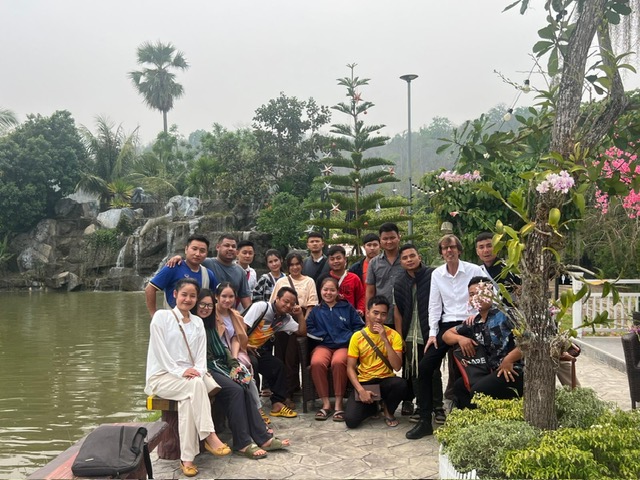
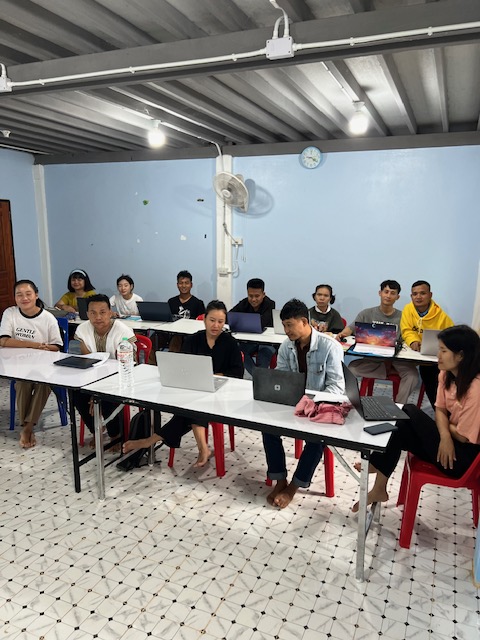
The pictures below provide a peek into my classes and the students. Hopefully, there is one with my sister and niece included. (Pictures of the senior KKBBSC are missing because, with this teaching hitch, described above, I had waded into a deep water with little strength. I had one thing on my mind, and it wasn’t “Hey self wouldn’t it be cool to take a few pictures of this moment”).
After my KHTS lectures my final Karen class was over for spring 2024. Within a few days, graduation was held which I attended and said a few words. In April I made my exit but my mind was a little out of joint because I hadn’t completed the course. Therefore, I called Dean “Wapa” (who with his wife Ashe- both trained gifted teachers who came from Nagaland, India to KHTS for a three-year hitch) and accepted his invitation to finish my trilogy. later again in 2024 in October I returned to begin teaching in November. Pictures of that new class of seniors are also included below.
Part Two: Teaching Picture Album
Photo Captions – Starting from the Top Counting From Left to Right: (1)KHTS Senior Class (My Class I am in the Center and my sister Elizabeth on my right -Spring Trip (2)KHTS Sunday afternoon Preach -Titled “Why, Who” Luke 10:25 ff The Lawyer “Who is my Neighbor” (3)The sacred halls of the DK Hotel Hqtrs for missionaries and NGOs coming to the Thai Burma Border for decades (my 5am study spot) (4)Afternoon teaching hours KHTS Spring (5) HillLight Seminary South of Mae Sot, Thailand Bordering the Phop Phra District (6) KHTS Fall Senior Class ( Graduation occurs in March)

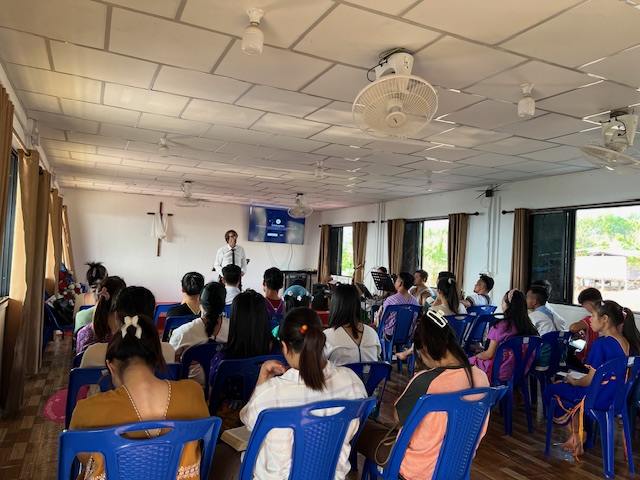
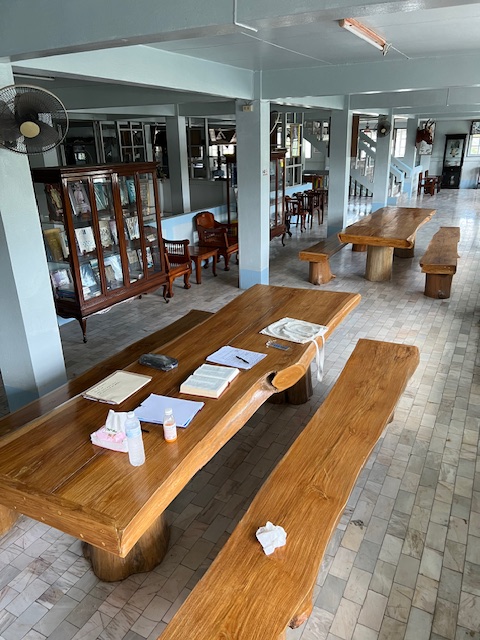

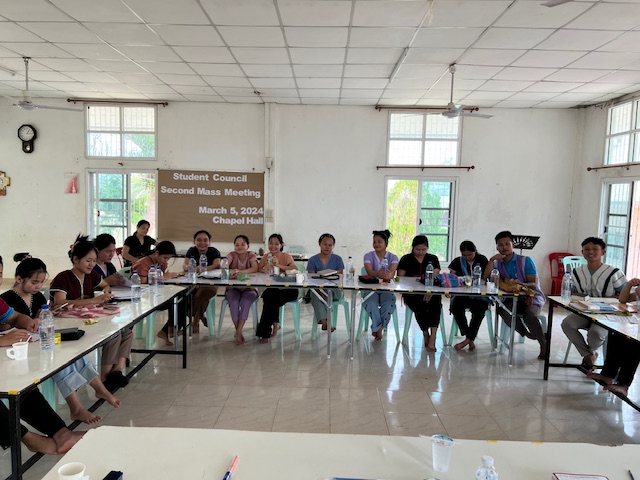
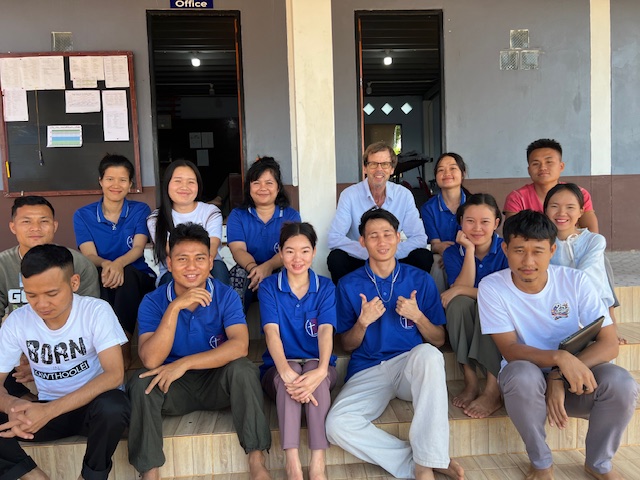
(7) KHTS Seniors Fall (8) March Graduating
KHTS Seniors (Get a Gift Note) (9) Hill Light
Spring (I am Seated Beside the President
Rev Dr Ye Ye)(10) Myself With KHTS Seniors
Enjoying an End of Class Party)


Part Three: A Piece from My Bondage, Justice, Freedom Lectures
Both of my 2024 teaching trips to S E Asia to Karen Schools along the Thai-Burma Border, the first commencing in February the second commencing in October, followed one course of study that was a trilogy built out of, but not limited to, the Egyptian enslavement of Israel and the subsequent Exodus. This trilogy was entitled Bondage Making, Bondage Breaking Justice, and Freedom Building. At the heart of my lessons was Hebrew justice. Bondage was the prologue and freedom was the epilogue of this justice. The story of the Exodus, the body of Laws – the Torah, that emerged after the Exodus at Sinai and laid the foundation of Israel’s common life, many of the Psalms and finally not a few of the prophetic oracles all contributed to giving birth to a distinctive Hebrew understanding of justice. As Psalms 103:6-7 (NRSV Updated Edition) states this unique debut of God’s Justice began when God showed his ways to Moses and his acts to Israel.
The Difference Between Religion and Ethics
This experience of justice formed the foundation or essence of Israel’s ‘religion’ where then it was transformed over and over again into ethics, worship, and eschatology (i.e., the coming kingdom). Religion, in the way I am using it here, has to do with what God did for Israel in delivering them from bondage. Ethics derives from this religious fountain and mirrors in some way what God has done for them, i.e., mirrors it in their (the Israelites) relations with each other, especially those among them who were vulnerable to, or entangled in, nascent or full-on bondage (cf -Isaiah 58 – note the key bondage like words repeated in this oracle). Many laws in the Torah were aimed at preventing the formation of social and economic conditions out of which material / economic forms of bondage emerged. (The assertion in the previous sentence, while not defended here, coalesced in my mind while studying for my course. In a forthcoming publication, I will defend it.)
The Beach and the Mountain Top: Two Horizons of the New Hope
Israel in Egypt was caught in the grip of binding forces stemming from Pharaoh’s imperial power mixed with his economic greed; forces that they could not extricate themselves. This bondage shines light on the historical meaning of justice. They (the Hebrews) needed help to get their life back, i.e. place themselves on a new footing whereby the promise inherent in created existence would be returned to them. The genius in the outcome of Exodus story is that this restoration of the physical, earthly (this-worldly) material conditions necessary to restart the life blessing given in creation must be mixed with something else.
Or one might state that this “something else”, this “new contingency” this “added feature” was there all along but only ‘on the other side of being extricated from Egyptian-Pharaoh bondage, at Sinai was it made open and explicit. On the other side of the Red Sea (‘Reed’ Sea) Israel was re-formed ; formed from a tribe into a unique people for the first time (cf Ex 19). And, but in this re-formation Israel was ‘legally and covenantally incorporated, first and foremost on a new religious (spiritual) foundation and then secondarily on a new ethical, economic, social framework (Exodus 20, Matthew 22:34-40).
The Pinch of the Point
Two main things occurred in this “new something” Here I have chosen to state B before A. What are these two things? (B) This re-organization of Israel ensured that the new beginning created by the Exodus would not revert into bondage. The Torah, I argued in my lessons, contains within it something(s) that intends to immunize Israel from bondage. To be sure Israel had a part to play. They must take this ‘antibiotic’ (take hold of it) and put it to work in their collective body relations so as to ward off bondage. Bondage is sort of like a wanton virus that lurks in the dark in search of environs where weakness or laxity exists. This example is imperfect because the bondage under discussion occurs most often at the nexus where power meets weakness or vice versa (Pharaoh the bondage maker has 1000 different suits he wears to pull the weak into service, many of which lead to bondage. This explanation does not by any means exhaust the Biblical insights of bondage. In my lectures, I went to chapter and verse in the Torah to defend the preceding assertion. In the N T bondage becomes more spiritually perceptive.
Now comes (A) because it is most important. It is, one might state – “elemental” and the ground of (B) By way of this re-formation at Sinai Israel is returned to the “true path”; the path whereby they could recover and freely build and enjoy their material, i.e., their this-worldly existence, and again partake of the blessing impregnated in it. The Hebrew vision of redemption has a residual earthiness. Take for instance this prophetic text “You will build houses and inhabit them, you shall plant vineyards and eat the fruit of them, you shall not build, and another inhabit you shall not plant, and another reap”. On the other side of the Reed Sea, the shackles of slavery left behind, surely, they turned their attention to this material physical blessing they had hoped through the long days of bondage. But there is a ‘hitch’, a caveat, the small print at the bottom of the page yet to come into the clear light of day.
Soon they will leave the safe shores of the Reed Sea and travel about Eight weeks to Mt. Sinai/Horeb where it all started between Yahweh and Moses at that juncture a spry 80. There at Sinai they will learn more details about their life in Canaan land flowing with milk and honey. Among these details, they will dis-cover, via Moses, the new arrangement upon which this prize existence ultimately rests.
The Torah ‘record’ states that there was a great mass of non-Israelites who were also part of the Exodus standing shoulder to shoulder with Israelites waiting to embrace this future. Almost surely all present on the other side of the Reed Sea were wonderfully focused on a one-dimensional future – the beginning of a free good life on the land. Life’s created promise was soon to be returned to them by this remarkable debut of bondage-breaking justice. Freedom plus land already prepared with wells, houses, orchards, and cultivated fields, was almost surely the horizon of their future.
Sinai is as subtle as a train smash. There the physical material this-worldly future is explicitly shown to rest on a religious ‘spiritual’ foundation (and here I am using ‘spiritual’ only to accentuate that this foundation is not solely material). Yahweh, via his words and power, did not simply show up (via his servant Moses) to face down Egypt’s bondage maker Pharaoh and perform a one-off saving emergency only to retreat; sort of like a prototypical Hollywood Western where Marshall Matt Dillon shows up with his side kick deputy Chester and delivers justice. The deed done, then, after the fact, tipping his hat on the way out he says, “Good luck, remember to contact me if you get in trouble again”.
This is a different kind of justice. Henceforth Yahweh, in his own unique way, becomes the living abiding spiritual foundation of their future. The religious emerges into the open and reveals the invisible ‘spiritual’ ground upon which the visible material/physical plane of human existence ultimately rests. (“Underneath are the everlasting arms” Deuteronomy 33:27 -”God is Spirit” – John 4:24). The Torah given at Sinai makes it clear that God will retain the title to the promised land they will rebuild their lives on and they can never successfully extricate themselves from tenet-steward status. There is no blank check of justice bequeathed in this salvation from Pharaoh’s enslavement. Canaan life and Canaan land is forever cast inside a relation that God has entered into with them to them as their God, a relation via covenant that they must and do enter.
The justice that broke Pharaoh’s bondage only at Sinai is made explicitly clear to have two pieces an out of – and a into piece. Freedom from Pharaoh’s bondage means their former life is now behind them but this past gives way to a new kind of future, a new kind of life unfolding directly before them. Justice births freedom but this freedom is like a coin with two sides -a from side that corresponds to their bondage past and to side that corresponds to a new kind of future. And this new future involves them in a new relation to God and a new relation to each other.
The First Commandment and its prologue capture this past and future. Past: “I am the Lord your God who brought you out of the house of bondage”. Future: “you shall have no other gods before me” Exodus 20:2-3) Or switching from the “thou shalt not to the thou shalt” Deuteronomy sums up this future “ “Hear O Israel you shall love the Lord your God with all your heart,and with all your soul, and with all your mind” (6:4-5). In time later in Scripture this Deuteronomy verse was combined with another in Leviticus summing up the “Ten Words” (“The Ten Words” is an abbreviation found in the Torah/ Pentateuch) with the above phrase and another in Leviticus – ‘Love your Neighbor as yourself”. Ultimately Justice is not satisfied until freedom finds the life that protects freedom from morphing back into bondage. This is what Sinai is about. And whilst these truths are born inside a story about one particular family on the earth the truths it carries belong to all people on the earth. The bondage breaking God that made his debut in the Exodus indeed is about a justice wedded to freedom but let us listen closely to the unique shaping of these words in their Biblical setting. “Something is happening here Mr Jones but I don’t know what it is” ( The Ballad of a Thin Man -Bob Dylan). But maybe we are starting to grasp it a little. The justice and freedom we seek for ourselves and our world is moving us to be in this world in a new way; namely from a location inside and under this God’s care live out our lives in devoted service and loyalty to him before all others and from thence turn out to others to lift them up as if she or he is our sister, our brother, our neighbor. It may be that no other kind of freedom immunizes against bondage.
In my discussions, I followed my triune bondage-justice-freedom paradigm of Hebrew salvation into the New Testament, both the Evangelists (Matthew, Mark, Luke, and John) and the Apostles, after which we considered two contemporary contexts where the truths we clarified intersect. One context was the Karen plight vis a vis the Tatmadaw and the impending challenge of shaping a new society for a new future. The other was late Modernity in the West referencing U S of A as a case study. In the first draft of this End of 2024 Teaching Ministry Recap I included a summary sketch of these discussions but
eventually, I came to my senses. To overdo is to undo.
Addendum A – Arrival & Departure Movements
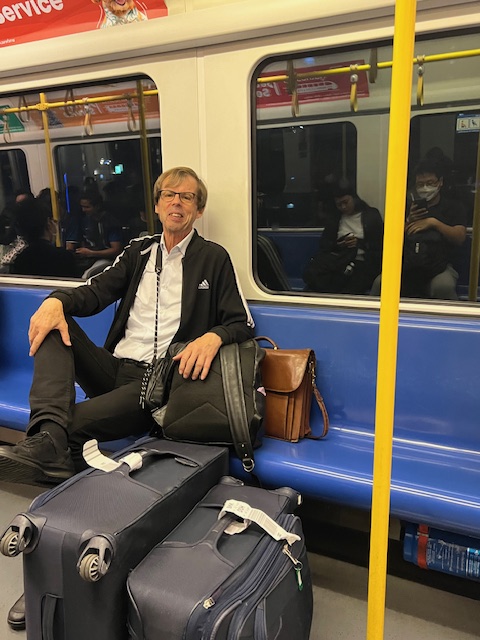

Before Departing: Trip One
 existence and faith