
Kawthoolei Hope Theological Seminary, Phop Phra, Thailand
Seminar November 3-15, 2025
Daniel Age, M Div, Ph D
From Bondage to Freedom

Introduction
It was a fine, bright summer’s day, and my business in town was finished, so I dipped into a bar to have a Guinness before returning home. It was dark, I strained to see. In the back corner, there was a little stage and under a dim light, a young woman clothed in yellow and lavender was softly singing and dancing. I drew closer. She glanced an abbreviated smile. She was not drunk. She was not a salacious dancer. Her face glowed, and she radiated joy. Her movements were wonderful and agile, incarnating her spirit. I muttered to myself, “Behold Freedom”. Indeed, she was free, free as the wind blows, free as the grass grows, free to follow her heart. Freedom leaves footprints. I saw them, and I know what I saw.
Having adjusted to the dimly lit bar, I looked around, but no one was there; it was empty. But my conclusion was premature. As I looked closer, I saw an outline of a man in the corner. I moved toward him and prepared to greet him, but once I drew close, my impulse vanished. His head was slightly bent, and he gazed into his mug, which he clasped with both hands. I saw the arches of his brow. They were deep, curling downward; his eyes were lifeless and sullen, the dearth in his face betrayed resignation. Instantly, I knew what I saw. Bondage had come for this man and locked him in despair. As I turned to leave, he spoke, “My name is Bondage and I will come for you too”.
Bedazzled and disturbed by these scenes of bondage and freedom, I forgot about my Guinness and made for the door. Once on the street, I attempted to re-adjust my eyes and refocus them. But my efforts were in vain. Everywhere I looked,d I saw freedom and bondage, joy and despair.
I have sculpted this little vignette to describe my enchantment with viewing Scripture and life through a lens of bondage and freedom.
During this two-week seminar (November 3 -15, 2025), we will look at Scripture and life through the lens of freedom understood over-against bondage. Freedom exists in a dialectic with bondage and bondage with freedom. They are not friends; they are like Jacob and Esau, whose conflict with each other, Scripture tells us, started in the womb. The Bondage-Freedom story in Exodus casts the Biblical understanding of salvation (both the Hebrew and the Christian) in a redemptive plot. Redemption occurs when something that has been lost is restored (redeemed). In Scripture, freedom is lost to bondage, but God breaks bondage and restores freedom; however, in this restoration, there is an anomaly. The new freedom, when it arrives, isn’t what it used to be. The new life of freedom is intentionally sculpted differently- i.e., different than the freedom (so-called) that existed before bondage came. This course is about this new shaping of freedom.

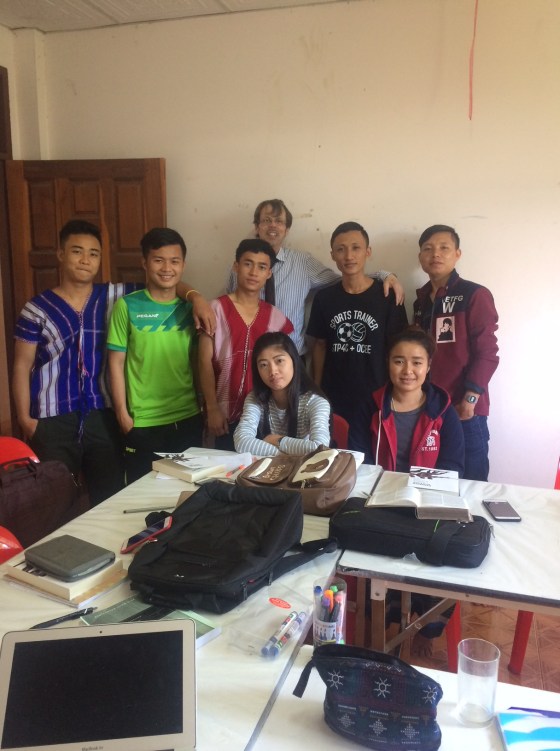
at his “Mekong Office” in Luang Prabang, Laos.”
In order to unpack the insights I hope to open up in this freedom over-against bondage seminar, my pledge is to employ stories. Stories, I believe, are sort of like the engine at the head of the train. The engine generates the movement needed for conceptual thought and understanding to occur. My aim is to shake the trees of memory, Scripture, and history with sufficient vigor so that at least 20 stories will fall into my lap. In our lecture discussions, once we get a story or two into play, then we can go about our business of trying to better understand bondage and freedom in Scripture, life, and our calling.
It would be a mistake if, after reading this introduction, one concluded I was simply plucking random examples of bondage and freedom off the back of a slow-moving truck. This seminar is guided by a thesis which I will disclose in my introductory remarks on day one and then set about to expand upon via each lecture-discussion.
There is a methodological and theological pattern in play in these discussions, one that is not absent in the New Testament. While many, if not most, of the lecture-discussions will begin by recalling the Torah (the Pentateuch) with its story of deliverance from Egyptian slavery and the giving of the law, this occurs for two reasons. First, there is a desire to net Hebrew insights that surround their liberation story; insights unique to their salvation history and eschatology (i.e., unfolding hope). These, of course, are not found in the New Testament ‘in kind’ because the two salvation narratives are dramatically different. Nevertheless, this does not mean that many of the ‘very earthly’ mandates in the law/Torah do not in some way intersect the shape of the Gospel found in the New Testament (like a shadow reflects the shape of a reality, but imperfectly). After the Exodus liberation via the giving of the law, in many ways, certainly not all ways, life is more or less shaped toward a higher ideal, a post-Egypt-Pharaoh ideal. And this ideal is ‘this-worldly’, wholistic, earthy!
The earthiness of the law and the Prophets must not be lost but kept in conversation with the New Testament – especially the Post-Pentecost Apostolic witness of the Gospel. Why? Because this latter witness focuses our attention on the coming of a heavenly kingdom and calls us to spiritual readiness. The Apostolic witness’s emphasis on the spiritual/heavenly dimension can obscure the earthly dimension. Surely the O T earthiness and the N T spiritual depth are not to be seen in opposition. Luke, in his Book of Acts, states that much of what was spoken by the Prophets has not yet been fulfilled but awaits fulfillment. The vision of the ideal never realized by Israel still has a future (albeit transformed) when the Kingdom inaugurated by Christ is consummated. The coming kingdom of God is the ultimate reality given to us in Scripture, and it is to be remembered that Jesus taught us to pray “your kingdom come on earth“.
Second, despite the dramatic differences between the Old Testament’s saving narrative and the New Testament’s saving narrative ( both of which reference Bondage Breaking Justice), important parallels exist. This course bears my Christian bias. That Jesus is the Christ means he has not only become the head of the ecclesia, the people of God, but the promised one who inaugurates the Kingdom of God. The presence of this bias /confession, however, does not show up in the form of a Marcion dualism where Law consists of salvation by works versus an Apostolic Gospel that consists of salvation by grace, or some facsimile thereof.
I will argue off and on during the course of this seminar that, via the Apostle’s Gospel of Christ, the Law goes through a transformation. This transformation is sort of like Mother Robin at feeding time (Robins are a favored bird in North America). Msz Robin sits on her branch and looks for food for her baby. Upon detecting the movement of a worm, she dives down, secures it, and returns to her perch, where she masticates and digests the worm before regurgitating it and feeding it to her baby. This imperfectly describes the transformation that the law of righteousness goes through in its route to its universal destiny. From Pentecost onward, the law of righteousness is ‘evangelized’, i.e., transformed for its Gentile career. This transformation of law righteousness corresponds to the Apostles’ Gospel of Christ and the freedom it proclaims. Along the way in this course, we will grapple with this transformation. Both the law as it was given on Sinai and the law as it was transformed by the Gospel of Christ served freedom. The former was provisional and in its form contained the seeds of its temporality – a warning as such is explicitly stated in Deuteronomy. In more than one discussion, we will explore how the law that was given to protect post-Egyptian freedom was shaped in such a way that it could evolve to foster bondage. And this did occur, but it did not come about because the historic people of God were born in a covenant of works. Their birth commenced with an election of grace. There is more than one way to slip off the foundation of grace! But the concern of this course is freedom. God laid a love-grace foundation for his relationship with humanity, and this foundation alone supports a freedom between heaven and earth. Righteousness and justice on earth must be shaped in a way so that they will not subvert freedom but enjoy freedom’s power and delight. Could it be that God is on a passionate journey through time, where he sets about to get what he hopes for from his creation of humanity without resorting to coercion, that ugly dynamic that spoils all relations?
On our final class day, our focus will shift to contemporary contexts of freedom. In many places in the secular and non-Christian world today, there is passion for freedom and justice. In Scripture, there is also a manifest passion for freedom and justice. The Church and the world today, in many places, appear to share a common interest. For sure, the church does not have a monopoly on righteousness. One of the challenges facing the church, if it is to escape being sucked into a pessimistic and moralistic mission against modern freedom and justice, or escape becoming pulled into a naïve idealism regarding modern freedom and justice, is to better understand the distinctive character of the Biblical-Evangelical (Gospel) witness to these two saving dynamics. I hear this challenge in Jesus’ mini salt-sermon. “You are the salt of the earth”. But “if the salt loses its savor, it’s good for nothing”, he asserts. What is this salt that remains salty, that, although exposed to the corrosive acids of changing times, does not lose the potency of its truth? I believe this potency (i.e., the saltiness of the church’s witness) turns on the presence versus the absence of the church’s evangelical witness (i.e., good news witness) in such a way that it also exposes the lie enshrined in the world or the church as truth. (Inside God’s yes, there is a no.) Darkness and idolatry often possess a chameleon character. In this course, among other interests, it is the Biblical and Christian freedom birthed by God’s bondage-breaking justice viewed in relief or distinction from Modern justice and freedom that we are seeking to understand better so that our witness in word and act may be potent. “Now we see through a glass darkly” (1 Corinthians 13:12) and “If any man (or woman) thinks he knows anything, he knows nothing as he ought to know it” (1 Corinthians 8:2 KJV). In this sense, this seminar really is a venture of hope
From Bondage to Freedom
November 3 -15, 2025
Kawthoolei Hope Theological Seminary
Phop Phra, Thailand
Daniel Age, M Div, Ph D
Lecture-Discussion Subject Titles
Introduction
The Thesis Behind “From Bondage to Freedom”
Lecture-Discussion
One
Behold the Spider, Pity the Grasshopper
Inquiring Into the Nature of Bondage
Exodus 1:8-14, 2:23-25 (23*)
Lecture-Discussion
Two
Breaking the Power of Bondage Before Bondage is
Broken:
From Despair to Hope
Exodus 3:15-17, 4:29-31,1 Peter 1:3 & Romans 15:13
Lecture-Discussion
Three
Bondage Breaking Justice
The Source of the Church’s Doxology
Exodus 15:1-2,20 -21;2 Peter 9-10
“Religion is grace, ethics is gratitude,” T W Manson
Lecture-Discussion
Four
The Teleology of Freedom
From Forced Servitude to Free Service
Exodus 8:1, Matthew 11:28-30, 1Corinthians 8:6 (NRSV), Galatians 5:1&13
Lecture Discussion
Five
Bondage to Freedom
(Part A) From Outside to Inside the Lordship of God: Viewed From Both the Hebrew and Christian Salvation Narrative
Exodus 20:2-3; 2 Timothy 1:9-10, Acts 3 & 5, Ephesians 4:8,
Romans: 35-39, 1 Jn 5:4, Philippians 2:12b -13, Psalm 23:1
Lecture-Discussion
Six
(Part B) From Bondage to Freedom & the Struggle With Power
From “Before Me” to After Me Viewed From Both a Hebrew and a Christian Narrative
Exodus 20:2-3, Matthew 22:35-40, Acts 5:27-29
Ephesians 6:12, Mk 8:35
Lecture Discussion
Seven
Mind the Gap & Avoid the Gulch
Freedom Requires (A) Boundaries & (B)
Connectedness
Exodus 20:1-19, Deuteronomy 5:6-22
Lecture Discussion
Eight
Part A: The Law
Torah Legal Structures to Prevent
Relapsing into Bondage
(Key Torah Passages on Land Ownership, Stewardship, and Accumulation and
Debt Forgiveness, the Other as Brother, Dependence, Tithing)
Part B: The Gospel
Releasing Evangelical Weapons to Subvert
Ideological Structures of Bondage
Luke 10:25-35, Luke 18:9-14, Galatians 2, 3 & 5, 2 Timothy 2:9,
Ephesians 6:12, Hebrews 4:12, Rev 1:16
Excursus: The Relation of the Church to Politics
(Excursus on Walter Rauschenbusch -J Moltmann & the Dia-Stasis that Hope Creates)
Lecture-Discussion
Nine
(A)
Freeing Righteousness From Bondage to Heteronomy & Fear
(B)
Existential Freedom Depends on Understanding &
Doing the One Thing That God Will Not Do for Us
Existential Bondage to Freedom
Philippians 2:12-13
(B-2)
From Spiritual Bondage to Freedom
Upsizing to Downsizing
Fear, Dread, Shame, Guilt, Pride, Hatred, Bitterness,
Grief, Hardness of Heart, Anger, Anxiety, Greed, Self
Pity Versus Love, Joy, Peace…
Lecture-Discussion
Ten
The Economic Sources of Bondage and Freedom
(Selections from the Torah, Isaiah, Jesus, and Paul -R Y Ruler)
Lecture-Discussion
Eleven
Freedom: The Pearl of Great Price in all Relations “
“Thy Will Be Done on Earth as it is in Heaven”
Matthew 19:16-26, Matthew 11:28-30,
Philemon 8-9, Hebrews 3:7-8,
Revelation 3:20,
Lecture-Discussion
Twelve
Epilogue
Christian Freedom Faces Modern Freedom:
From Pessimism & Idealism to Differentiation
Matthew 5:13-16
 existence and faith