Is There a Point of Contact Between Revealed Christian Truth and Philosophical Thought?

The Stout of Mind and Heart at MBTS Seek Historical Answers to a Big Question

A number of my students from schools in S E Asia where I have taught, through the grapevine, discovered that I was teaching a course entitled The intersection of Christian Thought with Philosophy (Malaysia Baptist Theological Seminary April, 2019). To satisfy their initial curiosity and wet their appetite peradventure I might also come to their school sometime in the future and teach such a course, I decided to post here an edited version of my course description.

The Purpose of the Course was to provide a short introduction to “Christian Philosophy”. This is what I was asked to do. But as my title suggests, for me, ” the actual existence of an item called ‘Christian Philosophy’ remains an outstanding question. Certainly one can summon a particular philosophical insight to reflect on the Church’s beliefs, or one can start a conversation between the truth that the church received, handed down by the Prophets and Apostles of old, and a given philosophical idea alive in the world, but can Christian truth be transformed or morphed into a philosophy? Or can philosophy and Christian truth become fused or synthesized? After restudying the designation assigned me, teach an introductory course on ‘Christian Philosophy,’ I decided to employ a historical method organized around one basic inquiry. This question has to do with the major twists or flirtations in the ongoing romance between the church and philosophy from then to now, i.e. from the late Apostolic period to the present. 

Continue reading

My return to Mae La Refugee Camp: A photo journal

In my last teaching hitch for 2018 I returned to Mae La Camp (KKBBSC) on the Thai Burma Border. In this post I share a few pictures and notes on my work. During my time I lectured on Matthew 5:13, here follows my pictorial show and tell.

Here I am heading back to Mae Sot to return to KKBBSC for the 10th time since 2011


Under the shadow of a great great mountain in the remote region of Tak Province in N W Thailand, just a few miles away from the Burma Border, there is a large refugee camp, the Mae Camp. There are 50,000 Karen in this camp who approximately 25 years ago fled their homeland across the border in Burma / Myanmar when the military turned against them burning their villages, slaughtering tens of thousands of them, violating women and confiscating the land inhabited by their ancestors for hundreds of years.

In Section A, B & C there are approximately 11 churches and one college of over 500 students. Repentance is gracious. It is gift and task. Change is not at our beck and call, an easy extension of our will. Gracious opportunities for change arrive at our door step and if ignored suddenly fly away like a bird on a limb.  The Burmese military in 2012 enjoyed such an opportunity and  began to commit themselves to change but like a drunk who swears he has changed, then goes on a binge, they returned to their ways with the Rohingya. The Karen are now talking to the Military again in hopes of change but now their land has been over run. 

In the picture above I am lecturing to the senior class (some of whom are visible in the photo). My theme for the week was “You are the salt of the earth but if the salt has lost its savor…” Jesus Christ VS the Church and the World. Jesus entrusted to his followers the salty difference of his way and truth, this salt is radically different than the way of the world. If the church loses this difference it melds into the way of the world and Christ, the great chef, cannot use it in his work. We plumbed the truth in this text looking at it and listening to it every which way.

This is a picture of one of my students captured by another student who I lent my phone. Most every student was attentive. Because they are living far away from the main currents of civilization, sort of like I did in my secondary education growing up, they are hungry to understand what is going on in the church at large and also the relationship of the church with what is going on in the world. Up until Fall 2016 many students applied for and received sanctuary in the USA. Now the gates are locked & their applications are not being processed.

They are curious about the changes going on in our country and the relation of church to politics. I taught them that while the church is public in its witness to truth (” you are the salt of the earth...the light of the world“) and while this unique truth of Christ shines light on every sphere of human existence, individual and national, the church is not political. As Scripture teaches the church is the bride of Christ and belongs to him alone and exists to carry out his mission on the earth and even if it wanted to it cannot wed itself to political parties left or right. Even so the ‘heat’ generated in culture and the nation’s political theatre threatens to suck parts of the church into its orbit (left and right) and if and when this happens the church loses its salt.

Here in this picture I am explicating “The Impossible Possibility” ( Luke 18:18-23). After the Rich Young Ruler came to Jesus for a meeting about how to enter the kingdom he commenced to listen to him. At first it seemed to him he was in good stead to enter the kingdom. But Jesus upped the ante and he then turned away. When Jesus called him to unload his great wealth and become his disciple it was one bridge too far. The Gospel record of the story tells us that he turned and “went away sorrowful”. After the RYR left Jesus said to his disciples “it is hard for a rich man to enter the kingdom of heaven.” To this statement, Peter retorted, “who then can be saved?” Responding to this question Jesus spoke of the impossible possibility. In this class I developed the significance of these discussions, first between the Rich Young Ruler and Jesus, then between Jesus and Peter. The substance of my lecture focused on the 2 questions: why its hard for people laden with wealth to enter the kingdom and then how it is possible for such people to enter. There is a little hope in one direction.

After exploring the text the discussion turned to the naïveté lodged in the original DNA of the modern world toward wealth first set forth by the Scotsman Adam Smith, a pioneer of modern economic theory. Smith, which posited a laissez-faire economic  theory was confident that any and everyone who plunged in and found a way to create personal wealth, no matter how great, would be doing the common good a favor (his theory was in my estimation not too far removed from the crass motto ‘greed is good.’ With Christmas nearing my refugee student seniors, themselves poorer than church mice, began to think about the lesson at hand and asked the question who is really laying in the manger in this 21st Century World where both East and West) have embraced Christmas with all its frenetic buying and selling frenzy––Adam Smith or Jesus Christ? And with this question another “has the witness of the church on this matter lost its salt?” One student blurted out “I think some one switched the baby”.  It seemed to them that a great hiatus had irrupted between the Jesus Christ that comes to light in the Gospels and the Christ of Christmas in the 21st Century.

On the final day with my class, after I finished my lesson, the seniors asked me to be seated and carried out a little ceremony saying prayers and making little speeches to express their gratitude and at that time they gave me a Karen shirt to show they accepted me as one of them.


This picture was taken on the last day of my classes this year. This year I was given the entire senior class, approximately 60+ students. I am seated in the middle of the front row.  

Everyday I traveled one and a half hours on an open bus through the mountains to the Mae La Camp passing through two military checkpoints. Shortly after I reached the camp it was time for chapel. I took this picture the last day I was with the school from the platform where I was seated. Shortly after this picture I spoke to the student body speaking from Ephesians 3:16-19 emphasising the words found in the passage about the need to be “rooted and grounded in the Father’s love”. The thesis of the message I presented argued that there is an all important relation between the seen and the unseen. If our lives are not “rooted and grounded” in the invisible love, that is far greater than any visible earthly love, we will be tempted to reach too far beyond ourselves in order to possess these earthly visible loves. And we will also try too hard to connect to them and will be tempted to draw too deeply from their comforts and pleasures. When the visible loves that God the creator put in this world for our good and enjoyment become too important, and when in their absence we stretch beyond ourselves to reach them, and partake of all we ‘need’ and desire from them, then it is that our humanity is spoiled and harmed. One definition of transgression reads as follows, “sin occurs when humans put the good things in the room that only the best things belong.” Only if and when we through the power of the word and Spirit come to see and recognize that the invisible love of God is the root and ground of our existence are we able to moderate the importance of earthly created loves so their presence does not become too great or their absence tempt us to reach beyond ourselves to possess them.

Facing Down the Gnostic Spilt

Facing Down the Gnostic Split

KKBBSC’s Maiden M Div Class

 KKBBSC’s Maiden Master’s of Divinity Class Discovers Why Christology Matters

Gather up the fragments,” Jesus said, “so that nothing will be wasted.” One of the recent teaching excursions that I failed to report on was a month-long visit to KKBBSC’S new M Div program. The adjacent picture is the sum of the maiden KKBBSC’s M Div class ( If you wonder what it looks like to be 22 years old, just have a gaze). The School is located outside instead of inside the nearly 500 strong undergraduate school that meets in Mae La Camp for Karen refugees. I was asked to teach a course on the Christological struggles during the first 500 years of the church. I began with what most likely was the first Christological struggle that irrupted toward the end of the 1st Century addressed in the Epistle of 1st John. Here follows a brief sketch of my insight from 1st John. The following text communicates the essence of what I now believe is being redressed in 1st John.

FF Bruce, the renowned Scottish New Testament scholar, has shown convincingly, in my judgment, that 1st John is a passionate pushback against a contemporary named Cerinthus. History notes these two lived in the same locale. There is a story that claims that these two accidentally crossed each other’s paths in a Roman bathhouse whereabout hard glances were exchanged. The tension of these two was recorded and lived on in the ancient records that church historians mine. Moreover, Cerinthus’ teaching is also available to us, but admittedly, not firsthand but by his enemies. Cerinthus was infected with what I call the Gnostic Split. The gnostic split, as I am using it here, answers to a Greek view of the world and drives a wedge into reality, dividing its spiritual and material dimensions. The material realm is lowered to the valuation of waste. It is degraded and clings to us, dragging us downward. The material realm is that which forges chains that hold us captive. Matter, all material, chiefly the body, binds us, but the spiritual realm made accessible by way of elitist ‘truth’ or gnosis, i.e., experiential knowledge, and ascetic disciplines liberates us. Cerinthus’ teaching requires a radical revision of the common meaning of the Christian designation Jesus Christ.

Jesus and Christ are ultimately separated in Cerinthus’ teaching. Christ is heavenly, spiritual, divine, but Jesus is earthly, material, lowly. For three and half years from his Baptism onward to Good Friday, Jesus’, wholly identified with material bodily, transient existence, became a mere vessel for the divine Christ- spirit. There was no substantive union. At the cross, Jesus, identified as a human material bodily vessel, was finished and cast off. Christ as wholly spiritual, at the eve of the crucifixion, was fully liberated and ascended to heaven, never exposed to the suffering and ignominy of death on the cross. “Salvation” is complete at this point in Jesus’ short life because, at the eve of death, the material and the spiritual split and go their separate ways, one down and the other up. The vessel is tossed aside because it is material, and materiality has no lasting significance. The spirit now freed is absorbed back into God  (something like that).

There are key verses in this epistle that reveal John’s polemic against Cerinthus more than any others. These are found in chapter 4:2-3. The verses read as follows “ By this, you know the Spirit of God: Every spirit that confesses that Jesus Christ has come in the flesh is of God, and every spirit that does not confess that Jesus Christ has come in the flesh is not of God. And this is the spirit of the Antichrist, which you have heard was coming and is now already in the world”. The ASV has an alternative reading, the term “confesses” in verse 3 is translated annulleth (If anyone annulleth or annuls this coming in the flesh). F F Bruce quotes the R A Knox translation which reads “no spirit which would disunite Jesus comes from God. ” The Knox translation is known for its precision, and rather than spoon-feeding the reader, it sometimes uses clumsy, but more accurate words, to convey the meaning. Disunites hits the nail on the head.

The issue in 1st John is not the same as that found in Matthew 16, where Jesus “asks who do men say that I am” and the disciples give all the wrong answers that people have come up with, and then, Jesus asks the disciples “who do you say that I am,” and Peter answers “you (Jesus) are the Christ the Son….” The question and affirmation of Jesus’ “Christ” ( i.e., messianic) identity in Matthew 16 and the question and answer of Jesus’ identity in I John are driven by two entirely different concerns. The former  (Matthew 16) is in the setting of Jesus’ identity early on when he came on the scene in Judea and Galilee – whether he was or was not the Messiah ( the Christ) promised by the Prophets. The latter has to do with whether Jesus is united or divided from the eternal Christ of God. Cerinthus is in captivity to the cultural view of reality that prevails in the ancient Greek world. But this is not the end of the problem, only the basis for understanding it. Cerenthus builds on the traditional Greek dualism of the day, his own unique Christological construction that complements and supports his ‘gospel’ – a unique gnostic experience whereby one progressively ascends to spiritual heights.  At the heart of the struggle addressed by John in this epistle is almost surely the Cerinthusian heresy. The divine Christ, which is viewed as heavenly and altogether spiritual, a Christ that descends from and then returns to God, is ultimately divided from the human, earthly material Jesus.

What is John doing in this letter by what he is saying? He is asserting the unity of Jesus and Christ over against Cerinthus’ who separated from these two. In Cerinthus’ model, the “fleshly” Jesus is separated from the Christ of God. In this epistle, John will have nothing to do with this separation but affirms Jesus Christ as the son of God (1 Jn 1:1-3). John cannot talk about Jesus apart from Christ and Christ apart from Jesus. He sinks his ax into the very root of this heretical tree from the very first words he writes in his epistle. He commences his letter by affirming the real materiality of Jesus Christ, calling him the “Word of Life” and “that Eternal Life” that was with the Father, which they “looked upon,”saw with their own eyes” and “their hands handled.” The physicality and materiality of Jesus Christ are intentionally asserted by these first words and phrases that open the epistle. These words and phrases answer directly to his term “flesh” that I referenced in the preceding paragraph citing Jn 4:2-3. “Jesus Christ come in the flesh.” What is John doing by what he is saying? ‘Flesh’ refuses to surrender Christ over to pure spirituality but pulls Christ back into solidarity with physicality, materiality, and body-soul humanness, as such ‘flesh” always and forever insists on not merely Christ but Jesus Christ.

But why? And the answer that I gave and sought to demonstrate to the class was this: everything that the Christian religion and gospel have to give to us, everything wonderful, marvelous and so very precious and valuable, depends on and rests on this union Jesus & Christ. Or to state it in the negative as a warning, everything valuable and precious is lost when some form of the  ‘Cerinthusian’ gnostic split is put into play.

Here follows a terse attempt to unpack something of the significance of this insistence on the unity of Jesus & Christ versus a bifurcated Cerintusian Christ. Three intimately related levels of reflection come to mind. One is about ‘redemption’ cast by John as the gift of life eternal.  Secondly is the nature of spirituality – life-giving ferments in the soul. And thirdly, ethics come into the picture – walking in the light, i.e., walking according to righteousness versus walking in darkness. The original union asserted by John in refutation over against the disunion of Cerinthus exerts a decided influence informing and shaping the unique character of these three. In the following, I discuss each of these, but in truth, I have found it impossible to discuss one without bringing some aspect of the other two into the discussion.

Christology is not an isolated inquiry about the unique nature of Jesus Christ. It has everything to do with the distinctive Christian teaching about salvation, which John identifies as “life eternal.” According to John, this Life is given to us. It is not innately lodged within us as a spiritual dimension. “This is the record,” John states, “God has given us eternal life and this life is in his Son” ( 1 Jn 5: 11-12). As such, salvation is not a progressive spiritual experience; instead, it is the gift of Life given to us in this peculiar place, in this union Jesus Christ, because in him, humanity’s sin was expiated or “propitiated.” God did this propitiating through his Son (4:10) because of this, the gates of Eternal Life open to us.

This changes everything. The believer ceases to look within herself to find the spiritual progress and life that eventually leads one upward to “God.” In Christian salvation, we do not progressively go up to God; God comes down to us, and in Christ Jesus, He takes humanity into himself, and there redeems humanity full stop. Via Jesus Christ, eternal life with God and others is entirely ours now, even though we do not yet tangibly possess it. Faith believes this good news and hope waits for it ( I Jn 3:1-3). Therefore in John’s teaching, spirituality is about living by faith – having something we cannot yet see, and it is about hope, i.e., waiting for something that graciously belongs to us now but is soon to be bestowed. Faith can be and often is a struggle; spirituality is not all peaches and cream. John writes in chapter 4, “This is the victory that overcomes the world even our faith.” Add to this, in 1 John, spirituality is about present Joy over the life given to us in Jesus Christ and fellowship with the Father and the Son who are the source of this gift and others who believe and are filled with joy and hope ( 1 Jn 1:1-5).

The earthiness of Jesus Christ described in Chapter one ( verses 1-5), and also by the term flesh (“Jesus Christ came in the flesh“) flies in the face of Cerinthus’ spirituality. Abstract ‘flesh’ from this equation, i.e., abstract Jesus coming in the flesh and one “hellenizes” eternal life, i.e., reshapes it after a Greek versus a Hebrew understanding of reality. Salvation becomes the absorption of spirit (with a small s) into the divine Spirit, completed at the eve of one’s death.  In the gnostic split, all material form, ultimately all fleshliness, earthiness, all historical particularity vanishes, all psycho-somatic identity disappears.

The ‘Jesus Christ’ kind of redemption unites heaven and earth, the material with the Spiritual, God, and humanity (real humanity). Material this side of the incarnation, this side of the union of Jesus & Christ, is in the grip of redemption. It cannot be negated, amputated, subjugated, nor separated from the spiritual. Heaven and earth cannot be sundered. ‘Creation,’ incarnation, the resurrection of the body, life eternal, the future of the earth, particular human identity – the I, the self, the ego all hinge on the affirmation asserted in John 4:2 & 3.

During one’s life, according to Cerinthus, the object is, of course, to live on a higher spiritual level and suppress the material level. In this way, the complete split or separation that is consummated at the eve of death is reflected in one’s ‘ethics’ before death. The more spiritual a person (so-called spiritual), and the less entangled with material bodily existence, the closer one is to the divine spiritual essence, which is her destiny. The imminent onset or approach of death completes this. Jesus’ significance, according to Cerinthus’ logic, is that he took spiritual existence further than any other. He is our example. He ‘saves’ because he is a forerunner, a path breaker, the exemplar of this spiritual way bar none.

Cerinthus has, by all deductions, constructed a spiritual ladder from the earthly historical material realm to heaven. Every round goes higher higher –  at the eve of death, the final release of the spirit occurs. At this point, it returns to its destiny in God. But the old Apostle John ( maybe ninety years old by the time he delivered this epistle) asks us to step off the gnostic spiritual escalator and turn out to our sisters and brothers who are in need of deploying acts of love that deliver relief. “Love not in word and in tongue but in deed and in truth,” he admonishes in this epistle. “This phrase “in deed and in truth” is anti gnostic to its core. The ethic of love, rather than going up higher and higher, goes down to earth lower and lower where one meets and serves others by putting love into action. Love is historical, incarnational, earthy. And it is empowered not merely by will or by one’s nobility (as if love was a stable moral compass lodged in human nature), nor is love adequately empowered and sustained merely by the existence of a commandment or an imperative. Ultimately by God alone, love is generated. God is the embodiment of love (“God is love” 1 Jn 4:8). God makes Godself known by love, that is to state, God makes himself known by deed and action, by material, by bodily solidarity with humanity in need. Jesus Christ, coming, living, ministering, suffering, and dying on the cross in time and place is the concreteness of God’s love turned out to serve and help humans in real need (4:9&10). The ethic of love derives from discovering that one is on the receiving end of this love. This divine love made manifest and delivered in Jesus Christ empowers human love. When doing good( i.e., ethics) is disconnected from the receiving of divine love (i.e., spirituality), it is in danger of losing its strength and depth. Sever the human delivery of love to others from the divine delivery of love to each of us, and the ethic of love begins to short circuit, atrophy, and drain off into sentimentality. This is what I believe happened to Cerenthus. Cerinthus’ Christianity morphed into a spirituality that ascends higher and higher above the earth until it ceased to intersect human need and suffering.

The unprovable metaphysics that speaks of a God who sends his only Son to do things for us we could not do for ourselves, resulting in life eternal offends modern rationality just as it did ancient Greek rationality. But this is the mainspring, the wheel of love that turns every other wheel. It is this invisible divine source that ultimately empowers the radical nature of agape love, the radical turning out toward another in need requiring the downsizing and lowering of the self to that of a servant to others whether high and low by society’s standards. Where this divine wheel is not turning in a person’s life, one’s compassion and care for others are in real danger of growing hard and dry. For sure, Jesus said I have others who are not of this fold, but this is what Christian believes – “the Love of God has shed abroad in our heart via the Holy Spirit”(Romans 5:1), and once they’re in the heart, it lubricates the ethic of love. Even so, we must work out what God works in (Philippians 2:12&13), i.e., we must make real choices in time and place and roll up our sleeves and take action.

End Notes

When you read this little letter of 5 chapters one thing that comes to the fore is that right and wrong, darkness and light, truth and lies, Christ and antichrist do not float 20 stories above one’s grasp in spiritual air. They are nailed to the ground. They are incarnational, meaning they take on flesh and bones so to speak. They are materially grounded. They involve actions – doing and not doing x y z. In contrast, Cerinthus ‘ethics’ was very ascetic.  His ethics, if it can be called that, is all about denying the body, repressing the body, transcending the body, and living in a spiritual state that some form of unique esoteric ‘truth’/experience facilitates.
 
Somewhere in my doctoral thesis, I have a direct quote from the brilliant but wayward son of a Reformed ( Calvinists) clergyman, Fredrick Nietzsche. Nietzsche scoffed at the English in his day for wanting, as we would say, to have their cake and eat it too. They wanted Christian ethics but did not want Christian metaphysics. By metaphysics here I refer to the religious doctrinal parts of the Christian faith like the incarnation, resurrection, and the saving Gospel of free grace correlated to what the Apostles said Jesus’ death on the cross was really all about. In short, all those parts of the Christian religion during the zenith of the age of reason that offended humans, including many church-going Christians, were being excised. Nietzsche, while disdaining both Christian ethics and Christian Metaphysics knew that the latter sustained the former and if the English were to carry through with their project to harvest from the Christian religion the kernel(i.e. ethics) from the “chaff” (the metaphysics) they would soon end up with neither. He knew that the metaphysical, i.e. the church’s doctrinal claims and beliefs, really sourced, informed, and empowered Christian ethics. Beware of the gnostic split. The temptation of Cerinthus in one form or another is perennial.


Continue reading

Beware of Political Heat: History Speaks to the American Church Today

MBTS Church History II

Penang and Kuala Lampur 2018


Picture # 1 Church History II Kula Lampur Class Picture # 2 Penang Class ( The T-Shirt I am wearing was a gift from the students. The Front is a picture of Georgetown in Penang, and on the back is printed “Church History  2 and each of their names)


Introductory Remarks

This posting explains how and why the church in the modern period gets sucked into political movements and loses critical elements of its essential Christian difference.   The source of this essay comes from two lecture-discussions I delivered on April 18, 2018, to my MBTS Church History 2 class in  Penang, later revised and delivered again to my Kuala Lampur class. After teaching it to my Penang class, I wrote a review as a follow-up to the lecture to help my students grasp more fully the ideas presented. What you will read in this posting is an edited version of that original review, Much of the original texts remains and betrays itself by direct statements from me to the class. I chose not to rewrite the text of my review that I sent to the students 48 hours after the lecture because it possessed it captured the passion created by the live presentation of this material on Aprile 18th, 2018. From the beginning to the end I have inserted additional into the original text in order to supply the background needed to properly grasp the subject at hand.   

The general subject being discussed in the following text is the peculiar nature of the church-world struggle in the modern period. In the modern period, because of its unique make-up, conditions arise from time to time that pulls the church out of itself, i.e., out of its God-given difference and into conformity to political and cultural winds and storms that arise in the world that it inhabits. I presented to my students a thesis, my thesis, on the distinctive character of the church’s temptation vis a vis its encounter with the world in the modern period. This thesis is stated in the body of this posting. In order to unpack this thesis and give it historical flesh and bones, I reviewed the Mainstream Protestant Church’s struggle with Nazism in Germany in the 1930s and ’40s. If I was arguing my thesis before a panel, the above church struggle would be “Exhibit B”, “Exhibit A” preceded “Exhibit B” by several days. This “Exhibit B” lecture is touched on here and there in the following text in order to bring interested readers who did not attend my course up to speed. 

 The Church’s Relationship to the World: Understanding the Challenge that the Birth of Modernity Created

With the progressive demise of Constantinianism, i.e., the demise of the fusion of church and society accomplished through the alliance of political and ecclesial power which commenced in the 4th Century by the Roman Emperor Constantine and began to disintegrate by the 17th Century, a new challenge and a new temptation in the church’s relation to the world emerged. From the 17th Century onward, the church-world relation progressively was reconfigured, and the church found itself in a new location vis a vis the world.  By way of ideological and political revolutions, the church slowly became privatized ( here ‘privatized’ means that the Christian Religion was disestablished rather than established by the state). The concomitant of disestablishment was that nations and their societies became secularised.  Properly understood secularisation does not mean that nations and societies displaced religion for secularism. The meaning of these two words is dramatically different.

In the wake of the challenge of the Protestant Reformation with its theological revolt against the absolute top-down ecclesial authority,  came the Enlightenment with its Age of Reason. This period gave birth to the primacy of the rational individual, the ascendency of science and technology, democratic governance, and a feeling of progress.  Not to be overlooked there is also in this period the rise of the Free Church movement spawned by Baptist in England beginning in about 1603 quickly spread to New England. This movement made a potent ecclesiological – theological challenge that insisted that top-down political power must be made to suffer new limitations. Political power must cease to establish the Christian religion suborning everyone to subscribe to the King’s religious will and thereby desist from trammeling individual’s consciences arguing that no power has a right to meddle in the religious-spiritual zone. This zone is the sacred space between God and the soul. And no one power has the right to impose outward unity on the church the body of Christ. This unity is only real when it arises via the Spirit from the bottom up, from experience, conviction, and inner freedom. This is a thumbnail sketch of the forces that gave rise to Modernity but these forces were not equal in influence. the Enlightenment provided the largest and the most lasting contribution to Modernity. Under these forces of change, the western world (i.e., societies and nations in Europe and the Americas) began a long march toward progressively wresting themselves from their captivity to top-down political and ecclesiastical authority that had persisted for over 1200 years. But it is equally true that the church also joined in this march and reconfigured its power (more or less but ultimately more).  But when I assert they joined this march I do not mean to state that they shared common underlying assumptions and beliefs.

Whilst Modernity came to judge truth from error by Reason and science alone the Church, when it remained true to itself, without scorning science and reason, ultimately privileged the revealed truth of its Sacred Revelation in the realms of theology anthropology, and ethics. Whilst Modernity called for the separation of political power from ecclesial power the church early on the church began to call for the emancipation of ecclesial life from the hegemony of political power. Whilst modernity began to view history through an idealistic lens of human progress the church when and where it wrested itself from the seduction of this charm reasserted that whilst penultimate change for the better was necessary and possible when humans via decision and action embraced the suffering and discipline to effect it real change was born from repentance and ultimately awaited the promise of end-time divine intervention. Whilst Modernity gave birth to the doctrine of the existence of absolute innate created right and freedom of the individual the Church while not aligning itself with a revolution against this political-cultural dogma taught that human rights and freedoms ultimately rest, not on a naked claim of innate right and freedom but a revealed truth that asserts that human right and freedom rests on grace alone conditioned by faithfulness to the higher will of God who is both judge and savior. While Modernity gave birth to a near-absolute doctrine of private property and dominion over nature the Church when and where it has been faithful to the revealed truth given to it then it witnessed to the existence of an unprovable invisible truth, namely that ultimately that God claims ownership of all land and nature and that humans are ultimately stewards accountability to the divine master. Modernity gave birth to a new dogma of economics that informed its ethics. This doctrine presumed that political restraint should be lifted from one’s engagement of free enterprise, this freedom should not be trammeled or obstructed because freedom combined with enlightenment reason always results in human uplift and advancement. When and where the church rediscovered the relevance of its realistic anthropology and eschatology ( understanding of history and change)  it rebuked Modernity’s naive anthropological idealism and decried the gross exploitation of laborers by capital calling on political power to enforce restraints on this freedom that underwrote ( that legitimized) systematic greed. And they raised this witness grounding it in a higher witness to God revealed in the Sacred Text that disclosed the very nature of God, immutable way of God to all humans by recalling the Biblical vision and meaning of justice revolutionized by God’s treatment of the Hebrew people when he liberated them out from under the exploitation of Pharoah.  Add to this Old Testament vision of justice the New Testament that proclaims liberating justice to all flesh captive to sin, guilt, and death through the Gospel ( Romans 1:16-17 “That he might be just and the justifier of them that believe ..”). The Apostolic Evangel proclaims that God bestowed justice to all Jew and Gentile through the Christ messiah requiring only the faith of dependence and trust in this good word.  These and other contrasts marked the deeper tensions between the church and Modernity. But as I have emphasized the church’s witness is not revolutionary as if its goal is like Shariah law to displace Enlightenment morality and dogman and establish ‘Christian’ morality. Rather the Christian witness is not programmatic, not revolutionary, but dialectical! Its motive is to disclose the weakness and shortfall of the earth by the heavenly in order to lubricate the repentance that prepares people and nations to meet the Kingdom of God that Jesus and the Apostles assert has come and is already invisibly established in and through the Christ alone and yet is coming openly, publically and absolutely to rule and reign on earth via Christ and his return. “The meek shall inherit the earth”. As such the Christian Gospel rooted in Hebrew prophecy is the ultimate antidote to bowing the knee to modern Baal which upon looking directly at the resilience and dominance of evil, exploitation, greed, unrighteousness, and injustice in history asserts that all things continue as they always have been ( 2 Peter ). “Let us eat drink and be merry for tomorrow we die”.

The April 18 Lecture circles around the blowback that Modernity’s dogma of individual right creates and the pluralism that always emerges with a polis that structures this individual right suborning political power under its sanctity and in defense of its expression. To understate the matter, once Modernity in the West took hold, the new relationship that the church found itself in vis a vis, the world created new challenges and temptations heretofore unknown to it. First another explanatory not

( Explanatory note to the reader: The posting of this review of my April 18, 2018 lecture at Malaysia Baptist Theological Seminary, emailed to my students within 2 or 3 days of the lecture, attempted to clarify one side of the peculiar struggle confronting the church in the modern era. This review was not an exception. It was one of about twenty reviews I wrote for the class in order to deepen and clarify each lecture. I chose to post this review because I think it possesses ongoing relevance. Some editing has occurred, and some additions made to the original review have been made so as to clarify the text. I have posted the substance of the entire lecture here because I wanted this piece on the record.  This was an important review because my meaning was grossly misunderstood by one student and if one, perhaps others. In order to understand what a person is saying, one must attend not only to the words spoken but the meaning intended. Or to state this another way, the student must attend to what a teacher is doing by what s/he is saying. Beyond this reason for clarification, there is another. I believe this lecture has ongoing relevance because it helps both believers and non-believers understand the peculiar temptation that the Evangelical segment of the church in America has been overcome by in many locals, some more some less.

The Aprile 18, 2018 Lecture Review.

The 4 lecture discussions that preceded this one all addressed a common focus – the church’s encounter with the modern world. In these discussions, I labored to provide you ( my Penang History II Class, later my Kula Lampur Class) with a paradigm that could become a working tool to understand the movements and skirmishes between the church and the world in the modern period. If this is possible, more or less, then I will have given you a device that empowers you to not only read church history in this period as a series of disparate events but interpret events and developments within a wider framework. In one of Bob Dillon’s songs (Bob Dillon is an American folk singer popular in my youth), there is an intriguing lyric “something is happening here, Mr. Jones, but I don’t know what it is.” The interpretive paradigm I have framed is an effort to give you a way of understanding “what is happening here.” It is not perfect. It is itself a work in progress that has been in the making for a long time ( my study and thought in this particular area commenced with my Ph.D. thesis in St Andrews many years ago).

Modernity that proceeded from the Enlightenment and the revolutions that occurred in the 18th and 19th Centuries in the West ( Western Europe, Britain, and North America, created a new playing field between the church and the world. Once Modernity took hold of the world in the West it was no more under the church/religion pedagogy that had been formally established  (Erastianism and Constantinianism). It (the world) had emancipated itself progressively from the grip of the church’s tutelage and gained a magnitude of its own. This forced the church to re-find itself and re-understand its relation to the world. Protestant Missions and Evangelism were born in this period, and a degree of clarity emerged regarding the proper relation between church and the modern world, (insofar as missions and evangelism were not mixed up with the European hegemony over colonized peoples). This is one strand of the story in this period and I expect you (class) to do the corollary readings on this both in Gonzalez and other writers that will reach your email box shortly.

In the modern period, the church was forced to find its true and proper relation to the world.  It had to! The Constantinian- Erastian model of relating to the world was on the brink of death, breathing its last gasps. With rationalism and the Enlightenment in the 1700s in Europe and America, Modernity was being born, and with its birth, the death knell was sounded of that 1200 +-year history of the established church, i.e. the world formally united to the church in the West via political leverage. But not all is lost because whilst something is dying something new is being born. In fact, the new made its debut with not a little fanfare. In American Football the game starts with a big kick-off when the kicker boots the ball nearly 100 yards downfield and 11 men rush forward simultaneously. The Wesley brothers, Whitfield, and in America other evangelists like Jonathan Edwards emerge simultaneously and the gospel leaves the sanctum of the established church and makes its way to the world in the shape of witness and a call to faith. In this shape, the church is back on track, re-finding its true relation to the world. The church is progressively disestablished              (separated from its formal ties to state power which served to establish it). Actually, the seeds of this new relation, as mentioned a couple paragraphs earlier, were conceived from both Protestant Christian sources and secular Enlightenment sources. The Protestant roots go all the way back to 1530  and the Augsburg Confession, written by Luther’s colleague Philip Melanchthon and presented by him to many of the princes and magistrates in Augsburg including the Emperor of the Holy Roman Empire Charles the 5th. But the historical development of these seeds faltered until the English Baptists emerge in the 17th C (we have already given due consideration to the 16th Anabaptist movement and the peculiar character and motivation of their call for an end to the established church – this is fundamentally different development).  But here I want to stay on track and not revisit the pre-modern period. This review is about the temptations endemic in the modern world that time to time in the history of Modernity heated up and seduced peoples in time and place and often seduced the lion share of the church and sucked them into conformity to political movements resulting in the substantial loss of their distinctive message and mission.

The broad setting of this lecture was about the struggle with the underlying dynamics of Modernity as they manifested themselves in particular historical developments. Looking at some of these developments guarantee we in this course of study continue to be connected to the church’s story and have not extricated ourselves from real history into the neat and clean world of ideas, concepts, and truth debates. The following recaps in a very few sentences the underlying assertion which I put forth already having provided my reasons at the onset of this section.

Modernity’s dynamics (I reduced these dynamics to five in my first lecture on Modernity and the church) became established and canonized in the West and began to spread from there to many, but not all places in the world. And Modernity and its underlying dynamics were not merely cool rational ideas they created ‘heat’, that is to say, they gained social magnitude and were carried forward as history-making, with a great deal of new confidence and idealism. It is not unfair to state that Modernity was infused with a sense of mission and optimism. It saw itself as the harbinger of a brave new world. Humanity was conceived as emerging from its childish swaddling cloths reaching for and moving toward its true nobility and dignity in hopes of realizing humanity’s innate promise. Man/woman was now poised at the crest of becoming, becoming mature, shedding their childish servitude. Humanity at long last was poised to unleash its own innate power to realize their God-given destiny. All this is smartly stated by Emmanuel Kant in the piece I sent you.

The significance in the assertion “they (i.e. the dynamics that self consciously coalesced in the wake of the Enlightenment period) gained magnitude” or “heat” is subtle, here I make it explicit. The new collective confidence that Modernity and its underlying principles gained is not merely intellectual, reasonable, mathematical. Modernity’s dynamics quickly gained emotional mass, “religious” devotion, and enthusiasm in the West, and as such, they exerted on the church a centripetal attraction. Centripetal is a keyword here. It is very useful because it describes that dynamic that pulls disparate pieces (particularities) on the outer parameter into the center. Modernity’s new idealism gains the center mass and exerts a centripetal force on the church. When this occurs, unless the church is well-grounded in its essential difference, it is pulled out of its distinctive character into this center mass that possesses a different geist or spirit (‘heat’) derived from wholly new dynamics. What happens when this occurs is that the church is in danger of losing its distinctive color and conforming to the prevailing ethos of the center that it is pulled into.

The church as I have argued, in skirmish after skirmish with Modernity, took up at least one of the following three postures. One they were pulled into conformity to Modernity (more or less) and became uncritically open to its spirit and rationale. Two they became anxiously protective and insular to the modern world with an aim to guard its Christian truths and ethics from corrosion and change. Their concern was that the modernist spirits in the church were carelessly surrendering the essential truths of Christianity to the dust bin of history. This response shaped itself in a defensive posture, or as Dillenberger and Welch state in their classic book on Protestantism, a “rearguard” posture. While this description may seem negative I do not conclude this. I believe this response is not without its importance. After my review on the 24th or 25th on the history of “Orthodoxy”, this will become clearer. Three the church struggled to remain differentiated from Modernity whilst remaining offensively connected to Modernity. Here differentiation is not merely a practical endeavor or accomplishment. To the degree that this third model occurred, it was empowered by a return to its formative truths because it found in them underlying presuppositions that enabled them to see and reclaim its difference with Modernity. 

This 3rd response whereby the church refuses to become uncritically open to the modern world or anxiously closed and protective, I believe is of critical importance. Christ as the head of the church speaking through Scripture and the Gospel via the Spirit empowers the church not only to understand Modernity and respond to it but also understand Modernity in a way that discerns the promise in its formulation but also the seeds of destruction within it, i.e. the seeds of idolatry that can become harmful and destructive. This 3rd response then exerts, not a destructive or damning attack on the world, or a defensive retreat from the world, but sponsors a redemptive difference (redemptive with a small r).

In taking up this third response the church must often return to its evangelical Gospel to meet the challenges facing it. This, in fact, is what Paul did when he plumbed the truth of the Gospel to expose the fallaciousness of the movement in the Apostolic church to force Gentiles to become Jews in order to be full-fledged members of the church. And this is what Luther did when he returned to the Gospel to expose the legalism and sacerdotal idolatry in medieval Roman Catholicism. Once Modernity and its values established its sway over the West, progressively, from the Enlightenment period onward, the worlds in which it took root were in time exposed to naive optimism or in time a reactive pessimism. If the church could be prevented from being sucked into these geists it would be necessary for it to reground itself in its formative Apostolic truth, “truth of the Gospel” (Galatians 2:14). Only by drawing fresh insight from this Gospel, insight that could enable them to see what was going on in its world through a different lens, could it escape being pulled into an uncritical alliance with rampant harmful toxic pessimism and anxiety about the direction that the Modern world around them was headed, or escape being pulled into an alliance with naive optimism and idealism rife in the Modern world around them. In this way, the church becomes the salt of the earth because it finds its difference whilst remaining connected to its world

I have posited these three relations of the church to the world that surrounds the church, but before proceeding to focus on the third kind of response it is important to note an important distinction that has everything to do with this lesson. The first response contains two different histories. These two histories are similar only in the fact of being uncritically pulled into a ‘world’ that surrounded them. Behind this commonality of being uncritically open, there are profound differences. At one moment in time, the church is vulnerable to becoming sucked into optimistic idealistic winds seeded by Modernity, at another moment in time the church is vulnerable to becoming sucked into winds that commence blowing within its world that arises in reaction to Modernity and its principles. The make-up of Modernity, mixing with historical changes and developments has created a seedbed for both of these. There was an idealism inseminated into Modernity in its birth, and although chastened by historical events and new ways of thinking, this idealism remains subtly present and just because of this there is also a perennial risk of reactions that arise against this idealism. It is sort of like the highland in Scotland.  Hiking the highlands on a clear warm sunny day, no clouds as far as the eye can see, be sure and bring a poncho. Weather changes quickly in the highlands. Modernity contains within it latent makings for idealistic and pessimistic storms.

In my presentations, I have argued that this third response involves a creative return to the evangelical/gospel truth that gave birth to Protestantism. With this restatement, I proceed to one of the discussions we had on April 18. By the time I finished the class on April 25 I will have reviewed several of these skirmishes, but here and now my mind is focused on April’s 18th’s second lesson.

This “skirmish” has to do with the mainstream Protestantism’s encounter with National Socialism between 1932 and 1945 in Germany. This struggle between the mainstream Protestant Church (the DEK) quickly became the elephant in the (national) room. I have done a fair amount of reading on this epic struggle thanks to Syracuse University and the Bird Library, who hold a treasure trove of material on this subject. Here follows the important historical example of my church in the modern world thesis that I presented on the 18th.  My regret is that all these discussions require further work and development in order to be helpful for the church in the East.

The April 18 Lesson

Modernity changes the make-up of society. This is so because Modernity structured into the political contract of modern republics a guarantee of individual rights and liberties. As soon as this happens many expressions of individual rights, once repressed, expressions good, bad, ugly, or beautiful (depending on who one consults), commence flowering in society. This flowering contains within its socio-cultural changes. Society once outwardly more or less monolithic, becomes increasingly pluralistic. And this pluralism eventually challenges preexisting hegemonies. These could be moral, ethnic, economic, religious, or racial hegemonies. These in turn create a seedbed or potential for an authoritarian blowback and a turn against parts of the modern social contract. Such blowbacks are potentially endemic to Modernity, but they do not just happen as a matter of course events, personalities, and fickle wrinkles or accidents of history come together. Add to the unpredictable rise of populist political figures who exploit and magnify discontent with changes in society empowered by Modernity’s commitment to individual liberty and pluralism ( i.e. equal public space and rights for minorities both as individuals and groups who do not share common values, beliefs, and customs with the majority).  

In Germany’s history, the Weimar Republic replaced monarchial Germany, and, by virtue of its republican modern principles, empowered a new diversity in society. In my lecture, I quoted Martin Marty an eminent Lutheran historian who taught at the University of Chicago Divinity School, “everybody wants a seat at the republican banquet”. In other words, once the constitutional contract guaranteeing rights and liberties are put into place everybody emerges and demands public space for their difference, no matter if the mainstream in democracy likes it or not. This is so because democracy backed by a Bill of Rights guarantees’ space’ for the expression of individual expression as long as it does not explicitly harm another. Without this Bill of Rights or a facsimile thereof, democracy as majority rule easily transposes into the tyranny of the majority! Any expression of individuality that the majority doesn’t like it simply refuses public space. Here is a thumbnail sketch of how this played itself out in Nazi Germany. This digest is widely understood. It is not unique but before studying this a long while back, I did not see the populist and ecclesial temptations endemic to Modernity’s doctrine of inviolable individual freedom. The career of modern republican/democratic ideas, first as it came to dominate the West, but also as these ideas spread East, is not without a downside. Over time these temptations have become clearer. The rise of National Socialism in Germany looking back, enables us to see the nature of these temptations.

In its beginning, National Socialism magnified the feeling that German pride and greatness had been wounded and undermined and in this way, Hitler came into power on a platform of restoring Germany’s greatness. His slogans explicitly embodied this kind of language. Military defeats and the reparations exacted played a part in this sense of weakness. But added to this was the ‘the defective social consequences’ (so goes National Socialism’s logic and claim) that the Weimar Republic had inflicted on the nation. If Germany was to become great again, their logic concluded, the nation had to be cleansed of all these idiosyncratic peoples and practices that were allowed to emerge under the Weimar Republic because these had compromised the innate greatness of the nation. This, is in fact, the logic that was put into play by the new government, although the full reach of their designs was not known from the get-go. Gypsies, prostitutes, gays and lesbians, the mentally sick and challenged, even old people, the lame, and the infirmed were on Hitler’s cleansing list. Add to these the Jews. Progressively Hitler increased the authority of the government, and progressively recalled the rights that these minorities had under the fledgling Weimar Republic and set into action overt and also covert action to cleanse and even get rid of or push underground these groups and foreclose their practices. Here is one of the key points in this lesson. Nations organized on Modernity’s principle are always susceptible to optimistic and pessimistic winds, and some of these escalate into full-scale storms. 

On the surface, this campaign sounded good, plus Hitler was possessed with amazing charisma. He bedazzled the masses high and low and drew them into conformity to his platform. A toxic authoritarian nationalism was born and part of the seedbed for this authoritarianism was Modernity’s doctrine of near-absolute rights and liberties. But what does all this have to do with the church? This is the question I want to privilege because this is the sole purpose of revisiting this chapter in history!

Hitler went after the mainstream Protestant church and courted their support for National Socialism and for the fascism required to give his socialism teeth. He wanted mainstream historic Protestantism on board and perhaps was anxious about their dissent. I outlined the several strategies he put into play. First, he applauded their historic religious-spiritual greatness recalling the Reformation born in Germany by Luther. Add to this that by the time the 20th Century arrived the mainstream Protestant church in Germany suffered from a low sense of public relevance compared to that which it enjoyed in the days of its former glory when it was established and revered (wherever Protestantism was established in German territories under the immediate impact of the Catholic-Protestant split). Hitler came on the scene offering it a new job description to help him make Germany great again (  church beware of relevance). This phrase popularised in America today is so close to the actual historical facts and language in play in Germany from 1933 to 45 that its usage here is warranted and not a distortion.

Second Hitler set about to unify mainstream Protestants (Lutheran and Reformed congregations existing in federated synods geographically distinct) by reconfiguring them into a new common National German Church and then formally linking this National Church to his government. In addition to this, he commenced a theological campaign to revise Christian virtues and doctrines by editing out vicarious suffering, meekness, patience, compassion, and the ‘passive’ virtues. In their place, he elevated more muscular activistic ‘virtues’. He also revised Christianity’s history by attempting to excise it from its Jewish roots, but not only these roots historically, but the Abrahamic Covenant Paul argues abides from Jewish antiquity through Christ to the present as the foundation of faith.

Leading spirits from within the mainstream church, identified as the DEK (German Evangelical Church), became known as German Christians and were sucked into and under Hitler’s platform taking the title “DEK” with them. As Germans they believed Hitler sponsored an answer to their nation’s wounded pride and weakness, and, more importantly, as the church, they believed that the new National Socialism platform answered the moral decay and licentiousness of German society that had ostensibly devolved from the Weimar Republic. At long last, they concluded, God had sent one to restore moral and spiritual strength and fiber to Germany. The toxic nationalism and authoritarianism were accepted as a necessary compromise to reclaim a strong moral nation. As the rollback of rights and liberties progressed and the concentration of authority increased the church adapted and tailored their sensibilities accordingly (“love covers a multitude of sins”).

In hindsight, it is clear that the largest sector of the church in Germany         (mainstream Protestant churches) was seduced and from the get-go uncritically open to the Nazi development. While not excusing them, one must understand the strength of the deception they came under. A historical seedbed, growing out of the Weimar Republic existed, which inclined the church to embrace what appeared to be a conservative moral renewal movement. It was viewed as a God sent. To roll back liberties was viewed as a small price to pay in order to restore society to moral high ground. Part of this seduction grew out of Protestantism’s identity. Mainstream Protestantism, because it had been established and favored by the state over most of its history remained too closely identified with the state.  By the 1930s the Mainstream Protestant Churches were much weaker than in bygone days. Formally its ecclesiology had become too closely tied to the nation. It had Progressively become a handmaid to nation and culture. This ecclesial subordination especially became problematic when, in the grip of Modernity in the 19th Century, culture and nation were thought to possess intrinsic future making significance. Coming out of the Enlightenment history was submitted to a rethink. History was not what it used to be. Humanity was shedding its swaddling clothes and now taking a giant step forward. 

Karl Barth who drafted the Barmen Declaration for the Confessing Church who broke from the German Christians (the Declaration was corrected and minimally revised by both the Reformed and Lutheran Clergy gathered) later wrote that the changes in the church that rendered it powerless to resist seduction by the Third Reich occurred a long time before a Third Reich ever existed. In the 19th Century, beginning in the late 18th Century Mainstream Protestantism’s theology underwent changes that rendered it compatible with and integral to the historical and anthropological optimism and idealism birthed by the Enlightenment. Modernity could not in principle abide a unique revelation of truth, a God uniquely and definitively revealed once and for all time in Jesus Christ. Or as Barth asserted borrowing from Soren Kierkegaard that there existed “an infinite qualitative difference between God and Humanity” Modernity’s truth and the truth of God revealed in Jesus Christ could not be synthesized.  Modernity had arrived at a place where they believed all truth was and is ultimately immanent, i.e. lodged in nature, history, and humanity in its essence or depths progressively and inevitably making its debut through the means of reason. Truth is ultimately resident in human nature and history (cf Schleiermacher, Hegel, and others). This transition Barth insisted accounted for the German Christian’s naivety. They saw, like almost everybody else, Hitler as a God sent. He was sent from God at that propitious moment in time, in history to restore Germany to moral greatness again. His charisma, his vitality, his conviction, his own sense of identity that he was called by God to fulfill a national mission to make Germany great again, his presumption to unabashedly grasp ahold of absolute political authority and use it, were all signs and wonders pointing to his providential appointment. Barth argued that when the church ceases to be grounded in God’s unique revelation of himself that is mediated through the Prophets’ and the Apostles’ witness to Christ, grasped by faith, sooner or later the seen, the immediate, the direct experience will heat up and bedazzle and seduce even the wise and great, even great philosophers and esteemed and revered university educators and even religious sages who were supposedly rooted and grounded in the sacred tradition. And it did.  And this apostasy, I repeat, occurred because the unique revealed foundation the Gospel of Christ cradled in Scripture was sold out to relevance to Modernity long before Hitler showed up. Not only society at large, high, and low, was seduced, but the mainstay of the Church high and low was also seduced. The irony in this story is that the church’s uncritical alignment to Modernity’s idealism flowering in the 19th Century laid the foundation for the church’s alignment with an anti-Modernity storm in the 20th Century. And this is because their periscope ( i.e. their grounding in the unique revelation of God in Christ) had been dismantled and Put in storage. Tied too close to nation and culture, handmaid to them they followed them into the pit of hell having hooked their wagons to Hitler’s make Germany Great again project. They could not see what was really happening because the only lens that would have enabled them to focus the problem had been compromised a long time before.

After reviewing these things I shifted our attention to the heart of the lesson. How did one relatively small segment break off from the DEK (DEK translated in English – The German Evangelical  Church) and form itself into the Confessing Church and resist becoming sucked into and under Hitler? How did this Confessing Church, which baptized itself as the true DEK, keep from becoming conformed to the new powerful gestalt that enveloped everybody else? Almost, if not, in fact, the only group in all of Germany that successfully resisted becoming seduced by Hitler’s moral greatness vision for Germany was the Confessing Church, something explicitly noted by Albert Einstein, a German Jew who survived.

(Explanatory Note to the present reader: This paragraph opens with the promise I made to my Penang students when I wrote this review) On Tuesday, I will go over the 6 articles of the Barmen Declaration drafted by the Confessing Church and sent to their brethren who were being sucked into and under Hitler, and also it was sent directly to Hitler, who upon reading (according to documents I discovered after repeated visits to Syracuse University’s Bird library) flew into a rage the likes of which exceeded all other outbursts except one. The document reads that regularly Hitler flew into rages in front of those he did business in his office but as soon as they would leave his office he would laugh. It was a pretense honed as a control mechanism. But when he received the Barmen Declaration he trembled with real rage the likes of which the person reporting this scene had never seen in all his secretarial dealings except on one other occasion. The lecture on Tuesday will complete this lesson. It is to be noted that the Baptists in Germany at this time refused to say anything that would introduce any tension with National Socialism in order to secure their right to continue with their evangelism and worship.

My argument and purpose for revisiting this chapter in church history are for one reason. The Confessing Church resisted becoming sucked into a toxic nationalism by one means only – namely returning to its Reformation evangelical base and anchoring itself to it. Barth sometime later wrote that he believed at Barmen Christ, the living head of the church gave the church, via the Declaration drafted and agreed upon at Barmen, gave them an insightful timely Evangelical word of truth enabling them to meet the emergency it faced. Those gathered at Barmen listened to Scripture and the Gospel of Christ and heard in it a fresh word that gave them offensive courage and freedom to escape the seduction that surrounded every other group in Germany like a dense fog. The reach of this seduction included their brothers and sisters in the DEK known as “German Christians”. Orthodoxy alone could not liberate them. The church graciously received clarity from the Gospel that exposed the deception the DEK was caught in. The pressure to conform was great. At the end of the day, those gathered at Barmen and those they represented did not simply need to gather heroic moral strength and character to resist the threat at hand. What they needed was a fresh understanding of the Gospel of Christ that shined light on what was really happening. Light exposes darkness as darkness. Hitler’s magnitude was everywhere felt and his platform to make Germany great again was everywhere trumpeted but only a small minority were uncomfortable and resisting. The document that emerged at Barmen, largely crafted by Karl Barth ( a Swiss Citizen teaching at the university in Bonn) who had already broken from 19th Century liberalism because he had stumbled on a new dialectical lens through which he came to reunderstand the primitive Apostolic Gospel faith. Fifteen years earlier Barth stumbled on this new dialectical lens through which he viewed the truth of the Gospel. This new Evangelical lens was the thing that completely broke the charm of 19th Century liberalism and revolutionized his thinking. This theological transformation he had already gone through prepared him to sit at the table with his German brothers at Barmen and script a pithy six article two-page offensive the was dubbed the Barmen Declaration.

The church, in order to keep and gain its footing vis a vis modernity, ( not only idolatrous idealizations of Modernity’s Enlightenment truths but the rebellions against Modernity such as the Nazi fascist debacle) must not merely retreat to Scripture or orthodoxy but seek and by grace find, in Scripture in general and in its Evangelical Gospel particular new light to expose the particular shape of evil and darkness that had stolen a march on the world. The darkness that is in the world always penetrates the church. In finding this difference and holding on to it the church will be praised and despised.  The church must be about this task not in order to become politically relevant as if that was its calling, but first to save itself and its witness and mission from corruption. Differentiation from the particular shape of evil that has stolen a march on a given world in time and place restores the church’s proper tension with that world. But this tension is both a gift and task. No static rearguard move will suffice, the Gospel must be plumbed and opened up so as to speak to the particular shape of darkness that has stolen a march on the world.

Clutching hard and fast to orthodoxy will not ultimately save the church from being uncritically absorbed into the world nor provide the salty offensive difference that Jesus ordained his followers’ to mix into the world. Jesus said the faithful steward must bring out of his treasures things new and old. Old truth must, from time to time, be visited and re-understood and restated in such a way that it exposes the lie that has become a public parade. Furthermore, I believe this action, as I have already mentioned is not about being relevant, as relevant is most often understood. It is not the job of the church to export its truth and ethics to the projects and crises that materialize in the world around them. Rather, exactly the opposite is true. “Earth” must be viewed in light of the magnitude of “heaven”, the penultimate viewed in light of the ultimate. The truth and values of the world viewed in relief with the revealed truth given to the church. Keeping the church’s evangelical difference alive without sponsoring a division guarantees the potency of the church’s witness. In this, it has not changed its vocation from witnessing to its truth it was commissioned by Christ who created the Church for his own purpose to that of becoming a handmaid to the nation-state in times of crisis real or imagined.

Modernity is like a bowl of soup on the deck of a ship at sea. The church will be tempted to hasten to the deck and join with others outside the church in the world and clasp the bowl and steady it in stormy weather. This is not its vocation. Its job is to view what is going on in the world in light of the truth in its different meta-narrative so that when it speaks and acts what is going on in the world around will be lifted and understood in a bigger picture in light of a different view of reality. If in doing this the church influences what is going on politically this is not a successful effective effort but an accidental affective result. If and when the church is true to its vocation it may end up exerting an influence on the state but this influence is accidental, tangential, and most importantly it is the result of the presence of dialectical tension. 

Whenever the church looks at its nation in time and place in light of the ways and means of the Kingdom of God which is and is coming to meet us and bears witness to the deep incongruities and contradictions that emerge into the light of day because of this contrast then it is “salty”. “You are the salt of the earth,” Jesus said. Then he added a but, “but if the salt has lost its saltiness it is useless to me.” But I hasten to repeat the presence of this salt, the purpose of this salt, is not to stabilize and help the state to fulfill the destiny that Modernity dreamed it had given birth. Rather, this salt witness, if it is potent in time and place, urges forward the change of repentance that prepares people at every level of their existence to meet the Kingdom of God that is and is coming. Corporate formations that structure evil and injustice are not exempt.

One student concluded I was up to something in shaping my lesson about the captivity of the German Church by the Nazis. He concluded wrongly that I was building a parallel between Nazi Germany in the 1930s and America in 2018 because I pointed out that both political entities brandished a platform about making their nation great again. While I did mention the presence of this parallel it was merely made in jest about how short our historical memories are. Anyone using such a phrase surely had forgotten that it was already used and it did not end well. This was not what the lesson was about. This person was getting his exercise jumping to conclusions literally because he actually jumped out of his seat and started screaming at me as he bolted from the class. The Aprile 18 lesson was precisely and only about one thing. It was about one historical example that I believe poignantly demonstrates the thesis I am teaching at this juncture of our course. The rise of Modernity in the West sponsored the optimistic anthropology birthed by the Enlightenment. Progressively governments, first in the West, began to restructure their political and cultural values after these new ideas. The Cromwellian Revolution, The French Revolution, and most influential, The American Revolution comprised the ideas and nascent forms needed for the development of the modern state restructured to protect the innate sanctity of the individual and privilege the power of the people, and underwrite the sanctity of all minorities giving them equal public space and voice. For the purposes of this discussion, it was Modernity’s near-absolute assertion of an individual’s inalienable rights and liberties, formally incorporated into a nation’s polity and seeded into its culture that birthed an ever-increasing individualism and pluralism in society. 

The career of these dynamics in modern nations rendered them vulnerable to both the rise of naively optimistic and pessimistic movements. These ferments infected society and politics. On the pessimistic side, they gave rise to authoritarian blowbacks. This phenomenon, Dietrich Bonhoeffer, also a very significant churchman in this Nazi story, alludes to in his Ethics, without developing it. Every pastor who has completed her or his Master of Divinity course knows what happened to mainstream Continental Protestantism in the 19th  and early 20th Century. First, as already stated, much of Mainstream Protestantism’s ecclesiology merged with Modernity’s vision and project to transform Western culture. Second, its eschatology merged with Modernity’s belief in progress. Modernity, coming out of the Enlightenment, seeded a seductive blinding idealism and the lion share of the Church in Europe, but also America, in a less dramatic and different way, became enchanted by its own version of this idealism and was in danger of losing itself. My lesson on April 18 reviewed here focused not on the idealistic winds that enveloped the West in the 19th and early 20th Centuries but on the pessimistic storms against modernity that arose in Germany in the 1930s and ’40s that seduced the church. 

Reactive movements promoting a toxic nationalism, authoritarianism, and the rollback of rights and liberties, are endemic to liberal democracy. The pluralism and individualism that sooner or later arise from Modernity almost inevitably become the seedbed for such a reaction sooner or later. Liberal democracies create a climate, real or imagined, or both that moral order is collapsing and ragged immoral and unhealthy forces have come to roost and or national purity and greatness are disintegrating under modernity’s principles that underwrite pluralism ( “everybody wants a seat at the republican banquet”). When these occur many people outside the church, and many in the church are susceptible to becoming pulled into a toxic nationalism and the enlargement of top-down power to “clean up the situation.” Attracted by its moral tone, real or imagined, or both, the church can and has been drawn into this political-cultural heat. When this occurs it almost certainly will lose its saltiness (i.e., its distinctive Christian difference) as Reverend Martin Niemoeller from his Luthern pulpit in Berlin preached two weeks before being shipped off to Dachau. My purpose in my lesson could easily be misunderstood. I am not here aligning left or right (pessimistically or optimistically as regards Modernity’s dynamics). Rather my aim is descriptive. I have wanted to disclose the persistent elemental make-up of Modernity that time and again heats up in the nations where it is formed and renders these nation-states vulnerable to idealistic and pessimistic storms. Each storm, while having roots in the very make-up of Modernity, has an individual character unique to its particular time and place and the varied situations that serve to provoke it. And these social conditions can be and have been, exploited by populist political leaders.  If and when the Christian Church (or the church that wants to remain Christian) existing in the midst of these storms is to resist being pulled out of its true Apostolic identity and mission and into alignment with these pessimistic and optimistic movements, it is helpful to understand this bigger picture and also to be firmly grounded in their distinctive Gospel mission and the relation of the church to political power that its mission imposes.

The answer to the question of whether I believe a toxic nationalism exists now in America is yes at the time of delivering this lecture comparatively a mild case. Do I then believe that there is a parallel between America in 2018 and Germany in the 1930s and ’40s, or to state it bluntly, between Trump and Hitler? No, I do not. As I have said in several public settings, in the USA, we measure the body’s temperature in Fahrenheit. The average normal body temperature on this scale is 98.6 degrees. I believe the temperature of the body politic in America, to the degree some members of its national body have become infected by a nationalistic fever at the time of the writing of this review of my lecture, is maybe 100 degrees Fahrenheit – a slight fever, perhaps – time will tell. Germany’s nationalist fever was comparatively 107 degrees Fahrenheit. At 107 F, the body will burn up and a body politic, metaphorically speaking reaching 107 F, will self-destruct, and it did. No comparative heat ratio currently exists! No comparison between Germany in the 1930s and 40′ and the USA in 2018 was made in this lecture on 4/18/18. No identification between Trump and Hitler was being made or subtly intended. Furthermore, the lesson was never about setting up such a comparison but clarifying the historical forces that grew out of the ‘back door’ of Modernity and created a powerful force field that sucked the mainstay of the church into its grip. If the mainstay of the church had been moored in its own distinct evangelical mission and truth, it would have recognized that this new movement that was calling the church to play a moral religious role in restoring Germany’s greatness possessed a different spirit, power, and ethic. Furthermore, the mission that National Socialism invited the church to assume was dramatically foreign to the one Christ had yoked the church to.

Here I insert a note to my E&F readers. I am now willing to think about what is happening in contemporary American politics and the alignment of Evangelical leaders and churches to it in light of the paradigm presented here. This was not suggested or discussed in this or any other lecture to my Malaysian students. I do, however, believe the insights contained here should be given consideration by church leaders in North America. Centripetalism is I believe a useful description that applies to this lesson.  Here it is an action that pulls micro-entities that reside on the periphery of a national polis into substantive unity with macro entities that inhabit the center of the national polis. In my model centripetalism describes what happened in Germany when church congregations and denominations were pulled out of their Christian mission identity into harmony with a larger more powerful entity that had a different mission, different ethics, and different beliefs.  I believe this is happening within a large segment of Evangelicalism at the present time. Politics has heated up in America, and I believe a toxic nationalism is alive and present at this time. Where it will lead and what will come of it, I do not know where the present political-cultural storm is headed and I am not writing and teaching about this subject because I am anxious about where it will go but only why it is happening. Here I have argued that the very makeup of Modernity seeds a naive optimism about the fruit its principles will bear, and it also seeds an anxious pessimism. Both of these when they gather steam consolidate and become more or less self-conscious movements and then proceed to suck or pull people and groups of people like the churches into sympathy and support to their cause. The genius of the Confessing Church was that they realized the church at large was being pulled out of its true identity and mission and into something else. While it seemed like they had identified with a great righteous moral cause and mission they were fast becoming post-Christian. 

The makeup of Modernity’s principles almost precludes that if and when nations import these principles and build upon them in time it is almost inevitable that both pessimistic and naively optimistic storms will arise and the church will be pulled into sympathy to this storm. This is the main lesson of this lecture.  When one places the lens on what is presently happening in contemporary America I believe the above paradigm generally applies to a large percentage of the Evangelical churches across America. This asserted other factors need to be remembered. Here are a few of these.

In American history beginning in the early the Colonial Period, Later at the time when America transitioned from 13 colonies to a nation with states,  again in the 19thCentury leading into mid 20th Century, Mainstream Protestantism was intimately and explicitly involved in nation-building and not shy to suborn political coercion to effect this building project.  In other words, American Mainstream Protestantism has within its historic genetic DNA a church- nation boundary problem. It has been intimately invested in the moral -cultural complexion of the nation-state, and in one form or another continues to be explicitly invested in it. To stay close to the main point of this lecture, much of mainstream Protestantism, precisely because it has been and remains too close to the nation’s political-cultural winds and storms it is thereby rendered vulnerable to becoming naively drawn into identification with pessimistic movements.   The Moral Majority is not an anomaly in American history. Created by Jerry Fallwell Senior in the 1970’s it re-formed ‘Christian’ into a conservative moral shape and exported it as an antidote to the cultural moral changes and the anxiety that were occurring in the nation. In this way, a significant portion of conservative Protestantism morphed into The Religious Right. In this new identity, a segment of American Protestantism again achieved what seemed to them, and many on the political Right, to be a high level of public relevance by becoming a sentinel of morality unambiguously willing to court political power to correct its wayward child’s use of modern freedom. 

Karl Barth’s indictment of Mainstream German Protestantism is I believe instructive. The root of the problem he insists was not merely formal             (i.e. the development of a state church or territorial church at the time of the 16th C Reformation which compromised its ability to sustain a healthy separation from the state) it was material. By material, I am referring to the contents of the church’s faith.  As already discussed in the 19th Century continental Protestantism’s mooring in Reformation evangelicalism deteriorated to such an extent it commenced to undertake revisions that rendered it compatible with Modernity’s optimistic view of history and anthropology. The church coming out of the Reformation believed that the revelation of the truth of God and God’s ways did not come through reason and experience. Rather the Gospel of Christ alone via the Holy Spirit revealed God and his way. Human beings of their own powers and native gifts of mind and body could not discover the way and truth of God.  Under the influence of the Enlightenment, the church departed from this presupposition and worked out theologies that argued for a native point of contact between humans and God. In reason, in experience, in moral and cultural development, in the historical thrust of human history, God was innately present.  Ironically buying into this optimistic view of human nature and history laid the groundwork for the church to be seduced by the storm the Nazis ginned up against the Weimar Republic. I state ironically because having bought into the Modernity’s anthropological and historical idealism the church prepared itself to be seduced by the negative attack on the Weimar Republic itself a shift that rebuilt German politics on Modernity’s principles. The seductive power of the Nazi’s vision to make Germany great again, which immediately required the constriction of individual and minority rights and freedoms by increasing top-down power is an anti Modernity move. Here is the clue to the Christian apostasy that occurred that is both the same and yet different from non-Christian Germans that also fell into line behind Hitler. Like everybody else they baptized Hitler as an angel of light, a God sent messianic figure to return Germany to greatness. Like everybody else, they were seduced by what they saw, felt, and experienced immediately, directly. But unlike secular Germans they had for decades played fast and loose with their Christian foundation that privileged the revealed truth of God in Christ above human rationality and experience. Christians do not hasten to baptize historical or natural manifestations of power and glory speaking great charismatic words as simple goods. It judges the immediate experience by mediated truth. Direct naked exposure to powerful charisma that moves the masses is almost impossible to resist unless one is spiritually grounded in a different truth that runs interference with what one is experiencing with their senses.  The mainstream German Christians had decades earlier suffused the mediated truth of the Gospel with the immediate truth claims of Modernity and in doing so rendered themselves vulnerable to the Nazi seduction of power to make Germany great again at a time when Germany was indeed weakened in every way including psychologically.

I believe there exists a distant parallel today between German Christians in 1933 and Evangelicals (so-called) today In another study I address the problem of the church on the Left.  Here follows three intersections. (1) American Evangelicals like German Christians have explicitly lent their religious resources to political power to effect cultural and moral change. In the 1970s the quasi Evangelical preacher, Jerry Falwell birthed The Moral Majority and became the ‘Morning Star of the Religious Right that soon emerged and managed to extend their influence over most Evangelicals and then widened its fraternity to other conservative believers and faiths. From the Regan era forward the Religious Right courted political power and the political far-Right courted the voting base of the Religious Right. (2) Similar to the German Christians Evangelicals (so-called) also revised their gospel into a moralistic legal or ‘nomosistic’ shape rather than an ethical shape informed by the evangel i.e., the Christian Gospel.  Evangelicalism was never as consistently and profoundly evangelical as they advertised. (3) Like the German Christians, American Evangelical have also shown themselves to be persistently uncritical, naive, and tolerant of abuses of power. For the German Christians, there was no moral bridge too far that the Nazis could cross that would cause them to rethink their alliance. In principle, not in actual acts and deeds, the same kind of tolerance exists among the lion share of Evangelical in America that was exhibited by the German Christian aligned with the Nazis make Germany Great again project,

All Americans including the Evangelical (so-called) have witnessed gross arrogance, widespread corruption, tribalism with its aim to divide and polarize people, inhuman and unjust treatment of strangers and immigrant people, and habitual gross lying to obscure and cover-up wrongdoing and corruption in the current Federal Government.  The problem is that the Evangelicals have persistently turned a blind eye. Why? My thesis argues that not sufficiently moored in the Gospel from which they take their name most Evangelicals have been sucked into the political heat generated by a far-Right movement. The true motives and mission and message of this populous movement, whatever it truly is for and against, one thing is clear it is foreign to the mission, message, and ethics Christ gave his body the church to carry into the world.

Although American Protestantism has a long history of mixing their ecclesial power with political power this is not the root of the present problem. Neither is it true that anxiety at large in the body politic over the nation’s greatness and its deteriorating moral texture real or imagined plays on the church and pulls them into sympathy to it. This is a contributing force but it does not excuse or justify the church losing its differentiated grounding. The real problem behind Protestantism’s church power-political power boundary problems is material not formal.  Like the German Christians of 1933 to 1945 the essence of the problem is that their anchorage in the Christian Gospel is not sufficient to steady them when cultural-political storms arise.  German Christians wanted to join hands with auspicious political power to save Germany from moral and cultural weakness and restore national greatness. While the German Church’s apostasy was much greater and deeper than American Evangelicalism           (what I call the German Church here historically were called German Christian) I believe a  distant parallel exists. And here to restate the purpose of this paper I am addressing the church’s response to cultural-political heat.

Many, if not all, nations organized on modern liberties and rights that always foster greater individualism and pluralism in society, now and then succumb to a nationalistic fever. When this occurs there is a shift toward greater top-down authority and a corresponding circumscription of pluralism and individualism. As discussed this shift in 1933 Germany sounded good to the church’s ears and the heat and attraction of the movement sucked them into identifying and supporting what developed into one of history’s greatest crimes against humanity. History is also the church’s teacher.  it is not wise to become alarmist and apocalyptic about the winds that blow in one’s nation. It is not healthy for the church to participate in moral anxiety and be pulled into a society’s moral polemics on the terms and at the legalistic level that the moral positions are defined. It is not wise but indeed foolish and harmful to make correlations between a particular nationalistic fever and that heat generated by Germany under Hitler or any other megalomaniac figure in history. Unhinged spirits who make such identifications are false prophets who excite alarm, and create anxiety and close peoples’ minds, and seduce them. Such leaders and teachers are unsafe. One only needs to read Barmen to witness the steady demeanor of those who stood squarely in the midst of a real storm not a few eventually paying with their lives. Rather than resorting to hyperbole and apocalyptic pronouncements, they calmly confessed their faith in a passionate non-reactive, nonanxious way, bringing to bear truth with penetrating insight that exposed the lie that was enveloping the church then and there.

If anyone in the class still misunderstands my lesson, its precise meaning, and sole purpose, this review should clarify it. If only clarification was sought in a timely way, then a stitch in time saves nine. My political sensibilities do not possess such ludicrous conclusions – never have. In fact, I am only mildly interested in politics, and my comments in class are pro and con mostly made in jest and lightness, right or wrong, this is an American habit. I have scarcely sat under one professor that did not exercise such freedom – bad company spoils good manners. Henceforth I am most happy to lay it down. When I go into my closet and shut the door and talk to God in secret, there is no jest. What I am passionately interested in is theological ethics shaped toward the world that empowers us to remain connected to the world but connected to it with Christian love and ‘truth,’ i.e., our salt ( our ‘Christian’ difference), intact. It is not legalistic salt that I write of here but evangelical salt – salt derived from Gospel, not law. This is what I am teaching in this section of our course, nothing else!

I want to assure every student that it is not important to me that you agree with me or that you write papers that agree with me, only that you write and think as clearly as you can and interact responsibly with the subjects we have studied and discussed. This is absolutely true. What are we if we cannot disagree without becoming disagreeable! Master-level classrooms work best in an environment of respectful dissent and questioning.

One of my favorite passages text in Scripture is in 1 Corinthians 8:2 “if anyone thinks that he knows anything, he knows nothing yet as he ought to know it. “The truth in this verse, above all other persons, addresses me! “I see through a glass darkly,” “I know in part,” and “I do not know as I ought to know.” And even here in this review, my larger passion is not to get the splinter out of someone else’s eye but the two by four (the big log) out of my own by the grace of God. And here, the big log in me is my inability to communicate my teaching with sufficient clarity that will prevent people from jumping to wrong conclusions or listening to me and think I am teaching conclusions that justify polemical thinking in an already over polarized world. This is why I have labored here in this text to clarify the April 18 lecture, namely to remove, if possible, any obstructions that prevent the lesson from being clearly grasped.   

 

Tongues of Fire

TonguesofFirebyathyGrimm©2012

The Five Movements of the

Word of God

Autumn 2017 Ecclesiology Exam Union Seminary, Wenzhou, China

After several weeks of theological discussions on the nature of the church (working with a seminary in the ‘Far East’), the Students were required to select ten of over fifteen essay questions. For those who follow my teaching mission, not only when and where but what, I share the first question in my final exam. Please take note of ” The Fifth Movement.”

Q #1. The Word of God has 5 distinct movements in reaching its final destination. Please name these expanding on the last movement for its significance in understanding the nature of the church.

A #1. From the times of Antiquity, through The Prophets, God spoke both words to his people in the form of prohibitions and promises. These promises were primarily about a blessing God would send to them and through them to all peoples ( Genesis 12:1-3 & Hebrews 1:1-3). This blessedness, both spiritual and material, was declared to make its advent into history through a promised messiah. This is the first movement.

The second movement occurred when the Prophetic “Word became flesh” (John 1:1-3&14) in Jesus of Nazareth. Much to the confusion of many, including even the prophet John the Baptist, Jesus’ messiah-ship, when it arrived on the scene, instead of bringing gloom and doom – the vengeance of God on the ungodly and deliverance to the Jewish people of God from their enemies, took an enigmatic form. The messiah made no powerful entry rather he showed up as a sage, a storyteller, as a teacher who opened up the truth of the way of the Kingdom of God to the common people’s minds and often applied this truth with withering prophetic power to those in power exposing their hypocrisy. The mystery of this messiah’s way was complete when whilst mixing and ministering to the lowly people with great compassion, healing and forgiving their sins, he finally allowed himself to be led like a lamb to the slaughter and weathered the gloom and doom, the judgment of God against sinful humanity (“my God, my God why hast thou forsaken me” Matthew 27:45-50).  This was the second movement of the word of God which the Apostle John attested to in the opening of his Gospel, explicitly stating that Jesus was the Word of God made flesh ( John 1:1-14)

Fifty days after Passover- Easter, the third movement of the word of God commenced its career empowered and clarified by the resurrection.  After Easter, the Apostles boldly declared the crucified Jesus of Nazareth to be the promised messiah and living Lord through whom the sins of Jew and Gentile had been judged and forgiven, and fellowship with God restored. God’s kingdom had come near to all humanity, crossing over the boundary of the Prophet’s predictions of a new future into the present poised to make its full and final revelation. This was a bold intruding word of grace and Life requiring faith and repentance. This Apostolic repacking of the birth, life, death, and resurrection of Jesus Christ as Gospel is the third movement of the word of God.

In due time, after the passing of the Apostles, the Church collected the letters and Gospels of the Apostles and canonized them as the New Testament. Herein the Apostolic witness was formalized and became the bequest of the church anchoring it once and for all times to the Apostolic witness. Henceforth the church was not free to become what it, or the world around it, willed it to become but was destined to return time and again to this singular witness, to stand and re stand on its Apostolic shoulders alone, so as to reform itself and realign itself in accord with this witnesses’ charter. In this way, alone, the church was predestined to sort through the complexity of the present and find its way into the future that God was and is continually calling it to witness to. This is the fourth movement of the Word of God.

The fifth Movement of the Word of God: Through the Church (i.e., where two or three are gathered in my name) under the initiative and power of the Spirit, the canonized formalized Apostolic Word time and again becomes freed up from its lettered fixity to speak God’s grace and life in time and place with effective power. When this occurs, souls hear and believe it and henceforth belong to the coming kingdom of God. Only through the power of the Spirit does this word come alive again, become, as the writer of Hebrews states, ” sharper than a two-edged sword piercing bone and marrow.” When this occurs, the word brings to bear light that exposes prevailing forms of idolatry in any given time and place. Moved by the truth carried by the word and the power of the Spirit, women, and men are spiritually set free and henceforth live by grace and gratitude, repenting of their sins. The Spirit, reinvigorating the Apostolic Gospel of Christ through its creation and instrument the church, performs this liberating miracle over and over again. Believers witnessing, preaching, teaching, mediating the Apostolic word of life in whatever way they can communicate the word of God one to another. It was Martin Luther who grasped this distinction between the word in Scripture and the reincarnation of this word in preaching in time and place.  This fifth movement of the word of God is the timely reinvigoration and often creative interpretation and application of the good canonized Apostolic Word of God performed by believers under the guidance of the Spirit so as to enable this canonized truth in the text to speak directly to a particular people or person caught within a particular set of conditions (else all that one would need to do is read aloud passages of Scripture and take one’s seat silently or simply gathers one’s satchel and goes home). Through the preaching- witnessing of the believing community, the laos – the people the formalized evangelical word in the text, so that comes alive and intersects the bondage and lies embedded in a given world, in a given time and place. When this occurs, the word ‘heats up’ and becomes like burning coal from heaven. Or as Paul to Timothy writes, “the word of God is not bound” via the Spirit, in and through the human agent, it is freed from its formal status quietly embedded in the text so as to come alive again where it can and does speak life and hope to souls for the first time, and time and time again. Repeatedly we read in the book of Revelation about the “sword of his mouth.” 

The career of the Holy Spirit acting in this way for this end commenced on the day of Pentecost. Acts 2 states that when the Spirit came on the day of Pentecost, it was like a mighty rushing wind, and it “sat upon” the Apostles like “cloven tongues of fire,” and they spoke the Gospel. Note the text states that not simply tongues sat upon them (i.e., the formal Apostolic witness, their verbal testimony that Jesus was and is the Christ-messiah). Nor does it simply state that fire sat upon them (i.e., divine power, remarkable spiritual charisma, the ability to command miracles from heaven) but “tongues of fire or fiery tongues sat upon them” (i.e., the Spirit acting according to its own purpose, timing and design caused the word of God -Apostolic witness of the Gospel of Christ, to come alive and burn with such brilliance that all lies that had been perpetrated against the identity of Jesus, mudding, distorting and darkening his true person and station, lies maliciously deployed to force his crucifixion, lingering like a dark public shadow over him after Passover weekend, all these through the power of Holy Spirit, who is described in John’s Gospel as the Spirit of Truth, were exposed naked to Satan and Jesus’ true identity was revealed as “Lord and Christ ( Acts 2:36). In this way, repentance and faith were made possible, even necessary! This is the fifth and final movement of the word of God that commenced at Pentecost (* Note –the mudding and darkening of Jesus’ true identity is the precise framework of the first sermon of Pentecost by Peter and subsequent sermons ‘remembered’ in the early chapters of Acts)

 “The Word of God is not bound” (2 Timothy 2:9 ASV), bound to the text as lettered form and Apostolic tradition, bound by worldly political, tribal, and national powers, bound by ecclesial powers who subsume it and fix it in rituals and neat doctrinal formulations. By the power of the Spirit, the Word breaks forth again and again, and when and where this occurs,  it comes alive. When this occurs, all lies enshrined and happily celebrated as truth and freedom cease to be safe. All who celebrate their moral and or social wholeness like the Pharisee who went into the temple to thank God that “he was not like other men” are in danger of being publicly exposed as spiritually diseased. But all who are wounded and broken by this world, captive to its pseudo powers, are called to Life, hope and freedom. The Apostolic Word, through the breath of the Spirit, comes, both with healing in his wings, harmless a dove, and as dangerous as a raging fire. When the Word is unbound, no one inside or outside the church is safe. All must hasten by faith and repentance for refuge in the beneficent sanctuary of the merciful Lordship of Christ. The church must attend to this Word, which has come down to us through the Apostles in the form of Gospel- good news. This word, in this Gospel (Euangelion) form, is the church’s meeting point with the Spirit and the secret of its power. In the following, I have composed a few questions and reflections that inevitably surface when the word of God is viewed through the lens of these five movements.

The Word of God, when viewed through the lens of these five movements, raises several discussion points worthy of reflection.

(1)  The Word of God viewed in light of these five movements of the word of God forces a rethink about to role doctrinal orthodoxy plays and does not play in the church.

(2) Identifying the Word of God with chapter and verse proof-texting is also called into criticism by the five-movement thesis present above.

(3) Doing the work to reconstructing the contextual meaning and the meanings tied to ancient culture and customs does not guarantee the text will come to life and speak to a contemporary situation.  

(4) If Jesus Christ is the Word of God made flesh, and the Gospel of Christ is the Apostolic Word of God proclaiming the saving meaning of Christ’s life, death, and resurrection to you and me in history, is the whole Bible equally the Word of God? Or is the Bible like Luther taught? “The Scriptures,” he asserted, “are like the swaddling cloths that wrapped the baby Jesus. The cloths were so tattered and human the baby they wrap so divine and precious. ” 

(5) Did the Word of God, once it achieved a standard canonized textual form, “the Bible”, and was printed and given to the people as such, render God’s Word simply available to human reach and understanding?  In other words, is the Bible in the hands of the people the living and abiding word of God? Or do we need to mind the gap recognizing that God’s word is always past and present and as present ultimately remains “God’s Word” until God speaks it to our hearts via the Holy Spirit? In this vein of thought does not the Word of God, the communication of God’s word, make itself known by way of a simple inquiry into the historical traditional word given in the text and a spiritual prayerful contemplative inquiry into its meaning then and now”? Is this word of God not only read but ‘heard’ via God speaking to us.   “Today if you hear his voice harden not your heart”. As such is not hearing the Word of God both gift and task, or a task bordered on each side by grace/gift?

Will the Real David Please Stand Up. Malcolm Gladwell’s David and Goliath

Biblical Criticism Inside Versus Outside the Church

A mother snake gave live birth to seven baby snakes. As soon as they exited her belly she ate them one by one. Daddy snake lay nearby and upon seeing what she did asked her, “why did you do that, don’t you know you destroyed our future?” “Now we are finished.” She smugly replied, “I must be true to the historical-critical method.”

The roots of the historical-critical method in nascent form first commenced on its career 500 years ago by Marin Luther who on April 18, 1521, in the Diet of Worms before Charles the 5th, Emperor of the Holy Roman Empire, and the papal delegation defended his writings by inviting anyone high or low to show him from Scripture and/or reason where he was in error. Up to this moment in time truth was established by the Church and ultimately by papal authority who decreed “a teaching is true when we say it’s true,” and “Scripture means what we the authoritative ecclesia say it means.” Luther elevated the authority of the Bible over the authority of the Church Ecclesia when he insisted that men and women of high and low estate could understand the truth if they sought to determine its veracity in light of Scripture and reason. In elevating Scripture over the church he did not set out to create a new individualism rather his interest was to expose the Church community, i.e. the hierarchy and the ‘laity’, to the prophetic power of Scripture.  What should be believed, and how one should live, Luther insisted, ultimately must be determined by Scripture. The Word of God, i.e. God speaking to humanity via Christ witnessed to by the Prophets and the Apostles must have the last word. The institutional leadership of the church claimed for themselves the prerogative to know and determine truth and exegete Scripture correctly and required the people to receive truth directly from them. Luther inverted this equation placing both the Church leadership and the laity under Scripture whilst at the same time literally placing the Bible in the hands of all people by translating it into the vernacular and making it accessible by way of Gutenberg’s new printing press.

The simplicity of this revolution was not without its own set of problems. One of these was how to read the Bible so that its truth became clear. Luther was not naive.  As soon as Luther gave the church  (the Laos)  this new locus of authority,  the Bible, he simultaneous gave them the Gospel. The one he insisted must be wedded to the other, the former read in light of the spirit and truth of the latter. Here is the pinch of my point in recounting this piece of history. Biblical criticism in seed form was born with the 16th Century Protestant Reformation making its self-conscious public debut at the Diet of Worms on April 18, 1521.

Luther was clear the Bible had to be critically read, and the standard of criticism in that beginning was the central controlling truth within Scripture – the Gospel of Christ ( 2 Timothy 3:15, Hebrews 1:1-3). Scripture as a whole he wrote was merely “the swaddling cloths and manger in which Christ lies, and to which the angel points the shepherds. “Simple and little are the swaddling-clothes, but dear is the treasure, Christ, that lies in them.” This meant that what was written in the Bible ultimately had to be weighed and evaluated in light of this Gospel. Luther’s famous statement that the book of James was an epistle of straw reflects this. By calling this epistle “straw”  he was thinking critically about Scripture. Almost certainly he was recalling Paul’s words to teachers in the Church of Corinth who had not grounded their teaching on the Gospel Christ. In 1 Corinthians 3:10-15 Paul insisted that because the Corinth teachers were not building the church with enduring ‘evangelical’, i.e.  Gospel materials their work would be “burned up”. Enduring materials Paul identified, as those materials that square with the foundation he laid – the Gospel of Christ,  “Gold, silver and precious stone”. Teachings that did not accord with this Gospel he likened to “wood, hay, and stubble” – straw-like. These would in time be burned up, not able to sustain the test of time and God’s judgment. Using Paul’s measurement Luther took a critical evaluative relation to James ( and all of Scripture). My point in this review is simply to build the case that a critical approach to Scripture made its fledgling debut when the Bible emerged out of Ecclesial hierarchal control with Luther via the Gutenberg press and was given directly to the people.

There is yet another dimension to this story often overlooked. This  is the relation of the Spirit to understanding the truth in the text.”The Spirit rides in the chariot of the Word wrote Calvin and certainly, Luther promoted this relation but this affirmation falls short of understanding the Spirit’s’ ‘innovative’ or interpretive role in unlocking the truth in Scripture.  The ‘truth’ in the text derives, not merely from reconstructing its precise original meaning by the aid of research, study and the Spirit, albeit this is important as Luther insisted when he wrote “The Christian reader should make it his first task to seek out the literal sense ( in a given passage) as they call it. For it alone holds its ground in trouble and trial” (Luther’s Works vol.9, 24). Unlocking Scripture’s truth goes beyond this exercise.

The text must be brought into an encounter with present forms of darkness and unbelief. The contextual past of a passage of Scripture and the present form and spirit of darkness needing rebuke and redress is both the seedbed out of which the truth of the text springs forth by the power of the Spirit. Here something of the spirit and form of truth from the past, embedded in the text, comes alive, not in ‘esoterism’, i.e.’ in the library’ alone or primarily,  but in its encounter with the shape of darkness in a given time and place. It might be said light needs darkness. Light shining from and out of the text depends upon a dialectic with contemporary darkness. And The Spirit, which John names as the ‘Spirit of Truth’, in bringing truth alive in the present requires a movement back and forth. One that interfaces the text with a present need for truth and light. The truth embedded in the text, wedded more or less to its historic context, in order to get free, needs not only,  or mainly a good library, but also a real situation crying out for the redress of spiritual truth. Analytic, historic, and technocratic skills brought to the text are not to be disdained or shunned but contemplative habits, prayer, and spiritual discernment, as well as a taste for the spirit and logos of Biblical and Evangelical truth, are to be prized. This approximates what Karl Barth called the ‘science’ underlying theology, (science because he discerned something of the abiding Christo-centric harmony and order of the truth of God).   The student of the Bible and the searcher for truth must follow after both ends ( past and present) the best she can, which is never enough.  Just as grasping something of the original context is helpful in releasing the revelation of truth embedded in the text, all the more the contemporary context, as it were, pulls on the text and compels it to speak truth because the present cries out for it. And in this dialectic, the Spirit is present so that if and when light exposes darkness in a given world the Church knows, and has always confessed, that a miracle of sorts has really occurred. And the name of this miracle is not naked ‘human academic ingenuity and prowess’ but “Holy Spirit”. Miracle, that is grace, explicitly stands behind the identity and job description of the Holy Spirit in the Gospel of John. Gift (i.e. grace) precedes task and undergirds it and follows after it.

This dialectic was not fully grasped in the Reformation even though it was certainly at work because the Reformers did not simply export Paul’s teaching of Justification by Faith in the shape, form, and purpose that he scripted it in the 1st Century Jew-Gentile crisis to the medieval situation. What the Reformers did do was connect something of the spirit, form, and inner logic of this Justification by Faith truth penned by the Apostle Paul to a contemporary ’emergency’ .”The Bible is alive, it speaks to me: it has feet it runs after me; it has hands, it lays hold of me…” Martin Luther

Recounting this is important because Protestantism was born not simply elevating Scripture but referencing it to ‘nauseant’ critical tools needed to read Scripture and arrive at the truth. They did this without fully grasping the hermeneutical secret of its original power or the dialectic necessary with a contemporary setting of darkness. Both of these play a role in opening up the power of the text.

It was from this critical and ‘reasonable’ beginning (cf Luther’s speech at the Diet of Worms) Protestantism elevated scholarship in the church and in the seminary. If the truth of Scripture was to be understood, pastors (and laymen to a lesser degree) must become Bible students. The mainline Protestant churches raised the bar of scholarship high and by the mid-sixteen hundreds, their original (limited) openness to reason birthed the discipline of Biblical criticism.

We view the birth of the Enlightenment as an outgrowth of the Renaissance and the independent rise of rational thought. But this is barely half true. Protestantism had created a primary place for reason in its religion that spread around the globe. And in theology and Biblical studies they opened themselves to the influence of reason, and rational disciplines in reaching conclusions about the meaning of the text. The Enlightenment has roots in Protestantism. Left unbridled this criticism often jumped the wall and left the Anselmian “faith seeking understanding” premise behind. In short disciplines of Biblical criticism brought into existence scholarship that proceeded on a course similar to the mother snake. “Faithfully” exercising their discipline many scholars progressively dismantled all that existed to regenerate and perpetuate the church.

Eventually, however, and this approaches a more Postmodern paradigm of knowledge, critical scholarship came to realize that the history and historical stories were never, or rarely, written in the interest of hard exact history, but as the stories and accounts of God’s dealings with them as His people, i.e. the people of God/Yahweh. Yes, these stories are rooted in real history not legend, but written primarily for the purpose of renewing and enlivening the faith and hope of the people in their God; the God who they knew had by his “mighty and outstretched hand” delivered them from captivity to Pharaoh. History and God’s judgments and deliverances were welded together in the Sacred Text. When they looked at the signature events of their history, they looked through the eyes of faith. They had faith glasses on (this understanding in the church, rightly presented did not compromise the assertion that God inspired and speaks through the Bible).

Using the historical-critical resources that have evolved inside and outside the church for over 400 hundred years, Malcolm Gladwell did with the Biblical record of the David Goliath story what any pastor with a decent search engine and library could do, ( see his  YouTube video and book David and Goliath: Underdogs). No question it was a delicious rendition nicely spun and finely researched and an important corrective because it brought into focus the advantage David had in the duel. But like those faithful exegetes serving the church, he also revealed subtle underlying presuppositions that he kept ‘faith’ with. His David possessed great skill derived from his shepherding, as the text implies and Gladwell elaborated. Gladwell’s research magnified this. His Goliath was a clumsy ogre with a growth disease. This may be true but this conclusion or suggestion is a stretch. Correlated to science and historical studies it can be suggested but by no means proven. It is to be fairly noted that Gladwell did not reference all the detailed pieces of the record of this story, but only those that served his presuppositions; here is the pinch of my point, which betrays my real point of departure from Gladwell’s revision. The record as it is found in the text is composed to magnify David’s trust in the delivering power and providence of a present, but invisible, hand – Yahweh. Gladwell is almost surely right that the historical career of the story likely came to progressively emphasize the imbalance of power on the field of play. David likely got smaller and weaker and the giant bigger as the story snowballed through the centuries in the hands of the people of faith as my introductory pictures depict. Gladwell however passes by the Biblical record’s refusal to credit the victory to the nascent shepherd military prowess because it is beyond the reach of historical-critical tools and because it is in tension with his revision. His conclusion is that David had an advantage going into this duel and its outcome was all but certain from the get-go, thereby inverting David and Goliath. David became as it were Goliath ( as if he was innately powerful) and Goliath David ( as if from the get-go he was at a distinct disadvantage). Neither position is important to the actual text.  The text as it reads shifts the rationale for the positive outcome of the duel to a place out of the reach of reason and higher critical tools of proof. Doxology in the Old Testament rarely reaches such acclaim as found in this story. David’s courage to go into this duel and his victory in it is referred back to a history of trusting God in his shepherd skirmishes with wild animals and coming out on top. By experience, the Biblical record infers, David knew before this epoch duel transpired that God had delivered him from evil many times and would deliver him again before this arrogant man who had dared to blaspheme the people of God. Anyone who has read the Psalms discovers a David deeply immersed in God’s saving power proved in crisis time-and-time again. David acts under pressure trusting, not in himself, and his proven abilities, but his God’s delivering power.

Jesus said, “do not cast your pearls before swine.” Looking at things such as the events that lay behind this story through the glasses of faith, and experiences of faith, one sees the invisible hand of God and indulges in doxology (glory to God). Take these glasses off and one sees and praises human skill, preparedness, innate advantage, pre-existing hazards and existing weakness sabotaging the enemy.

The maturity of mainstream Protestant scholarship that has not thrown the baby out with the bath, has not accomplished this conservation by burying her head in the sand in fear of historical-critical conclusions. Even so, their work does not do violence to faith. Their wisdom (or folly depending on who is judging) concludes what the Biblical proverb nuances “the horse may be prepared for the battle but the victory is the Lord’s.” Before the burning bush that, though it burned hot and long, refused to burn up, the voice said “Moses take off your shoes you are standing on holy ground.” In retelling this story Gladwell left his shoes on; even so, his terse moral was smart and timely.

Declaration # 2 (Understanding the Barmen Declaration)

nazicatholicpriestsandbishopsThis academic year I lectured on  the relationship of the church to political power. In the morning sessions I focused on what the Bible had to say on this relationship, followed by a survey of its history from the 2nd century to the present. In the afternoon sessions I lectured on the Barmen Declaration. I chose this topic not merely or mainly because 2016 compelled the attention of many believers on political issues, but because the church, in some of the countries where I teach, suffer the intrusion of political power, the precise issue that Barmen addressed.  In this posting I share some of my notes on Article 2, Declaration 2. Each of the 6 Declarations in article 2 generated good discussions, but none more than Declaration number 2.
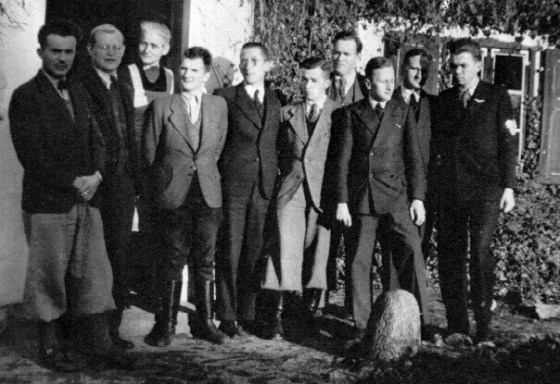
Declaration # 2

“Christ Jesus, whom God has made our wisdom, our righteousness and sanctification and redemption.”  (1 Cor 1.30)

“As Jesus Christ is God’s assurance of the forgiveness of all our sins, so, in the same way and with the same seriousness he is also God’s mighty claim upon our whole life. Through him befalls us a joyful deliverance from the godless fetters of this world for a free, grateful service to his creatures.”

 “We reject the false doctrine, as though there were areas of our life in which we would not belong to Jesus Christ, but to other lords – areas in which we would not need justification and sanctification through him.”

81af7fbed0917900c09fdb4b5c362245

In 1934, writing for and with the critical input of his fellow Swiss theologians, Karl Barth crafted the above words. This is Declaration number 2 of 6 in the Barmen Declaration which I will comment on in this posting. I am not alone in concluding that Barmen represents the high water mark in the church’s understanding of its relation to political power. ‘Necessity is the mother of invention’. Or if this saying is too secular for some readers a Bible text is in order. Paul writes to the Church in Corinth “God will not allow us to be tested beyond are ability to withstand but with every trial/temptation provide a way of escape”. The Mainstream Protestant churches were being tried and sorely tempted by the Nazis, and in order to regain their evangelical footing so as to withstand the immense pressure that was being exerted on them, they gathered at Barmen and drafted a declaration which made an evangelical confession of their position vis a vis the situation at hand.

This pressure was twofold. The Nazis wanted the historic mainstream Protestant churches to formally and ideologically align with their National Socialism vision and program. And with remarkable success they proceeded to effect this alignment. In short Hitler orchestrated a take over of the mainstream Protestant Churches which were known as the Evangelical Churches of Germany. These churches and their synods had enjoyed the privilege of being the established religion for Germany other denominations and faith existed on the periphery. By Hitler’s initiative these historic bodies, linked through a Reich’s Bishop to his office, were being welded into one national church. This was the root and source of the pressure but not its primary face. While Hitler had more or less succeeded in bringing the lion share of the German Evangelical churches into formal unity and under his influence, so as to orbit around his vision to make Germany great again, Barmen was written not directly (although indirectly) to the Nazis.Rather it was written to themselves first and second to their brethren (the DEK) who had been seduced and charmed by Hitler’s new vision for Germany and for their (the DEK’s (German Evangelical Church) new role in restoring the nation’s greatness .

The genius of Barth’s approach in this Declaration, writing with and inside the community of brothers gathered then and there at Barmen, was that it did not attack this church (the DEK) apostasy directly nor did he attack Hitler’s take over of the church directly. Rather he wrote in such a way as to enable the Confessing Church to clearly define themselves.

In Declaration # 2 the leaders gathered at Barmen were addressing something that might be called “parallelism”. Hitler wanted the church and its believers to accord him some autonomous political-national space wherein his authority and influence would be honored and obeyed unfettered by any competing allegiances. His ‘doctrine’ was something akin to the following personification. ” I Hitler affirm with you that religion enjoys a spiritual place in your lives and this space I respect. It is private space, individual space, a ‘soul’ space known between you and God. This spiritual realm is one realm among others. I, as your chancellor, exercise authority over you in another realm. This realm is that of the political – the national. It has to do with what is good for the nation. In this realm your homage belongs to me – I am your fuhrer.”

In actual fact, as Barmen states in another place, Hitler wanted total control over German’s lives in every realm and his respect for the sanctity of the spiritual realm was in one sense vacuous.  In another sense however his ‘concession’ was unfortunately too true to the way religion at that time had come to be viewed. Religion was an individualistic, spiritual, soul centered, inward phenomenon. This overreach by Hitler, i.e. his will to control every realm of life of the German people, is the precise backdrop of Declaration 2. The language in Declaration 2 is over against Hitlers over reach.

In Declaration Number 2,listening to Scripture, the leaders at Barmen asserted that for those in the Confessing Church no realm enjoys final autonomy alongside or above the Lordship of Christ. While it is true that in this world there are many lords who rightfully levy on its subjects many obligations, the authority of these lords and the obedience of the subjects render is relative and conditioned, not absolute – relative to and conditioned by the will of Christ who is Lord over all, and Lord and head of the church. Located inside and under these ‘lords’ believers, like other women and men, are bound to respect and obey them, but this respect can never be absolute. None of these lords enjoy final autonomy. In the context of the situation Barmen addressed, namely that Hitler wanted and demanded final authority over Germans national political existence as well as ecclesial realm, the words in Declaration # 2 were formulated. In these words Hitler’s absolute supremacy was denied and the freedom of the church asserted.

When I discussed Declaration # 2 in my classes what captured the imagination of the students was not only the over reach of the political powers in the life and teaching of the church that they were familiar  (in their land political power had attempted to control, not only congregational life and mission activity, but church teaching) but the wider significance of this truth that Declaration # 2 brought to the front. People live inside of orders where an expected ethos ( ethical culture) and nomos (rules and laws and principles) prevail and many of these ways are contrary to the truth and right of Christ and his kingdom. These orders are familial, economic, academic (schools), the military , recreational (sports)  and national  (political) and often ecclesial. Life is not lived as free individuals. In the real world people live, more or less, inside and under existing orders and institutions, and inside these there are cultures and ethics and rules in play, and authorities or ‘lords’ that enforce these. Inside of these institutions and orders people (and even groups of people) are located. This is where a large share of their life is lived. And as such the people within  these are folded into and conformed to the organizing ethos and noms that prevail. Inside of these the ethos and nomos that are in play often enjoy unfettered power over all.  Christ as Lord is quarantined, cordoned off, made applicable to a little individual – spiritual realm. Straightjacketed in these realms it is domesticated. The prevailing ethos within any institution or group culture often arrests the ‘dangerous’ difference embedded in  Christ’s way rendering it harmless.

Declaration  # 2  writes of “God’s mighty claim upon our whole life” and states that “through him” (through Christ) we are delivered “from the godless fetters of this world” and set “free (for) grateful service to his creatures.”

What is remarkable about the language in this declaration, as in others, is that Barmen brought to the front, not what should be, thereby calling for change and reform, but what is already real through Christ. Inside Christ and his Kingdom humans are already folded into a higher order and reality that is under written by a higher power and authority. No matter how awesome and overwhelmingly powerful and controlling these orders are that we are subsumed into, when they forge godless fetters to bind us the Gospel asserts we are free. As free daughters and sons of God we cease to see these orders and the lords that enforce them as “trees walking”, as the be all and end all that we are helplessly under, and to whom we must conform and revere. When their rule is false and idolatrous we are free and and not bound.

At the time Barmen was drafted the pressure to conform to the Nazi’s , the political lords, was overwhelming. Many church leaders in the mainstay evangelical body called “German Christians’ accused and maligned the Barmen pastors as enemies of the state – against the nation and the campaign to restore its greatness. Add to this the prevailing interpretation of Romans 13 shaped by Luther. Luther had taught near absolute unconditional submission to political power, a position that persisted  hundreds of years and remained enforce thereby exposing the Confessing Church to the charge of treason against state. A final source of pressure was the cost. Refusal to conform brought swift punishments. The withdrawal of freedom of assembly and freedom of speech followed their stand. Seizure of funds, intimidations and threats, and imprisonment in the concentration camps quickly unfolded. Barth and the Barmen Pastors thought in this Declaration does not first, or mainly, ask the believers to reach down and muster up moral courage and heroically resist Hitler’s over reach.  Rather it frames the church and the believer as already free from the godless fetters that the lords of this world bind their subjects. The emperor (in his over reach) has no clothes. The church and its members, viewing itself in and through the reality of the Gospel, knows that they are not exposed to the naked power and authority of these lords. There view is from the inside out. The Gospel frames then them as securely inside and under Christ rule and authority. It tells them that they belong to Christ, are inside and under his rule and kingdom.  Resistance is not heroic it is capitulation to the One to whom they belong. It is a witness to their freedom. Here resistance to the Nazi overreach is an expression and witness of their pre existing location in Christ and his kingdom rule.

As Barth points out in another place the Christian’s obedience to the state is first her free obedience to Christ. It is not an obedience that is parallel to one’s obedience to Christ, it is not alongside Christ. It is not even a hierarchy of authority – God first and the ruler second. The obedience to the state authority that is given by the believers is his or her free obedience to Christ and is limited by whether the ruler is functioning within the purpose and limitations, that God in and through Christ, has given a political ruler to exercise his power – a purpose and limitation that Scripture clarifies. No direct obedience obtains.

The careful reader will recognize that resistance cast in this way does not give place to a militant rebel or revolutionary perse. This is so because as with the Confessing Church a direct challenge to authority was not being formulated. Rather they capitulated to a higher authority. Theirs was not a resistance that said I will not do x, y,  or z  rather they said we cannot do x, y, or z. The freedom exercised was not derived from a swollen “I”, an enlarged claim of individual right, however just or problematic one may view such claims. Rather it stemmed from believers who  openly capitulated to a higher authority and rule that they were folded into. The true church through the ages has no native interest in challenging political power directly, their interest has been only that of being faithful to Christ. The direct action Bonhoeffer was involved in against Hitler, he believed, was merited because he recognized that in Hitler political power had become the embodiment of the antichrist. The distinctions discussed in this posting emerge later in the Barmen Declaration and are endemic to Barth’s evangelical thought.

(Picture # 1 German Churchmen giving the Nazi Salute with the response “Heil Hitler” Picture # 2  A few of the church leaders in the Confessing Church Movement who gathered at Barmen)

*


The Relation of the Church to Political Power: Test Your Biblical Knowledge

Over the last semester I’ve traveled to one school in the Far East and another in Southeast Asia along the Myanmar-Thai border and taught a course on the relationship of the Christian church to political power. Test your own biblical knowledge on what The Bible teaches on this relationship.

img_4365

Here follows part of the final exam I gave my students, which covers the five different periods in biblical history of the People of God.

Section One: The Relation of the People of God to the Political Power of Pharaoh in Egypt

  1. Question: In my discussions about Pharaoh’s exercise of political power over the Children of Israel I said that he trespassed. I chose this word carefully and used it precisely. What did I mean and how did Pharaoh trespass? (Answer) To trespass means to step over a boundary, to go beyond one’s rightful province, place or proper reach or station. In class we said that if a janitor cleaning the principle’s office heard a knock at the door and quickly sat down behind the principal’s desk and invited the visitor into the room and presented himself as the Principal he would be trespassing because he would be taking to himself duties and a dignity that did not obtain. Pharaoh was the top ruler of Egypt but this did not mean that there were no limitations to his power, even if in Egyptian law and culture no limitations to his power existed. The nature of righteousness is ultimately eternal. It is created by and grounded in God and is not the creation of men and women. The ruled and the rulers must attend to righteous boundaries. Pharaoh had a hard time realizing this (evidenced by his unwillingness to allow the Children of Israel freedom to worship their God and the bondage and exploitation he placed them in). He truly believed he owned them and had a right to complete control over them. It was not mere perversity of spirit that led him to recant repeated agreements to let “his slaves” go and worship. He believed he had total godlike power over them. There are at least three explicit ways the Exodus text reveals he trespassed. First he forbade them to go to the desert and worship their God. As such he claimed spiritual power over them acting as a God instead of a secular governor. He exploited the Hebrews for their labor placing them in what appeared to be irreversible unconditional bondage. They had no future. He acted as if he had ultimate total power over the Israelite people body and soul. In killing innocent babies he acted as if he had capricious power over life itself. From the bigger picture and revelation of righteousness given in Scripture and the emergence of the Kingdom of God Pharaoh trespassed because he exercised his power in areas of life that were beyond the province of his authority.
  2. Question: Thinking about what happened to the Children of Israel in Egypt write me a short essay on the precise meaning of justice. When I asked you in class what justice meant you gave me answers like peace, fairness, equality. These are all the fruits of justice but what is the root meaning. Answer: Justice in the Bible has to do with restoring to a person or people what they need to live. By ‘live’ I do not mean merely surviving but live as free, purposeful and self supporting human beings under God. Justice restores the means of life, community and one’s place within community and ultimately one’s place with God. In Justice it is all about providing ground underneath people’s feet so as to build and live life. Sometimes through fault of their own, sometimes through no fault of their own people lose what is needed to live, build and sustain life. Because it includes mercy in its very character, justice turns a blind eye to what a person deserves, and instead graciously provides what they need.
  3. Question Where did the Biblical concept of justice come from? How did it come into existence in the Bible and the church in both the Old and New Testament? Where did it start? How was it formed? These are all one question. Add to this question another one. Turning the pages of the Psalms and the Prophets one comes upon references that reveal where the idea of Justice began. Can you find one of these and comment on it? Answer Psalm 103:1-8 is one passage among many that answers this question. In verse 4 & 6 “God works justice for those who are oppressed.” Those who are caught in a ‘pit’ and cannot get out God redeems their life. “He redeems their life from the pit” (vs 4). Justice, in its essential meaning corresponds to those who have lost the means of life (physically, socially i.e. community and spiritually) and who cannot, using their own resources, get these means back again. The bondage in Egypt is a formative example of justice because the Hebrews could not extricate themselves from bondage/enslavement. They were, metaphorically speaking, in a pit and could not get out. Freeing them from bondage was the seminal act of justice in the Bible and this is what Psalm 103 goes on to state. “He (Yahweh) made known his ways to Moses …” (vs 7). Here in this deliverance the God of justice made his debut. Justice with the Hebrews did not begin with hard thinking but a signature act – the Exodus. This signature act of deliverance then becomes reflected on and this is how the conceptual meaning of justice, as it is found in Scripture, was formed.
  4. Question: The Children of Israel were freed! Freedom, true freedom, the freedom we meet in Scripture always has two faces. It is like a coin with two distinct and different sides. Please tell me what these two sides are within the Exodus story and expand on them. After you have discussed this two-sided character of freedom within the Exodus setting think of this two-sided concept of freedom within the setting of the Christian life. Answer: Freedom in Scripture is always shaped in a from – to The Children of Israel were delivered from bondage to Egyptian/Pharaoh slavery. But this was followed by a call into a new covenant community where they would live on the land as God’s people with a new God given purpose and righteousness. In the New Testament in Galatians, freedom is freedom from enslavement to the law, but this from the law gives way to living life in a new way – in the Spirit and as a servant to others in love.

Continue reading

Incurvatus In Se


hope

While Donald Trump was ascending to his glory, at the very moment the decisive count was being tabulated I was at the center of the universe, well that is a slight exaggeration, not the center of the universe but the world, our world – planet earth. Without question KKBBSC was for me, at that moment in time, the center of the world because since the world is round the center is wherever one is located. I was located at The Mae La Refugee Camp an hour and a half north into the mountains by the Line Bus from Mae Sot, western Thailand. I was in Section A in the camp, teaching a course on The Relation of the Christian Church to Political Power to junior and then senior students of The Kawthoolie Karen Baptist Bible School and College, one of the coolest schools on the planet!

When the score was finalized and the Electoral College votes tabulated it was midday the 9th of November and my afternoon class was approaching. To assuage my grief I held a memorial service to the campaign to become the 45th president of the United States. This memorial campaign, which had just exhaled its last gasp of fowl air before giving up the ghost, deserved in my judgment, to be eulogized. The nasty, nauseating, mud slinging, soul destroying, bellicose campaign, with all its wild and wooly claims, extending from little hands to a new great wall that will divide the Americas had come to an end. While something else was born the campaign was then and there, at that moment in time, over, finished, dead and gone. It seemed fitting therefore to immediately hold a memorial service in this tropical climate where everything rots quickly and disappears into the abyss of nature’s ferment.

Without reflection the only commentary on the life of this campaign could be none other than Bob Dylan’s refrain, or a close facsimile thereof, “something has happened here Mr. Jones but I don’t know what it is.” And this is what I did – I reflected out loud about what had happened. Setting my lecture notes aside I spoke extemporaneously for about 2 hours and mused over the campaign, sometimes using Christian and Biblical understandings as my tools, sometimes experience and reason. In fact, the truth be told, the students suborned me into this task, requiring me to say some final words for they too were confused.

The memorial service of sorts, which I did indeed publically name as such at the beginning of the class, came about sort of like a scene from an old western movie where a compatriot dies in a mountain shoot out. Instead of just riding off, someone in the gang with a conscience says “we cannot just leave ‘em lay here to rot we gotta bury ‘em”. And when they do cover the dead guy with a heap of rocks with a make shift stick cross wedged between them then they realize somebody has to say a word even if its ever so banal and terse. I was that guy. They forced it on me. The students made me do it. Their insistence however, it must be noted, was born mostly from a true affection for the USA. Karen students do not have a mere sentimental affection toward the USA born from rock and roll and the movies. More than any other country in the world it has been the USA who has welcomed Karen Refugees driven from their Burma/Myanmar homeland, held in camps inside the Thai border now for 25 years. Many students viewed the USA as their friend and a potential new homeland. Trump’s anti-immigrant Make America Great Again rhetoric echoed in these far off mountains and caused these students concern and confusion. “Will the real America we have believed in please stand up.” This is what many were saying during the campaign, and then November 9th arrived and by some luck of the draw I was there with them, and together before us the identity of the new America rose to its feet and it was a grim presentation. Not only were they confused and concerned – I was too! Here follows one of my reflections the best I can reclaim my words and thoughts.

Scripture tells us the struggle of human existence comes down to an outward versus and inward focus. Sin and agape love dual for the mastery. The primary sense of sin that comes to the fore in Scripture is that of a toxic propensity that temps us humans to turn inward to ourselves and our needs, our security and desires and to turn away from others especially others in real need. Over against this propensity there is a counter power – the Spirit from above, God’s Spirit, who pulls us out to embrace the way of love and the ethic of justice that agape love calls us to. Following this pull the self becomes downsized and ventures a turn outward where it finds it’s life in service to others in need to the glory, not of self, but of God. While the turn inward is supremely acquisitive, the turn outward is radically distributive because it turns its helps out to those in need in the posture of service and ministry. Curved in or turned out this is the struggle which Jesus and Paul made the explicit self-conscious struggle of every individual. And whilst this struggle is essentially a personal struggle carried by the individuals empowered by the Spirit and by the groups and congregations that body individuals, this struggle transcends individuals and their parochial groups and enters the worlds, cultures and polities that individuals and groups create.

While agape love cannot, and should not be directly translated to the affairs of the nation state, as if it were an ethical code that could be translated, the outward versus the inward voyage elemental to Agape is not lost. Its presence in the world does not belong to the realm of ‘good ideas’. Its presence in the world is not correlated to the life span of ephemeral spiritual ideas and pious virtues. This side of Easter it is the destiny of this outward turn to challenge and, if possible, penetrate every body and institution whether economic, familial, and political and upon penetrating its consciousness compromise, its consistent inward preoccupation. All individual and social realities must struggle with this revolution because the messiah has already come and given this revolution a historical career. It is the future of humanity, and this side of Easter it is not only coming, as in the age of the Prophets, it is present and coming to fulfillment. And while it cannot be instituted like a law or policy the power and genius of this turn outward can and must be discerned, and reflected in our bodies, not only body selves, but familial, economic, ecclesial, and national bodies the best we can. The self stands deep in these bodies, shapes and is shaped by them.

The inward focus centers all the attention on the explicit promotion and greatness of self. In this turn self narrows and becomes anxious. In fact it was Luther who wrote of this turn calling it the essence of sin. Sin he wrote in Latin is “Incurvatus in se“, “the self curved inward on itself.” From the lens of this inward focus every resource and person (or people) around it is seen in relation to the direct enhancement of oneself or threat against oneself. Self-focus, self-concern, self-protection, the security of self, as well as the promotion and preeminence of self, becomes studied, purified, streamlined into policies and baptized as a new ideology of strength. “Today on November 9,” (Asia is a day ahead in time) I told the students, “America officially and openly embraced a consistent inward focus whilst calling into open question and disparagement all of its outward, other centered endeavors. Like an immune system that becomes confused and attacks and destroys its own vitality, America turned against its own liberal magnanimity – the soul and secret of its vitality. The verve and nerve to turn outward toward needs and concerns beyond its own, to the extent such ex-centricity still existed, received a great wound. Jettisoning its outward focus and embracing a full throttle toxic inward focus the new leadership and their followers said “Let the world go to hell in a hand basket we must now shift all our attention explicitly on the nation self.” “From henceforth our platform will be about only those things that are explicitly, directly, simply, fusslessly, and immediately good for us.”

Never mind the deeper question that underlies everything else, namely whether this new ethic really attends to the subtly, complexity, liberality and humanitarian wisdom embedded in enhancing the greatness of oneself or one’s nation. Here it’s the explicit shift to make the national self’s greatness a simple, direct, unambiguous goal, as if that were possible to begin with. On the contrary, outward focus requires one to sit loose with one’s greatness, real or imagined, and to beware of the swelling and inflammation of self interest, and act out of a wide spectrum of interests where another’s good, need and plight enter into decision making and action.

Take justice for instance. Under the new Make America Great Again ethic the outward turn is viewed as an ultraistic ephemeral spirituality, fit for pious church people, but an ethic that has any business being woven deeply into the fabric of the nation state and its polity it is not. Justice – coming alongside the down and out in an effort to help restore the means of life – must now be interpreted as weakening the nation self. In fact almost every social benefit or relief can be viewed as a drain on the collective self’s economic strength. Embracing ethnic and religious differences, making room for them, and according them dignity and social space as a matter of principle, becomes interpreted as weakening the power of a more or less homogenous democratic majority (more or less – every year less). The mind set that believes that the funds from the public purse must not be used to put justice into play, in the myriad of ways it faces the nation is the opposite of greatness. It is anxiety driven and its driven by the ‘haves’  who fear their privilege will be compromised by the have nots. It is Incurvatus in Se, the national self curved in on itself.

America as a vanguard and sentinel for human rights and freedom in the world, a voice for exploited, abused and enslaved peoples, people without rights and a say in their future, is viewed as runaway liberalism, as elitist, as cultural imperialism. And most importantly it is seen as contributing nothing directly to making us great, muscularly great, nationally great and economically great and or militarily great, because it is in these measurements of greatness that the rubber meets the road in this ‘new ethic’.

November 8 decided it. The time had come for America to pull back, curve inward, and quit “saving the world” (the libel of its nay sayers). It is time, America said, to tend to our own needs and greatness. Its time to go back home and stay home and make America great again. Time to withdraw from the global struggle for rights and justice and freedom, except of course where our security is concerned. It is time to reign in the liberal notion that every difference is to be baptized and given free social commerce. These differences – do they not weaken us? This is what the majority of States ( not people/citizens) said on November 8 led as they were by one who was well qualified, perhaps qualified far above anyone else, to lead the revolt against the outward turn. For has anyone in America mastered incurvatus in se better than this new leader has, took it deeper and further than he has, practiced it with such awesome radical consistency as he. Is he not much more than merely president (one who is fit or unfit to preside over the affairs of state) but really far more the new man, exemplar man for all men and women where incurvatus in se is personified and the election of 47 percent, a collective act of erotic love.

By November 9 in the wee hours of the morning led by their new leader a sufficient majority of the states gained the mandate and said “we must now commence to circle the wagons and protect ourselves, the greatness of our country has come under many threats. We will now cease the outward venture and turn inward!” On November 9 the primacy of me, myself and I, the miserable ethic of Cain, morphed from the secret guilt of self -centered individual souls to a shameless boastful slogan of a new toxic nationalism.

Build a wall, a great wall and cast out all that weakens and threatens our greatness. Nothing captures what happened better than the great wall. It of course may never be built as it has been advertised but in my opinion it was never intended to be built as advertised. Real or imagined the wall was from the get go a metaphor for the new exclusivity that America was wrapping around itself. America had gone out as far as it was going to go and now it was time to turn inward, it was time to purge America of weakness and concentrate its strength and greatness and then protect it from contamination.

One must pause here, indulge a brief moment of reflective irony. Is not whatever greatness one person or nation approaches, sort of like the proverbial dog running up a shallow stream with a fish in his mouth. Upon seeing his reflection in the water the poor dog becomes mesmerized and confused and then thoroughly bemused, then suddenly drops the fish and lunges for the reflection losing both the fish and the reflection. I have already witnessed it, many here in the South East Asia have already realized the fish is gone from the dog’s mouth, the illusive mystery and wonder of America has gone flat! Even junior and senior college students wearing Karen ethnic wraps, living in thatch shelters made from leaves and branches perched under the cleft of a great desolate mountain out in nowhere in the rugged terrain in Tak Province in Northwest Thailand six miles from the Burma border know the mystery has gone flat – America has curved inward.

Hope is the key word all around. Hope here and now, means we Americans and friends of America renew hope that all of the peoples, agencies and religious organizations that have been turned out to the greater good, the common good, domestic and international, will not flinch but strengthen their resolve. Hope here and now means that the cries of oppressed peoples such as those in KKBBSC and the Mae La Camp, in Syria and the Syrian Refugee Diaspora and in Burma/Myanmar with the plight of the Rohingya Muslims and legends of other oppressed groups in South and Central America will be heard and real help will reach them. Hope here and now alas means that all in positions of power and wealth, including the 45th president elect and his suite of advisors and helpers, will be converted to true greatness – the greatness of turning away from swollen self interest and anxiety and out to those in need, the many real faces of need in search of friendly eyes.

unnamed-1

unnamed

Caught In Limbo

“How Does It Feel

How Does It Feel

To Be On Your Own

With No Direction Home

A Complete Unknown

Like a Rolling Stone”

Bob Dylan

Mae La Refugee Camp

Mae La Refugee Camp

 For a long time I have had a desire to write something on the problem that undocumented immigrants face caught in limbo between a country they left and a new country they could never call their own. My work with the Karen People along the Thai – Burma border rekindled this desire. The Karen people in Myanmar had to flee their ancient homeland when the military turned viral and set out on an ethnic purge. A horrific slaughter ensued and a wholesale exodus followed. But just as I was about to commence working on a little book on the Karen plight, caught are they are to this day inside of Thai refugee camps, unable to return home or secure entitlement to build anew in Thailand, the great diaspora from Syria commenced. The heart wrenching scenes of their inability to live in their homeland or to find a new start in another land continue to fill the news. Focused on these problems, for a moment, I forgot that my own country was failing to deal responsibly with its own undocumented immigrants. Suddenly the idea of writing about the Karen plight seemed like a practicing alcoholic holding a seminar on how to get the victory over alcoholism. With this in mind I set out to address the immigrant situation in the USA. Many if not most of my thoughts can be applied with a little imagination to all setting where peoples are caught in limbo. Here follows a synopsis of the book I wrote.

The threat of terrorism in America is teaching us vigilance the hard way but it is also tempting us to become anxious. Anxiety induces stupidity and moral confusion. Political pundits and leaders on the right are exploiting this anxiety and calling for a very muscular, legalistic response to the presence of undocumented immigrants living in the USA. Their response is morally confused at best and at worst acutely harmful. Most Evangelicals and their preachers have been sucked into this moral confusion.

The Strangers Within Your GatesScreen Shot 2016-09-03 at 9.19.50 AMUsing reason and the very Scriptures Evangelicals parade as the Word of God this book sets forth seven arguments that expose the attitudes and proposed resolutions of the Religious and Political Right as immoral and non-Christian. Only truth exposes error, and in this little book the truth is put on a lamp stand. The reader need not check his or her facility to think and reason in at the front desk and go upstairs to be preached at. “He has told you, O man, what is good; and what does the Lord require of you but to do justice, and to love kindness, and to walk humbly with your God?” (Micah 6)

The title of my book is The Strangers Within Your Gates: Overcoming the Moral Confusion in American Religion and Politics – Seven Arguments

Available as an e-book on Amazon or paperback at the The Book Patch