Incurvatus In Se


hope

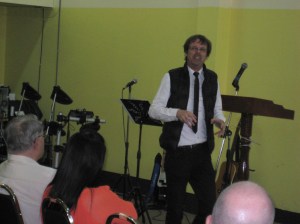
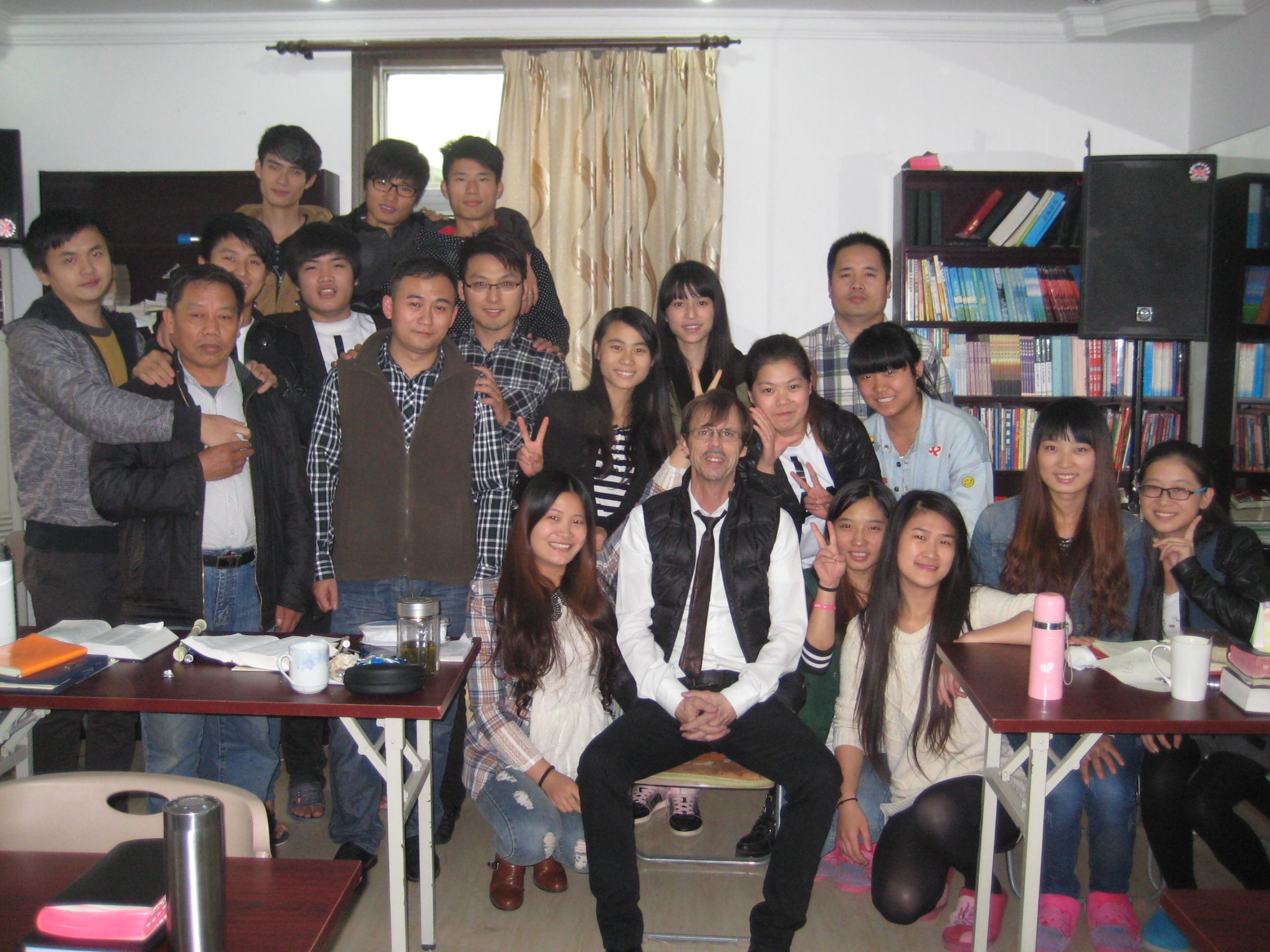
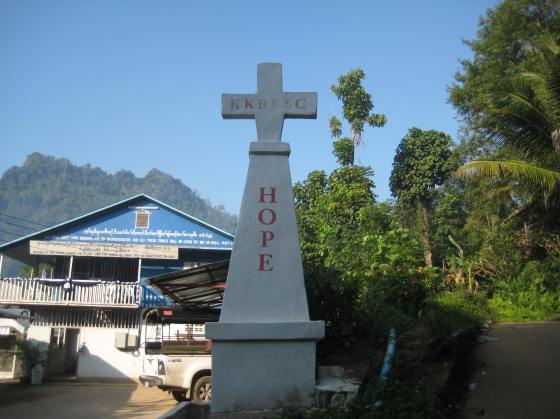
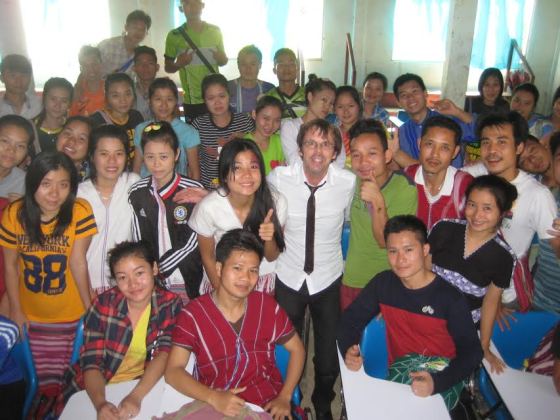
While Donald Trump was ascending to his glory, at the very moment the decisive count was being tabulated I was at the center of the universe, well that is a slight exaggeration, not the center of the universe but the world, our world – planet earth. Without question KKBBSC was for me, at that moment in time, the center of the world because since the world is round the center is wherever one is located. I was located at The Mae La Refugee Camp an hour and a half north into the mountains by the Line Bus from Mae Sot, western Thailand. I was in Section A in the camp, teaching a course on The Relation of the Christian Church to Political Power to junior and then senior students of The Kawthoolie Karen Baptist Bible School and College, one of the coolest schools on the planet!

When the score was finalized and the Electoral College votes tabulated it was midday the 9th of November and my afternoon class was approaching. To assuage my grief I held a memorial service to the campaign to become the 45th president of the United States. This memorial campaign, which had just exhaled its last gasp of fowl air before giving up the ghost, deserved in my judgment, to be eulogized. The nasty, nauseating, mud slinging, soul destroying, bellicose campaign, with all its wild and wooly claims, extending from little hands to a new great wall that will divide the Americas had come to an end. While something else was born the campaign was then and there, at that moment in time, over, finished, dead and gone. It seemed fitting therefore to immediately hold a memorial service in this tropical climate where everything rots quickly and disappears into the abyss of nature’s ferment.

Without reflection the only commentary on the life of this campaign could be none other than Bob Dylan’s refrain, or a close facsimile thereof, “something has happened here Mr. Jones but I don’t know what it is.” And this is what I did – I reflected out loud about what had happened. Setting my lecture notes aside I spoke extemporaneously for about 2 hours and mused over the campaign, sometimes using Christian and Biblical understandings as my tools, sometimes experience and reason. In fact, the truth be told, the students suborned me into this task, requiring me to say some final words for they too were confused.

The memorial service of sorts, which I did indeed publically name as such at the beginning of the class, came about sort of like a scene from an old western movie where a compatriot dies in a mountain shoot out. Instead of just riding off, someone in the gang with a conscience says “we cannot just leave ‘em lay here to rot we gotta bury ‘em”. And when they do cover the dead guy with a heap of rocks with a make shift stick cross wedged between them then they realize somebody has to say a word even if its ever so banal and terse. I was that guy. They forced it on me. The students made me do it. Their insistence however, it must be noted, was born mostly from a true affection for the USA. Karen students do not have a mere sentimental affection toward the USA born from rock and roll and the movies. More than any other country in the world it has been the USA who has welcomed Karen Refugees driven from their Burma/Myanmar homeland, held in camps inside the Thai border now for 25 years. Many students viewed the USA as their friend and a potential new homeland. Trump’s anti-immigrant Make America Great Again rhetoric echoed in these far off mountains and caused these students concern and confusion. “Will the real America we have believed in please stand up.” This is what many were saying during the campaign, and then November 9th arrived and by some luck of the draw I was there with them, and together before us the identity of the new America rose to its feet and it was a grim presentation. Not only were they confused and concerned – I was too! Here follows one of my reflections the best I can reclaim my words and thoughts.

Scripture tells us the struggle of human existence comes down to an outward versus and inward focus. Sin and agape love dual for the mastery. The primary sense of sin that comes to the fore in Scripture is that of a toxic propensity that temps us humans to turn inward to ourselves and our needs, our security and desires and to turn away from others especially others in real need. Over against this propensity there is a counter power – the Spirit from above, God’s Spirit, who pulls us out to embrace the way of love and the ethic of justice that agape love calls us to. Following this pull the self becomes downsized and ventures a turn outward where it finds it’s life in service to others in need to the glory, not of self, but of God. While the turn inward is supremely acquisitive, the turn outward is radically distributive because it turns its helps out to those in need in the posture of service and ministry. Curved in or turned out this is the struggle which Jesus and Paul made the explicit self-conscious struggle of every individual. And whilst this struggle is essentially a personal struggle carried by the individuals empowered by the Spirit and by the groups and congregations that body individuals, this struggle transcends individuals and their parochial groups and enters the worlds, cultures and polities that individuals and groups create.

While agape love cannot, and should not be directly translated to the affairs of the nation state, as if it were an ethical code that could be translated, the outward versus the inward voyage elemental to Agape is not lost. Its presence in the world does not belong to the realm of ‘good ideas’. Its presence in the world is not correlated to the life span of ephemeral spiritual ideas and pious virtues. This side of Easter it is the destiny of this outward turn to challenge and, if possible, penetrate every body and institution whether economic, familial, and political and upon penetrating its consciousness compromise, its consistent inward preoccupation. All individual and social realities must struggle with this revolution because the messiah has already come and given this revolution a historical career. It is the future of humanity, and this side of Easter it is not only coming, as in the age of the Prophets, it is present and coming to fulfillment. And while it cannot be instituted like a law or policy the power and genius of this turn outward can and must be discerned, and reflected in our bodies, not only body selves, but familial, economic, ecclesial, and national bodies the best we can. The self stands deep in these bodies, shapes and is shaped by them.

The inward focus centers all the attention on the explicit promotion and greatness of self. In this turn self narrows and becomes anxious. In fact it was Luther who wrote of this turn calling it the essence of sin. Sin he wrote in Latin is “Incurvatus in se“, “the self curved inward on itself.” From the lens of this inward focus every resource and person (or people) around it is seen in relation to the direct enhancement of oneself or threat against oneself. Self-focus, self-concern, self-protection, the security of self, as well as the promotion and preeminence of self, becomes studied, purified, streamlined into policies and baptized as a new ideology of strength. “Today on November 9,” (Asia is a day ahead in time) I told the students, “America officially and openly embraced a consistent inward focus whilst calling into open question and disparagement all of its outward, other centered endeavors. Like an immune system that becomes confused and attacks and destroys its own vitality, America turned against its own liberal magnanimity – the soul and secret of its vitality. The verve and nerve to turn outward toward needs and concerns beyond its own, to the extent such ex-centricity still existed, received a great wound. Jettisoning its outward focus and embracing a full throttle toxic inward focus the new leadership and their followers said “Let the world go to hell in a hand basket we must now shift all our attention explicitly on the nation self.” “From henceforth our platform will be about only those things that are explicitly, directly, simply, fusslessly, and immediately good for us.”

Never mind the deeper question that underlies everything else, namely whether this new ethic really attends to the subtly, complexity, liberality and humanitarian wisdom embedded in enhancing the greatness of oneself or one’s nation. Here it’s the explicit shift to make the national self’s greatness a simple, direct, unambiguous goal, as if that were possible to begin with. On the contrary, outward focus requires one to sit loose with one’s greatness, real or imagined, and to beware of the swelling and inflammation of self interest, and act out of a wide spectrum of interests where another’s good, need and plight enter into decision making and action.

Take justice for instance. Under the new Make America Great Again ethic the outward turn is viewed as an ultraistic ephemeral spirituality, fit for pious church people, but an ethic that has any business being woven deeply into the fabric of the nation state and its polity it is not. Justice – coming alongside the down and out in an effort to help restore the means of life – must now be interpreted as weakening the nation self. In fact almost every social benefit or relief can be viewed as a drain on the collective self’s economic strength. Embracing ethnic and religious differences, making room for them, and according them dignity and social space as a matter of principle, becomes interpreted as weakening the power of a more or less homogenous democratic majority (more or less – every year less). The mind set that believes that the funds from the public purse must not be used to put justice into play, in the myriad of ways it faces the nation is the opposite of greatness. It is anxiety driven and its driven by the ‘haves’  who fear their privilege will be compromised by the have nots. It is Incurvatus in Se, the national self curved in on itself.

America as a vanguard and sentinel for human rights and freedom in the world, a voice for exploited, abused and enslaved peoples, people without rights and a say in their future, is viewed as runaway liberalism, as elitist, as cultural imperialism. And most importantly it is seen as contributing nothing directly to making us great, muscularly great, nationally great and economically great and or militarily great, because it is in these measurements of greatness that the rubber meets the road in this ‘new ethic’.

November 8 decided it. The time had come for America to pull back, curve inward, and quit “saving the world” (the libel of its nay sayers). It is time, America said, to tend to our own needs and greatness. Its time to go back home and stay home and make America great again. Time to withdraw from the global struggle for rights and justice and freedom, except of course where our security is concerned. It is time to reign in the liberal notion that every difference is to be baptized and given free social commerce. These differences – do they not weaken us? This is what the majority of States ( not people/citizens) said on November 8 led as they were by one who was well qualified, perhaps qualified far above anyone else, to lead the revolt against the outward turn. For has anyone in America mastered incurvatus in se better than this new leader has, took it deeper and further than he has, practiced it with such awesome radical consistency as he. Is he not much more than merely president (one who is fit or unfit to preside over the affairs of state) but really far more the new man, exemplar man for all men and women where incurvatus in se is personified and the election of 47 percent, a collective act of erotic love.

By November 9 in the wee hours of the morning led by their new leader a sufficient majority of the states gained the mandate and said “we must now commence to circle the wagons and protect ourselves, the greatness of our country has come under many threats. We will now cease the outward venture and turn inward!” On November 9 the primacy of me, myself and I, the miserable ethic of Cain, morphed from the secret guilt of self -centered individual souls to a shameless boastful slogan of a new toxic nationalism.

Build a wall, a great wall and cast out all that weakens and threatens our greatness. Nothing captures what happened better than the great wall. It of course may never be built as it has been advertised but in my opinion it was never intended to be built as advertised. Real or imagined the wall was from the get go a metaphor for the new exclusivity that America was wrapping around itself. America had gone out as far as it was going to go and now it was time to turn inward, it was time to purge America of weakness and concentrate its strength and greatness and then protect it from contamination.

One must pause here, indulge a brief moment of reflective irony. Is not whatever greatness one person or nation approaches, sort of like the proverbial dog running up a shallow stream with a fish in his mouth. Upon seeing his reflection in the water the poor dog becomes mesmerized and confused and then thoroughly bemused, then suddenly drops the fish and lunges for the reflection losing both the fish and the reflection. I have already witnessed it, many here in the South East Asia have already realized the fish is gone from the dog’s mouth, the illusive mystery and wonder of America has gone flat! Even junior and senior college students wearing Karen ethnic wraps, living in thatch shelters made from leaves and branches perched under the cleft of a great desolate mountain out in nowhere in the rugged terrain in Tak Province in Northwest Thailand six miles from the Burma border know the mystery has gone flat – America has curved inward.

Hope is the key word all around. Hope here and now, means we Americans and friends of America renew hope that all of the peoples, agencies and religious organizations that have been turned out to the greater good, the common good, domestic and international, will not flinch but strengthen their resolve. Hope here and now means that the cries of oppressed peoples such as those in KKBBSC and the Mae La Camp, in Syria and the Syrian Refugee Diaspora and in Burma/Myanmar with the plight of the Rohingya Muslims and legends of other oppressed groups in South and Central America will be heard and real help will reach them. Hope here and now alas means that all in positions of power and wealth, including the 45th president elect and his suite of advisors and helpers, will be converted to true greatness – the greatness of turning away from swollen self interest and anxiety and out to those in need, the many real faces of need in search of friendly eyes.

unnamed-1

unnamed

Caught In Limbo

“How Does It Feel

How Does It Feel

To Be On Your Own

With No Direction Home

A Complete Unknown

Like a Rolling Stone”

Bob Dylan

Mae La Refugee Camp

Mae La Refugee Camp

 For a long time I have had a desire to write something on the problem that undocumented immigrants face caught in limbo between a country they left and a new country they could never call their own. My work with the Karen People along the Thai – Burma border rekindled this desire. The Karen people in Myanmar had to flee their ancient homeland when the military turned viral and set out on an ethnic purge. A horrific slaughter ensued and a wholesale exodus followed. But just as I was about to commence working on a little book on the Karen plight, caught are they are to this day inside of Thai refugee camps, unable to return home or secure entitlement to build anew in Thailand, the great diaspora from Syria commenced. The heart wrenching scenes of their inability to live in their homeland or to find a new start in another land continue to fill the news. Focused on these problems, for a moment, I forgot that my own country was failing to deal responsibly with its own undocumented immigrants. Suddenly the idea of writing about the Karen plight seemed like a practicing alcoholic holding a seminar on how to get the victory over alcoholism. With this in mind I set out to address the immigrant situation in the USA. Many if not most of my thoughts can be applied with a little imagination to all setting where peoples are caught in limbo. Here follows a synopsis of the book I wrote.

The threat of terrorism in America is teaching us vigilance the hard way but it is also tempting us to become anxious. Anxiety induces stupidity and moral confusion. Political pundits and leaders on the right are exploiting this anxiety and calling for a very muscular, legalistic response to the presence of undocumented immigrants living in the USA. Their response is morally confused at best and at worst acutely harmful. Most Evangelicals and their preachers have been sucked into this moral confusion.

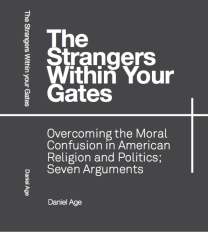
The Strangers Within Your GatesScreen Shot 2016-09-03 at 9.19.50 AMUsing reason and the very Scriptures Evangelicals parade as the Word of God this book sets forth seven arguments that expose the attitudes and proposed resolutions of the Religious and Political Right as immoral and non-Christian. Only truth exposes error, and in this little book the truth is put on a lamp stand. The reader need not check his or her facility to think and reason in at the front desk and go upstairs to be preached at. “He has told you, O man, what is good; and what does the Lord require of you but to do justice, and to love kindness, and to walk humbly with your God?” (Micah 6)

The title of my book is The Strangers Within Your Gates: Overcoming the Moral Confusion in American Religion and Politics – Seven Arguments

Available as an e-book on Amazon or paperback at the The Book Patch

My Name Is Nitayya And We Are Many

Both religious and secular bodies in the modern world are tuned in to human exploitation. Wherever exploitation of peoples is occurring in the world, in whatever form, there is to be found religious and secular ‘missionaries’. They show up like ants to honey and commence to run interference. Wherever human dignity, human rights, are being usurped reporters and missionaries gather in flocks mostly from European and American NGO type organizations and religious denominations. This is especially true in Southeast Asia. The modern world is ostensibly singing in harmony on this front. Human beings must not be used and exploited and stepped on. Their dignity must be protected, especially children, young women but also young boys. Included in this list are the poor as well as refugees. These and other categories of people are very vulnerable to exploitation. All mission endeavors attempting to head off exploitation are well and good to the extent their peoples, methods and motives are insightful and righteous.

When she first arrived in Bangkok from her farming village in Isan, she was full of hopes and dreams.......to make money for her 2 young children, her mother and father, help her brother buy a PU truck, to learn the ways of the Big City and the World, despite her 8th grade education.......her smile was magical, she was an astonishingly beautiful female, engaging, sexy, magnetic, no matter what she wore or didn't wear....over time the Bangkok Night gradually ground her down....and down and down....too many men, too many ladydrinks, too many hotel rooms, promises, broken hearts, human misery and desire on full display night after night after night...after almost 6 years working, she was finally consumed by the fire and heat until one day she was gone.....

Isan Girl Being Consumed by the Bangkok Night By Chris Coles

In a former teaching trek I was invited to a new seminary in Cambodia. I arrived in Phnom Penh a few days before my teaching assignment commenced in order to have a look about the city and also to work through my notes. Finding a Western breakfast spot I began to frequent it each morning and with coffee and food I went through my lessons spending several hours. One morning illustrates my ‘ants to honey’ point well. Twice during my breakfast study Western men showed up harem in tow for their coffee and toast. The first guy had two Cambodian girls about 16 and 18 then a second arrived with three gals following him like a mother duck with her ducklings in tow, the youngest no doubt could not have been older than 14. I am not a religious or secular policeman. No NGO blood courses through my veins. But he spied me off in the corner with my white shirt and black pants and brief case and became unnerved. Abruptly he corralled his teen harem and made a quick exit. Western do gooders have arrived in the bad boys playground and are spoiling the party. There are many playing fields where these skirmishes to protect the vulnerable occur. I have seen these at close range but as a spectator. My job is to think about what’s going on and seed my thoughts into my lessons. Insight and understanding are needed for reform.

In the following I point to one of the forces that I believe is driving a part of the exploitation occurring in the sex for money trade in Thailand. My language and conceptual grid is of course Western, those of whom I write are non-Western and their conceptual cultural grid would not name and explain the same realities I describe in the same way or with the same meaning. The window through which I look at and understand the problem discussed here is Christian and Western. If the reader has no tolerance for a little theology (actually theological anthropology) then there is no need to read further. Theology, as I am using it, allows for a different way of understanding the problem of exploitation of young women involved in a significant segment of the sex for money trade.

At the heart of religion and culture in Southeast Asia (especially Cambodia, Laos, Burma/Myanmar, and Thailand (Vietnam) is an ethic of reverence. Reverence to all authority is linked not merely to the cultural inertia of old traditions but merit. Merit is a, if not thee, engine propelling this ethic. Reverence as I am using it goes beyond respect and here is where my Judeo-Christian meaning grid comes into play.

Reverence in my tradition intersects the problem that the First Commandment in the Ten Commandments addresses. When the invisible but revealed Yahweh/God is not the primary loyalty humans always give their highest loyalty to a visible secondary power and/or person. This visible secondary power or person may be collective or individual, human or natural (nature). Here follows a praxis setting where this problem is discussed. It opens with a true story of a 25-year-old woman named Nittaya. I have taken care to be precise and not bend the details to my thesis.

With purpose in mind, with a friend accompanying me, I went in search of a chat that might clarify some things. Success was easier than I thought. I met a young lady named Nittaya on a street in Bangkok and talked to her at length and then met with her several times again and corresponded with her. She is/was one of a few hundred thousand women working in the lucrative sex for money trade. Like many she did not chose this work it was chosen for her. She was not trafficked but merely obedient.

She is a college graduate. Her parents are middle class. Her father is a senior (i.e. tenured) teacher at the high school level, her brother holds a PhD and teaches in the university. All of her four siblings married and prospered within their middle class socio-economic standing. No economic deprivation existed but her parents picked her and arranged her future in the lucrative sex for money trade and of course they received a weekly dividend. She could leave this work if a suitor/husband rewarded the family accordingly. By her own confession she insisted that she disdained the work and wanted true love and romance and listened to western music which of course elevates romantic love.

Culturally and religiously Southeast Asia elevates the ethic of deference to the highest level, far beyond the western idea of respect to the level of reverence. The roots of this ethic come from the dominant religion, (Buddhism) which continues to inform and shape culture. Children at any age, young or older, will do anything their parents require and because it is for the parent that the deed or action is done, no matter what it is, save outright violence or robbery, the deed or action is not merely justified but becomes an act of righteousness and a maker of merit. Merit promises metaphysical benefits.

I have no mind to pick on Buddhism and ignore the problems inherent in culture and religion in the West. I would rather aim my critique at an opposite problem. If Buddhism in the East seeds an ethic of reverence and deference that can be abused, ‘human’ in the West conceived as an inviolable individual with near absolute rights and freedoms can also be abused. Lions hunt in pairs. No doubt devotees on each side of this divide view the other as the greater social menace. But here my focus is on trying to penetrate the roots of a particular problem in Southeast Asia.

Here in this ethic, benignly called deference or reverence, is a hidden player that I now believe combines with others and drives the exploitation of young women in the region. For good reason the West has elevated the idea of the innate rights of the individual and while this is catching on in Asia it founders when it comes up against traditions rooted deep in religion and culture that form in children an ethic of absolute loyalty to parents (and authority) and require children to advance the welfare of parents no matter how able and prosperous they are. This, I am convinced, is one of the invisible roots that often is a participant in the sex for money industry in Southeast Asian culture. Most often this factor, more precisely this force, behind a young woman’s involvement in this work is subtle and ‘benign’ i.e. not viewed as abusive or exploitative. Nor is it necessarily or predominately physically abusive.Mostly it occurs under a religiously engendered ethic of parental obedience and care and it does not rupture filial bonds. And it is viewed as generating merit.

Understanding this (or grasping this) I believe shines light on the weakness of secular NGO type antidotes to this problem. This is so both because their measurement of exploitation is limited to harsher more obvious transgressions of human dignity and because they often do not grasp the religio-cultural root that is in the mix. If my insight has merit, and I believe it does (not simply because of one encounter but many years living and working here in S E Asia thinking and reflecting about the culture) then simply importing a more robust aggressive human rights ethic with its premise of the inviolability of the individual has limited effectiveness. The Western dogma insists that every person is enfranchised by God and nature with life, liberty, self-determination and dignity that cannot be rightfully violated or trespassed. It is conceived as inviolable. I am suggesting that this doctrine and ethic does not and cannot travel with ease too far into many cultures in the East without coming up against another deeply rooted ethic and doctrine that weakens. if not. derails it within certain contexts. The ethic requiring children to exist in deference, reverence and obedience to their parents and to exist for their parents, because these are rooted deep in tradition, culture and religious metaphysics, easily resists the career of modern Western “values” into Southeast Asian cultures (i.e. inside the family /parent contexts discussed here).

This is why some of the roots of the problem under discussion here are deeper than economic deprivation or greed. To reduce the antidote of this problem simply to improving the economy for the poor,  better education and enlightenment about human rights and better law enforcement is not enough. The roots of the problem are deeper. Can we grasp that this problem does not vividly appear unrighteous within the cultures where it is found ? We see this movement of young women into the sex for money trade by parents as blatantly exploitative and unrighteous but many, if not most, people within these cultures see it differently. It is considered to be sort of like  ‘taking one for the team’. Or, as one looker observed, the prostituting of a daughter is like an obedient son required to lay down his freedom and become a soldier. But because necessity and deprivation may not be involved these illustrations fall short and we must look deeper into the religio-cultural dimension.

The First Commandment, while explicitly addressing God’s claim on our highest loyalty, implicitly points to the problem inherent in human nature. Where this higher invisible loyalty is missing, visible loyalties gain the highest place. Something in nature abhors a vacuum and this vacuum lies near the nub and root of the problem. The Church knows this and cannot simply merge its mission with the secular NGO type mission work, although the church no doubt should embrace common goals where they exist. The Christian Gospel is the evangelical friend of the First Commandment rooting in humans a higher invisible loyalty, which in doing so subtly makes relative (while not destroying) visible loyalties. In this relativism the real antidote, I believe, is to be found. It supports, empowers and transforms the individual ethic and it saves  mission work that is truly Christian from falling into ethical nomism and legalism that is rife in secular endeavors.

I lost contact with this young woman but she told me her story concluding with this phrase “my name is Nittaya and we are many…”

*Here follows a couple rhetorical and theological questions that I think are related to this discussion. Are we Western secular and religious missionaries simply assuming humans exist in Southeast Asia as ‘individuals’ by our definition, or a ‘universal’ definition, of what ‘humans’ are and what humanness is? And / or are we calling them to become ‘human’ by our definition. And if so can that be accomplished or fulfilled merely by an ethical campaign? Both the church and the secular world in the West and those enlightened in the East know that ‘individual’ is an imperfect conceptual construction of the human person. Even when ‘individual’ is balanced by concepts of community it fails to reach the Judeo-Christian Christian understanding of humanness. Secular definitions of human and of human rights and human freedom are not perfect, not without a serious downside. And they are not wholly synonymous with Christian understandings and solutions. I believe it is closer to the truth to state that ‘human’ is not something innate but something that is a project. And this project Christians believe involves us in a dialectic with an invisible higher loyalty. This distinction is not a novel one. Self viewed as complete in itself underpins the Enlightenment birth of this designation – individual. But many Jewish and Christian philosophers and theologians argue that human = human in relation to other/Other. I believe missions for justice, especially those that emerge from the Church must be chastened by this truth if they are not to lose their salt and become overly pedagogical, strident, judgmental and legalistic.

*Another distinction I think that is helpful in looking deeper into this problem and how it is met is to think about the difference between a rebellion and a revolution. All rebellions remain tied to that which they are rebelling against. Revolutions on the other hand discover a new truth that enables them to view the controlling party differently in their imagination. Looking at a controlling party through the lens that new truth provides serves to downsize the oppressor and open up freedom to reconceive the relationship on new terms. To rebel against parental ‘overreach’ (an overreach which I argue is one force behind this problem in Southeast Asia that we in the West call forced prostitution) is one possibility, one that I think is very rare and without a future. Another response would be for society to scold the parents and tell them they must shorten their reach and enfranchise children with more control over their own future. I am not saying this does not have merit. I think it does have some merit but it also possesses limitations and distortions because it would require a sea change in culture. What the church that is true to its Gospel brings to the table is a spiritual revolution that ‘accidentally’ undercuts the absoluteness of the position parents enjoy over their children especially as they mature into young adults.

*Another layer in this problem is the split between body and spirit inherent in prostitution, a split that is relatively compatible with much of Eastern thought but foreign to Judeo-Christian understanding. Even so this bifurcation has also infected the West coming into culture through the back door of an individualism and assertion of freedom and right that has lost its religious root. But this waits for a later discussion.
 

Zwingli’s Dare: From an Elephant Corral to a Leper Asylum With Spirit,Hope and Life

  Spring 2015 Mission Report: Part Four

If a hot shot TV preacher said it, I would reward him with a cynical grin, but it was Huldrych   Zwingli in the 1520’s. Zwingli, a German Swiss who was among the finest minds in the Protestant Reformation wrote, “dare to do something great for God”.  These words coming from this man provoked in me a rethink about ethics.  First when I read Zwingli’s dare I thought about it theologically but several months later by happenstance I thought about someone who took Zwingli’s dare. First here in this report I follow with a few reflections on Zwingli’s assertion then  I turn to a story about the transformation of an elephant corral that incarnated ‘Zwingli’s dare’.

In this statement “dare to do something great for God” I believe that Zwingli grasped the intersection between faith and ethics/service. When a person believes and acts from faith one does not view herself so close to God that she is a glove and God the hand and not so far away that its all about human free will and determination. In my reckoning, Zwingli, more than John Calvin, who came to dominate the Reformed branch of the Reformation, recognized the human ‘space’ and freedom that living by faith inserted into our service to God and others. When Ethics/service arise out of faith there is room for the human to be human and dare to do something for God and this daring to do something ‘great’ need not be the door to toxic independence, misguided visions of grandeur, pride, presumption, activism and willfulness but the space needed for a person to recognize and respond to a higher claim on herself to serve the Christ of God in the face of human need and suffering. The uncertainty and blindness that clings to faith (because faith by its very nature cannot exorcise uncertainty and blindness) protects and underwrites human ethical decision and action. In the end the person himself must transit from convictions and feelings of compassion, whether strong or weak and decide and act for a thing if help and change are to occur. This does not mean the hidden God is not before an endeavor preparing the way, in it and and following after it but ethics turns on driving a wedge of distinction between our and the subtle work of the invisible God.

Is it impossible, in some sense, for God to be delighted, even surprised? Is there room in the way of faith for us to irrupt in ecstatic gratitude and zeal and decide to give our best to serve God in the face of human need and suffering.The freedom of the woman befriended and liberated by Christ described in the Gospels comes to mind. In her heart she conceived a costly – great gift, one that mirrored her gratitude to Christ for his grace to her. Overflowing with thankfulness she went in search of very precious perfume and upon finding it she no doubt spent all she had to purchase it only to pour out every drop on Jesus anointing and washing his feet.  Touched by human need and suffering, often grasped, like this woman was, by the goodness  and gracious of God to her, humans time and again have gone beyond their inhibitions and limitations and beyond their instincts to make the primary focus of their lives taking care of themselves and prospering  and dared to do something great for God that cost them their all.

I stumbled on this Zwingli quote late in November (2014) whilst giving lectures on Christian Ethics in China but it wasn’t till this spring that it moved from the realm of idea into form. In May I went on a little trek to discover other mission projects in Thailand and without planning to I happened on Dr. McLean’s work. About the second day of four perusing the grounds where his mission occurred, reading placards and monuments and chatting with people Zwingli’s statement suddenly pushed itself back into my mind. With a rush of emotion I realized that I was seeing an incarnation of Zwingli’s spirited assertion.

Life is so short, for most people it is spent frantically trying to take care of themselves, secure, build and expand their nests on this earth. This of course is not a bad thing because from these settled abodes and livelihoods many sponsor indispensable help to humanitarian and Christian missions. But the following story of Dr. McKean stirs my blood because in a raw and real way, faced with human need he stood in the ethical gap where nothing is forced, required or necessary and dared to do something great for God in Christ’s service. Here follows a synopsis of his story.

It may not be exactly precise to state that Christianity came to Thailand first in Chiang Mai but the mission work that came to Chiang Mai in the 19th century laid an early decisive foundation for Christianity’s future in Thailand and it was holistic from the get go. Not only Gospel teaching and evangelism but education and health were in the mix. Around the turn of the century somewhere between the late 1890’s and 1900 a missionary doctor and a couple nurses working with what is now named The Church of Christ opened an outreach clinic near a bridge at the edge of the city where lepers congregated. From this meeting the great need and suffering of the lepers became vividly apparent. Leprosy was three diseases in one. It created social rejection and isolation because the nearest and dearest of the lepers’ kin cleaved from them. It ended one’s vocational and economic capacity creating desperate poverty and it cruelly deformed and severely handicapped bodies. Demonic loneliness, hopelessness and despair accompanied leprosy. Dr. McKean a Presbyterian doctor from the USA realized that their clinic response was a mere band-aid at best. But it cannot be said his work merely evolved. He faced a need and gave himself to it in a decisive and imaginative way. One moment in time facing this need he made a decision and dared to do something great for God.

Chiang Mai was a kingdom at this time and 16 Kilo out of town there was an island created by the Mae Ping River and a canal which the King owned, once a compound for training and keeping his elephants but now abandoned for fear of a rouge spirit of a great white elephant that reputedly inhabited this sanctum. Dr. McKean went to the king and petitioned him for this land requesting that it be given to his mission as a sanctuary for lepers, where they could live, be treated and rehabilitated and the king granted it to him. Because it was an island and created separation and because it was basically good land that could be built on and developed it was perfect for the mission  that Dr. McKean conceived.

In 1908 he commenced his mission “The Chiang Mai Leper Asylum”. From this beginning he began to treat leprosy with the herbs and compounds used at that time progressing with medical science as it unfolded all the while building living facilities, developing a gregarious working culture (leaving the asylum to beg was not allowed), creating enterprises that simultaneously provided vocational training and animal husbandry. Within this setting a lively culture was created that included not only work and treatment but recreational engagements and worship. Under all of Dr McKean’s endeavors the Christian faith was taught whereby hope, meaning, value and dignity could be restored and rebuilt on a new and better foundation.

In time McKean bought more land in out lying ares and organized 22 resettlement villages in Northern Thailand and staffed these with trained assistants once patients who could dispense medicine and maintain a healthy culture and order. In not a few of these settings former patients where returned to ownership of land and complete economic independence.

Albeit small in scale compared to the magnitude of human need and suffering around the world visiting and staying on this island for a few days I recognized that some one had dared to do something great for God with his life and over 100 years later, although change had come with the cure of leprosy, Dr McKean’s courage and labors continues to bear fruit. A fine small hospital thrives on this small island that treats many diseases including leprosy and a live-in center for the care of dementia patients has commenced. People deformed and handicapped from leprosy continue live and work there. Organic crops are grown and sold, fish farming for subsistence has been established and artistic painting and carvings are produced and sold.

I was moved by every facet of this mission project, its compassion and courage, its earthly wisdom, its holistic depth and its solid Christian base. The Christian foundation of Mckean’s work  among other things added to his material/physical rehabilitation the metaphysical glue needed for restoring and maintaining human dignity and hope as well as infusing self sacrificing love into all their societies and relations that developed in the asylum. Something great happened on this island and the shadow of it persists. Lepers came from as far away as Laos, Burma and China to live there. Not only bodies were treated but also broken and bruised excluded spirits where lifted to dignity, hope, spirited fellowship with each other and life!

Zwingli’s thought  “Dare to do something great for God,” stirred an ethical rethink in my mind but McKean’s work stirred in me the desire to deepen and build my own mission.

Ground Hogs, Pig Weed, Quack Grass, Black Locust Trees and Morning Glory: Why Love is the Greatest

Excerpts from Spring ICF Teaching Notes: Part Three

“Three things remain faith, hope and Love but the greatest of these is Love” (I Corinthians 13;13) – why? Paul Apostle to the Gentiles penned these words to believers in the city of Corinth in southeastern Europe about 57 C E. And they are holographic – meaning the whole is contained in the part. The big problem in Corinth can be detected in one little word in this verse. This word is ‘greatest’. The Corinth believers were enamored with greatness and commenced to splinter into competitive enclaves separated one from the other over what constituted  greatness in a leader. Some were in absolute awe about leaders who possessed great knowledge. Paul writes that at best our knowledge is partial (I Corinthians 13:9) and ‘if anyone thinks he knows anything he knows nothing as he ought to know it’ (I Corinthians 8:2). Others were enamored with oratory and homiletic skills. Others believed that great faith, the kind of faith that moves mountains, was the true mark of a great leader. To these claims Paul asserted that the spiritual gift to preach with the tongues like an angel or the gift to move mountains by great faith in and of themselves were vain. Even faith is a vain empty thing unless its mixed with a far superior spiritual ingredient he asserted.

Still others were bedazzled by prophetic powers and to these Paul reminds that Prophecies often fail. There is a novelty and openness about the future that defies the predictions of even the most Spirit filled prophet. ‘Now’, he writes ‘we see through a darkened glass’ (window) that is smudged and blurred by our anxieties, pride and simply for the fact that our feet are mired in mortal clay despite whatever spiritual giftedness we may lay claim to (real or imagined).  To this litany Paul’s adds an indictment against measuring greatness by heroic acts of piety. Some of the believers were no doubt insisting that greatness is to be found where the rubber meets the road – namely in heroic actions like bodily deprivations and sacrifices. ‘What is a man unless he puts his body on the line?’  But Paul argues, heroic acts of piety, no matter how costly to one’s body, are not in and of themselves truly great. Often behind such acts hides, not a humble self truly acting in courage for another’s good to the glory of God, but a soul desperate for applause thus venturing beyond himself and beyond the sanctuary of God’s blessing and protection.

Over against all these ways and means to greatness Paul asserts only three things really count – faith, hope and love and of these three love is the greatest. In a word Paul challenges the Corinthian believers yardstick of greatness asserting that they had it all wrong. Their measuring stick for greatness was not slightly flawed but dead wrong and needed to be trashed. Love alone is truly great and all measurements of greatness must be judged by the presence or absence of love. But while we hasten to agree ought we not to pause and question ‘why Paul is love the greatest?’

In this teaching I went in search of the greatness of love. I wanted not merely to accept Paul’s assertion that love is the greatest but feel after it and dis cover it. In this teaching I set out on a contemplative and “rational – existential” search to discover the greatness of love and seven reasons (evidences) emerged into the open. Here follows one of these.

Ground Hogs, Pig Weed, Quack Grass, Morning Glory and Black Locust Trees: Reasoning from Nature to Spirit and from Spirit to Love.

In another lifetime, in bygone days I owned ten acres in the Finger Lakes region of upstate New York. We had a spacious yard, a large garden, a three-acre meadow and four acres of beautiful mature Sugar Maple trees with a mix of wild Cherry trees great in stature, Beech, Pig Nut Hickory along with a smattering of scrubby ‘Iron Wood’ mixed in. It was not heaven but with my four kids, two goats and tractors I was determined to subdue this favored trek of land and suborn it to my aesthetic and practical desires and needs. But very quickly I discovered that there were enemies that were in place, rooted, ready and poised to subvert my determination. Not shy to name them openly, if only in detest I could even now twenty-five years later cast a shadow of shame upon them I list them here in the order of their ignominy. Let their infamy be published far and wide – Pig Weed (proper name Amaranth) Quack Grass, Morning Glory and Black Locust Trees. Add to these horticultural enemies the infamous northeastern United State Ground Hog that grew to the size of a small lumpy swine.

groundhog

When I first moved to this wind swept hill I was merely mused by their presence along with many other natural wonders like the Baltimore Oriole that came every spring, the Weasel that lived at the edge of the flower garden, the wild currents and shallots near the boundary of the yard and meadow and the Elder Berry Trees near the entrance to the woods. But within two seasons I realized they were not like the other rhymes and rhythms of nature. They were plotting a take over. Inbred in each of these was an inordinate self-interest, a grotesque over reach exceeding all other life forms that shared my stretch of land. Case in point. I set twenty long rows of kale plants in my meadow and commenced to cultivate them with my F 12 geared so low its driver could take a short nap by the time it reached the end of the row or listen to an inning of baseball on the radio. One day I came home and went out to the meadow to inspect my Kale project and spotted a Ground Hog at the far end of the field finishing off row eight. He and his wife had completely and systematically devoured eight complete rows of Kale the length of a football field.

pigweed

Pig Weed

In the garden I labored to achieve a fine pure tilt of top soil and then having achieved my seed bed I planted my entire garden only to realize that the Pig Weed was lying in wait. As soon as my seeds broke free and commenced their green career toward maturity the Pig Weed pounced. Everywhere I turned the Pig Weed was growing and growing ten times as fast as any of my plants gobbling up all the space, nutrition, sunlight and moisture.

morning glory

Morning Glory

The Morning Glory got their start on an edge of the meadow that I rarely visited. At first I paid little attention delighted by their happy light blue bell blossoms but soon I realized how aggressive these creepers were. They set about to abscond the land around them in ten foot leaps and bounds. And once they had it in their grip is was no easy task to reclaim it.

The black Locust Tree was sort of like Cassius Clay after he decided he was Mohammed Ali. To all other life forms on my land they boldly said, “we are the greatest”. A meadow left fallow for five years would literally disappear under the their avarice. Each year they would throw shoots out into the meadow 12 feet from the hedgerow and in one year they would grow two maybe three feet up and that far down. Here follows my point and one clue that reveals the greatness of love. The Quack Grass I will leave for another discussion. Here it is sufficient to state that its tactic was to look innocent above ground but underneath the surface spread like a malignant cancer in all directions so that it could not be uprooted.

Black Locust

Black Locust

There is a sturdy self-interest in all life forms in nature including of course human beings and here I am interested in human beings and employing nature to make my point. All to easily this self-interest heats up and becomes too great, too strong, captive to a destructive overreach. Sin as it is depicted in the Judeo-Christian tradition is not self-regard, or, properly understood, self-love, it is inordinate self-concern, inordinate exaggerated self-love. It is self-interest inflamed and expanded beyond its proper boundary such that it takes up too much social, spiritual and psychological space. Sin, as Martin Luther wrote, is self curved in, focused on itself (verses turned out to God and others). Sin is the opposite of love because as Paul writes in this letter to the Corinthians (chapter 13:5) ‘love seeks not her own’.

Here in this ‘does not seeks it’s own’ ( I Corinthians 13:5 KJV) lies the greatness of love. The way of love is great because love means to transcend the clamor of one’s anxieties, desires, needs and wants and turn out to the needs of one’s neighbor and the common good. To myopically focus one’s passion and energy on taking care of oneself, securing one’s place, one’s happiness and security not merely at the material level but at the social level is the opposite of love and the meaning of ‘sin’.

To focus on securing things (material) and one’s standing among others (the social realm of life) where honor, position, prestige, reputation, privilege and esteem have to do – is small and not great, no matter how successful one excels at this pursuit. And to relate to God purely on the level of one’s need and desire (the spiritual realm) is small. And this smallness is born not only from nature and the survival – security – anxiety instinct but driven by spirit, spirit that heats up and expands like the Pig Weed, Quack grass, Black Locust, Morning Glory, like the voracious Ground Hog whose appetite can never be satiated.

Quackgrass

Quack Grass

The destiny of Homo sapiens is different. Homo sapiens are called to venture humanness that involves being reshaped and remade beyond nature into the image of God. God and a higher destiny, higher than nature, are calling homo sapiens to break free from their slavish captivity to self interest, to tame, even transcend this propensity and venture humanness in God’s image by turning out to the uplift and needs of others, like God himself in the Christ turned out to lift up humanity.

“Love seeks not her own” here in this seeking not its own is to be discovered the greatness of love and this greatness the Christian Scripture asserts is the greatness of God. ‘God is love’ (1 John 4:8) and this assertion made by John the beloved is not merely an assertion of love as a pure seamless idea but the history of God; that God in time and place divests Godself of all divine power and prerogative and shows up on the human scene as a suffering servant to lift us up and set us free no matter the cost to God’s self.

The Good Samaritan Spring 2015 Mission Report: Part One

Spring has come to an end in the year of our Lord 2015, albeit with a qualification. Here in SE Asia “spring” is summer the hottest time of the year. Here follows my “Spring” (summer) Mission Report. Over the next two weeks, five or six posting will complete this report. It includes capsules of some of my spring teaching lessons, my explorations with three other mission endeavors in Thailand, reports on my meetings with college/seminary leaders. Here follows the first installment of a volley of postings to occur over the next two weeks.

WP_20150616_004

Excerpts from Spring Teaching Lessons: Even though  most of the colleges and seminaries that I serve bring their academic year to a close in March I have continued to work close with ICF (International Christian Fellowship) in Udon Thani, Thailand teaching lessons. ICF is a church and school that serve Thai Christians who want to worship and learn in an English speaking setting, Falang (foreigners) from Australia, Europe and America as well as Laos students who come to Thailand for 6 to 8 weeks at a time to study. ICF gains its funding from many sources including A G churches in the USA.  Here follows terse excerpts from several of these lessons.

The Second Question: In the parable of the Samaritan (which we call the Good Samaritan) we hear the lawyer, a scholar of the law, the Torah, attempting to save face by asking a second question. The lawyer had already asked Jesus one question and from this inquiry he came out looking a little suspect in the eyes of the people standing by. This can be deduced from the fact that he ended up answering his own question. This showed he already knew the answer to the question he had asked. Wanting to save face the lawyer ventured a second question. It goes something like this. “okay Jesus if you affirm that loving one’s neighbor as oneself is the gateway into life eternal who is my neighbor?” Without knowing it this question revealed the root of the lawyers spiritual – ethical disease. He had boundaries and limits to his neighborliness. The lawyer’s problem was sort of like the blinders the Amish put on their horses so that they cannot see anything except what is straight in front of them. He could not envision an application of the love your neighbor ethic beyond the horizons of his own kind. His family and kin, his Judean neighbors that lived in his sector, his Jewish people and the Jewish nation were the horizon of his love your neighbor as yourself ethic. In Jesus’ response to this second question he told the Samaritan story and literally burst the seams of the lawyers constricted ethical circumference.

WP_20150405_027

After Jesus’ story neighbor ceased to be parochial. It referred to anybody in need. The horizon of the love ethic was released from the cramped little religious, ethnic, familial, national spaces and places it was habitually caught in. Jesus’ love your neighbor ethic cast a light on the future world, what it will look like and the way of life it will incarnate, namely a true brotherhood and sisterhood where all care for each other and where difference ceases to divide. At first glance Jesus shows up in this story as its teacher –  a storyteller calling us into a new kind of future. But reading this tale in light of the New Testament Gospel Jesus pedagogy is wrapped in a riddle. He shows up in the human drama clothed in the Samaritan’s garb and is discovered hoisting our half dead bodies onto his donkey and taking us to a place where our souls are safe with and in God.

Spring 2015 Mission Report: Part Two

IMG_4233 copy

Excerpts Taken from Spring 2015 ICF Lessons.

One of the lessons I developed at ICF this spring was taken from the parable of the Pharisee and Publican who went into the same temple at the same time to pray. Here follows one small excerpt about the pharisee from my teaching notes.

Some one recently reminded me that 80% of human communication is nonverbal. The first thing we learn about the Pharisee is non verbal.  He positioned himself alone and central in the temple and lifted up his head. Not only did the Pharisees words signal his separation, as will be pointed out next, his physical posture and location sent this message. As soon as he opened his mouth his religious ethic that required him and prided him to separate from others became explicit. Words interpret actions. The Pharisee’s opening words “I thank you God I am not like other men” betray him. He views himself as morally – and religiously separated from “other men”. Indeed this assertion is historically precise – the Pharisees’ religion was fanatically focused on keeping themselves pure and separated from Gentiles and other Jews who they deemed were not careful in their Torah observance lest they be contaminated. The goal was not merely to be righteous by keeping righteous moral standards but to be righteous by being separated from the ‘unrighteous”. Righteousness was a sociological (and ecclesial) category. Separation from took on a life of its own and became the defining signature of the Pharisee religion.

These opening words not only betray his relation to others but to God. He assumes God is on the same page with him on this conclusion that he is fundamentally different – morally. He has not only made himself a stranger to other men but a friend of God. He views himself as on the inside circle with God so much so that he can speak for God. By thanking God that he is not like other men he assumes that God views him as he views himself – embodying the full righteous difference of the Torah, fundamentally cut from a different cloth, in a religious moral league of his own.

IMG_4232

Here are a couple of my reflections on this double entendre.

The real struggle in life is to remain connected to others who are different either in their moral sensibilities or absence of moral sensibilities all while being true to the way of truth and right that one understands and believes God requires of him. It is easy to remain true to one’s beliefs about how one is to live in this world if one keeps oneself separate from others who are different and lives safe and secure inside one’s own group (“he that shall save his life will lose it”). But the real struggle is interact with and befriend others who are different or ‘worldly’ while remaining true to oneself and one’s God. Jesus did this as the gospels tells us – eating with publicans and sinners. This is a practical observation but not one Jesus over looked (see Matthew 5:13 -you are the salt of the earth not the salt of the church ). Listening to the Pharisee’s prayer in light of the Gospel of Jesus Christ the root of the problem becomes evident.

“Jesus Christ” means the end of all elitist familiarity with God based on any and all distinctions that differentiate individuals and groups one from the other. Like the Pharisee, humans often imagine that their special, exceptional parts, whether they be moral, religious, doctrinal, denominational, spiritual, national, ethnic, racial or economic, not only set them apart from other women and men but set them at the table with God and God’s favor and blessing. There is a universal unbridgeable gap between God and humans. “Jesus Christ” is the name of that gap. Jesus Christ is God’s NO to all presumptions of intimacy and familiarity with God based on one’s darling differences no matter their source. “Jesus Christ” is the sword in the hand of God cutting the legs out from under ever person and people who have become intoxicated with the presumption that they are a breed apart, on the inside circle with God because of some distinguishing difference. The beginning of a relation to God founded costly grace is at the same time the end of all attempts to relate to God on the basis of something special within one’s person or people. Soren Kierkegaard somewhere writes that the Publican forgot the danger of God.  “Jesus Christ” is the presence of the danger of God toward all who cast about to find something within themselves and their religious, familial or national group that establishes common ground with God. There is no common ground with God there is only the ground of grace  incarnated and proffered in the Cross of Christ. The cross is at the same time enunciates a human gap and a  divine bridge between heaven and earth

Zoe Aeon: A Mekong Easter Missive (Take Two)

“That which was from the beginning, which we have heard, which we have seen with our eyes, which we have looked upon and touched with our hands, concerning the word of life, the life was made manifest, and we saw it, and testify to it, and proclaim to you the eternal life which was with the Father and was made manifest to us, that which we have seen and heard we proclaim also to you, so that you may have fellowship with us; and our fellowship is with the Father and with his Son Jesus Christ.” (1 John 1:1-3 RSV)

Here Follows an Exegesis (an attempt open up and bring out something of the meaning) of the above passage followed by an application or two.

Many years ago I remember sitting in Greek Class under Ms. Knapp and all on my own without her help, or anyone else’s help, for the first time I translated a portion of the New Testament out of the first century C E (Common Era) Greek into English. The above lines from 1 John were the verses I translated. As the words of the verses took shape and began to cohere, like the pieces of a puzzle coming together sufficient to begin to make out the picture, it was as if I had never read them before. Awe and wonder came over me. Here follows my thoughts on this passage penned here from the Udon Thani Landmark Plaza coffee shop Easter morning April 5, 2015 starting about 7:30 AM. The little fellowship I attend here decided to cancel the sermon and in its place hold a free McDonalds breakfast fellowship. My absence is my silent protest. Easter morning of all mornings the Gospel should be preached. Not preaching the Gospel on Easter morning is like a bride not showing up for the wedding. I will preach in a couple weeks the Lord willing and my sermon looks to be from this passage.

The thoughts that follow fall into two pieces. The first (Part One) is a simple attempt to open up the core meaning of the verses. The second (Part Two) looks at the text through a particular problem that confronted the believers to whom this epistle of 1st John was written. This piece contains an application to the dominant religion here in S. E. Asia with reflections on American culture.

Mekong River Tai-Lao Friendship Bridge

Mekong River Tai-Lao Friendship Bridge (Nong Khai, Thailand)

Part One

These opening words (1 John 1:1-3 quoted at the lead of this article) contain the foundation for everything else that is written in the five chapters that follow. Here I will make a few comments on the core meaning in these three opening verses then in Part Two I will shift my attention on the significance of the surprising physicality and ‘sensuality’ of the phrase “that which we have heard, which we have seen with our eyes, which we have looked upon, and our hands have handled (KJV).

The message in these opening verses, while poetic and profound, remain simple enough to grasp. Something hidden with God from the beginning was manifested to John and his fellow disciples and then they, doing what they were suppose to do, proclaimed it to the rest of us. When we receive this revelation we have fellowship with them and with God the Father and the Son. This is the ABC structure of the verses.

Manifested Over Against Hidden

The center piece of our passage tells us that something hidden in God was manifested. Something cloistered and hidden in God from the beginning made a debut. This is the structure of the text. “Hidden in God” is the flip side of manifestation and as such, while not stated explicitly, is certainly inferred. In order to get the full thrust of this word manifested it is helpful to think about the hiding that persisted prior to this manifestation and the effect of this.

Human beings only know what they experience. Reflecting on experience we distill wisdom and are able to speak about the future. The chief lesson life teaches us is that life, as we know it, is pinched by injustice, evil, greed, disease and death. There are a host of external and internal forces that humans are overcome by. In the USA we like to say only two things are sure – death and taxes. Life is not free to fulfil itself but in the grip of forces that obstruct life. Any other assessment is naïve. To believe in God or the gods as in former times does not necessarily help one’s outlook.

Where women and men have believed in a god or gods they simply imputed on their gods human attitudes. If life was severe God was severe, if they prospered they were favored by God or their gods. And most assuredly if and when humans failed the right formed in their conscience they believed God was out to get them and punish them. Humans have always created God after their own image. After the psychological, social and emotional ferments that inhabit their being humans sculpt the face of God. Beyond the changing canvass of the human mind beset with anxieties, guilts, fears, failures and morbid common sense experience God inhabits a different reality true to God’s own being. “For my thoughts are not your thoughts neither are your ways my ways says the Lord. For as the heavens are higher than the earth so are my ways higher than your ways, and my thoughts your thoughts” (Isaiah 55:8-10).

What was hidden in God and with God that no one was able to penetrate or grasp? Submerged in the human experience of this world we cannot see God nor penetrate the mind of God. What we see, touch, feel and experience is the boundary of our knowledge. We cannot see past our experience. But John’s word to us is that beyond this boundary of our experience and in contradiction to our experience, Zoe Aeon existed hidden in God from the beginning and was manifested here on earth through the “Son.”

The Manifestation of Zoe Aeon

The thing that was hidden was manifested and John is happy to tell us what it is – Zoe Aeon. The manifestation of eternal life in and through the Son is the big deal in this passage and the heart of all John and the other Apostles have to tell us. Everything else is superfluous in comparison. The curtain was pulled back and something that was there from the very beginning in the mind and will of God was manifested – Life with a capital L. Here follows a couple ways to get a handle on Zoe Aeon so as to grasp what it is.

Early on the disciples who threw in with Jesus began to recognize this thing John calls Zoe Aeon. Bringing Zoe Aeon to people was Jesus mission from the get go. At the very start of Jesus’ ministry returning from 40 days of fasting in the wilderness he went home to Nazareth and on the Sabbath entered the synagogue and when it came time to read the designated Scripture for that Sabbath day he stood up and read from the book Isaiah chapter 61 “The Spirit of the Lord is upon me, because he has anointed me to preach good news to the poor, he has sent me to proclaim release to the captives and the recovering of sight to the blind, to set at liberty those who are oppressed, to proclaim the acceptable day of the Lord”. When he finished he sat down and commenced to speak saying this day this Scripture is fulfilled in your hearing”. From the beginning Jesus was about life, about opening up life where it had closed.

When John the Baptist sent his disciples to see Jesus and ask him if he was the Christ-messiah that was to come Jesus was not quick to answer, rather he invited them to hang around and observe after which he said “go and tell John what you see: the blind receive their sight and the lame walk, lepers are cleansed and the deaf hear and the dead are raised up and the poor have good news preached to them. Blessed is he who takes no offense of me” Matthew 11:4-6 RSV.

Jesus in his ministry was about life, restoring it to the people who had lost it. Everywhere he went he removed anything and everything that obstructed life. He forgave them, healed them, restored their sight, and gave them hope where no hope existed. No doubt when John wrote that Zoe Aeon was manifested in Jesus Christ he also recalled Jesus’ earthly ministry. Even so Jesus life and ministry trekking around Galilee and Judea is not the main or primary antecedent of these words Zoe Aeon.

Indeed in Christ’s ministry life was being liberated wherever he went. That is the picture we get from the Evangelists (Matthew, Mark, Luke and John”. But the problem was that this ministry of liberation smashed up against the evil political powers and religious anxieties of the time exciting their furry. Reaching the threshold of tolerance, excited by bigotry and anxiety in one quick swift movement the charismatic Nazarene was branded a religious blasphemer and a political seditionist and brought before Pilot, who, to please the mob released him to the soldiers to be hung on a gibbet outside of Jerusalem on a hill. Life made an auspicious beginning in Jesus’ ministry but the darkness in men’s souls and the evil that easily embraces death as a solution to protect the lie that they had become, regained the upper hand as it always does. Hanging on the cross that black Friday of Passover the Zoe Aeon party was suddenly over. By early Saturday morning all the disciples ran off to Galilee to save their own necks. Zoe Aeon, they were sure, had disappeared for good. Disenchanted they were sure of one thing only, evil men of power ruled, death reigned and righteous men and women who touch people’s lives with healing, compassion and truth end up where they always do. Everything I have written thus far in this meditation comes to this climax. Zoe Aeon as it came to light in Jesus’ earthly ministry was partial, intermittent, veiled and ultimately showed itself to be fragile. Only on the other side of passover and the crucifixion did Zoe Aeon decisively and dramatically emerge. The full power and meaning of Zoe Aeon embodied in Jesus Christ was seen and comprehended only in the immediate wake of Easter by the disciples in time and place. Standing at the intersection of two colliding powers capsulated in the contrast between Friday afternoon and evening at passover and Sunday morning (Easter)  the message of the triumph of Zoe Aeon Zoe would be propelled out of the backwaters of Galilee and Judea into a cosmic playing field (no wonder when Peter tried to thwart Jesus’ decision to go to Jerusalem and Passover Jesus rebuked him saying “get thee behind me Satan”).

Easter reversed the disciple’s precipice fall into nihilism when it pulled up the stakes of their ideas about Jesus’ mission and reset them far beyond anything they had imagined before. By the day of Pentecost, fifty days after Passover, they had sufficiently comprehended what had happened and what had been manifested to commence preaching the Christian Gospel. And perhaps John, better than his Apostle colleagues, and with greater simplicity than any of the others, was able to convey what went down. The Jesus mission that came to light  in the wake of Easter, that is to state the horizon of Zoe Aeon that came to light in his travels in Judea and Galilee were exceeded by what happened Easter morning. All the liberating words and acts that had occurred in his thee and half year ministry were a preparation for and prologue to the main event when Zoe Aeon would come into its own in the risen Christ. Embodied in Jesus Christ is the power of God for life eternal and this power ultimately can never be subdued by the powers of darkness that seem so strong in this world.

Stated in the vernacular the following summarizes the meaning embedded in John’s language. Everything that is lame, that turns life away from the fulness that it was created to fulfill, everything that is false, fickle and untrue, everything that perverts and misuses the gift and power of life, everything that turns life against the blessing, power and purpose for which was created, everything that harms, hurts and destroys life is overcome on the cross and goes down into the grave and on Easter morning Zoe Aeon emerges in Jesus Christ full and free and is proclaimed to all as a gift in him. “This is the record God has given to us eternal life and this is in his Son he that has the Son has life.” (1 John 5:12, 4:9&10, 2:1&2). We do not have Zoe Aeon in ourselves as a possession it is in Jesus Christ united to him by faith we await its bestowal.

 What is An Apostle?

The Apostles like John were not especially wise, especially spiritual or moral. Their credentials for ministry turn on one little detail. They saw something up close and personal. They happened to be on the scene of the accident and just because of this they were summoned to testify to what they saw. When you sweep all the extra religious clutter that accumulates over time within Christian cultures this is what we are left with. Of course John and the other Apostles didn’t just happened to stumble on the scene they were called to the scene, chosen and groomed to see this manifestation of Zoe Aeon that emerged through the suffering and death of one come from God. Once the confusing dust of  the Passover crucifixion settled and the Easter encounters passed they began to grasp more fully the universal–human significance of what they had experienced, what had been manifested to them. Starting fifty days after Passover their new job commenced – preach the “word of life”. Through the suffering and death of the “Son”, through One life had been wrenched free from all that obstructs it and turns against it. Measured by their proclamation hope is no more a hope so hope. Hope waits for the coming of what has been manifested.  [see endnote*]

What is Fellowship?

In the final verse of our text John writes of a new fellowship that forms in the wake of the proclamation of the Apostles. And what is this fellowship other than the celebration of life, life wrenched free from the clutch of sin, evil, death and all that obstructs and negates it through the One who came from God. Many people celebrate life in different ways and find fellowship in doing so. The fellowship of which John writes certainly shares something in common with any group who exalts what truly sets the blessing of life free for all peoples. Even so it has a distinctive ring. It celebrates life in its fullness as a gift already given to us in and through the way God chose to give it. As such our celebration of life has a Christo – centric ring to it. We glory not only in the great blessing of life but in the God and Lord over us all who gave this gift of life reclaiming it for us in this surprising and costly way. This praise and jubilation for life and the life giver unfortunately transits from fellowship to religion whenever the teaching persists but the fellowship and jubilation cease.

Part Two

Will the Real Jesus Please Stand Up

In this Part Two I pay attention to the surprising physicality and ‘sensuality’ of the phrase “that which we have heard, which we have seen with our eyes, which we have looked upon, and our hands have handled (KJV). When I first translated the passage I was struck by the physicality of the Apostle’s encounter later I began to understand something about the purpose and importance of this physical emphasis and ‘sensual’ language. Remembering this can help us find the distinctive significance in our Christian faith.

For a long time scholars have suggested that pre Gnostic ideas had begun to infect the Christians this letter was written to. The early verses of chapter 4 are the give away. In these verses John explicitly warns against a new heresy making its way into the church that claims Jesus “did not come in the flesh”. Gnosticism would claim that Jesus was spiritual indeed but not physical at least by the time he achieved divinity. Gnosticism(s) generally taught that through esoteric (secret) gnosis i.e. knowledge or enlightenment one rises to the divine (Spirit) and this would have to include Jesus as well. He does not come from the father but achieves enlightenment and ascends to God and this ascension to or toward divinity is a movement away from physicality and materiality toward pure spiritual being. The teaching that the Christ as the Son was the eternal life, the word of life who was with the father, from the beginning who the Apostles saw with their eyes, looked upon and their hands handled is not merely poetic but a radical rebut to this kind of belief and a assertion of the union of the spiritual and material in Jesus Christ over against the splitting of these two.

The Eternal life written of here, also called the word of life, is not spiritual transcendence from the physical – material realm, it is corporeal. In Jesus Christ, his person, body and being, Zoe Aeon is manifested. He embodies this life. This is life wrenched free from the grip of everything that is not life, that is against life and these things are not psychosomatic per se, i.e. materiality and desire. This is a full-bodied life not the lame pseudo version pawned off as life sold to us in this world where the model of life has increasingly become measured by material and sensual fulfillment. Nor is this life a flight from the material existence via asceticism (denial of bodily and material desire and comforts) to spiritual being (the historical context these words addressed). It is embodied life rather than bodiless life, where every good and healthy desire, socially and physically remains intact but ceases to become the be all and end all. Rather it is asked to take second place, service to God and others taking preeminence.

John’s words here recall Jesus’ encounter with Thomas after the resurrection. Then he said to Thomas, “Put your finger here, and see my hands; and put out your hand, and place it in my side; do not be faithless, but believing.” Thomas answered him, “My Lord and my God!” (John 20:28 RSV). Whatever else that is true about this manifestation of Zoe Aeon one thing is clear – it comes to us embodied. Spiritual indeed it is because it comes from God who is Spirit (Gospel of John 4) and leads to worship of God. But this spirituality is not antithetical to materiality and all that is right and good in material existence and embodied human desires.

Application to Southeast Asia and the Euro and American West

Here in Southeast Asia these words that describe physicality and materiality of Jesus Christ and the eternal life that he is the bearer of finds a relevance partly different from that in the West. Thailand, Burma (Myanmar), Laos and Cambodia are 98 % Buddhist and almost, if not all Asian countries possess a significant presence of Buddhism. Here follows a description of the Buddhist view of reality for the purpose of rethinking what is invested in John’s Zoe Aeon and also for rethinking the crisis in the modern world and both contemporary Christianity’s and Buddhism’s religious and spiritual antidotes to this crisis. My Buddhist description is not perfect but it is not far off base.

In Buddhism one achieves enlightenment and learns self-denial by recognizing that all bodily material desire is fickle. Through spiritual enlightenment and asceticism (denial of desire, including body desires) one achieves through practice a level of karma toward the coveted state of nirvana (spiritual peace and serenity). In proportion to a person’s achievement or lack of achievement of positive spiritual energy their level of karma is raised or lowered and this karma energy is not lost but reborn in another life form after death. At death the karma that one has generated in their life and choices/acts is released from its body home and reborn in another to potentially ascend up the ladder toward pure spiritual subsistence -nirvana. The higher one ascends the more one is emancipated, not only from desire, but also from the mirage of selfhood as a discrete distinct unique identity. Depending on how Buddhism is interpreted the apex of this development of Karma finally involves the emancipation from form i.e. materiality

In this view of reality there is of course no body-self future, no resurrection of the body, no discrete self – ego in a new heavens and a new earth, no “the meek shall inherit the earth,” no “thy kingdom come thy will be done on earth” no “creation groaning in travail waiting for the glorious liberty of the children of God,” no “you shall plant vineyards and eat the fruit, build houses and in habit them.” Here life is conceived as a wheel, a never ending cycle of birth, decay and death and rebirth, during which the potential exists to raise the level of positive spiritual energy (karma) to a higher and higher level to be passed on and reborn into a new form to carry forward this quest. The level of spiritual energy is raised through turning away from desire fulfillment to nobler pursuits. And the potential of this elevation can reach the highest of ten levels that attained by the Buddha. Transcending desire via enlightenment and meditation and asceticism is the key to raising one’s spiritual karma. Desires lodged in the body subsistence – are the cause of suffering. Desire includes what in Christian Scripture is called the lust of the flesh, the lust of the eye and the pride of life. These are body desires, material desires and the desires that connect to the human spirit like pride and preeminence.

Buddhism and much of eastern religion are on the cusp of a crisis. The pursuit of happiness dogma enshrined in the Declaration of the Independence has arrived in the east with a vengeance and Buddhism is hard put to tame it. Even so Buddhism just because of this meeting of East and West is modernizing. It always knew something about the synergy between human suffering and desire and now when desire and the possibilities to realize it are really heating up in many places in the East, Buddhism is fine tuning its message to find a point of contact. Its meditation and praxis empowers a kind of transcendence of desire and ameliorates the downside of desire gone bad – psychological suffering. Buddhism was always confident that desire and the fulfillment of desire were a fickle facade and the answer was ascetic and spiritual transcendence modeled by the life of monks and nuns who eat one meal a day, earn and own nothing, desire nothing thereby endeavoring to transcend the mundane world by their meditation and by practicing their enlightenment teaching. Most assuredly Buddhism will not stem or stop the new materialistic party that the east from Shanghai to Mumbai, from Singapore to Bangkok are celebrating with great fervor and enthusiasm, but it will minister to its casualties and provide a reprieve to its exhausted adherents. Because Buddhism fundamentally impugns the reality and validity of desire and sets out to transcend material and bodily desire, it can only provide a Band-Aid. The whole world now is drinking deep of Jefferson’s libation – the pursuit of happiness doctrine. Ironically Buddhism’s ontological presuppositions (its understanding of the structure of reality) may turn out to be practically justified. Every order that supports human existence is now trembling, ready to come apart at the seams under the stress of a world that wants more – for the door of desire once opened can never be closed and can never be fulfilled. Ironically the world is becoming fuller and hungrier than it ever has heretofore. Indeed we do desperately need restraint of desire – all desires. My disagreement with the Buddhist antidote to desire and materialism is not in its call for restraint but the nihilism that lies at the root of their message (the claim that there is nothing good or meaningful or purposeful, human or divinely ordained in desire and the enhancement of the material base of life. Add to this problem the fact that the ethic of restraint, while justified and empowered by a negative assessment of desire, is pinned to and worked out by living under rules and disciplines.

It is easy to see your neighbor’s flaws far more difficult to see and face one’s own. Madonna sang a lyric in one of her songs something to the effect “if it’s so good why is it so bad”. Here I ask rhetorically, if materiality and desire satisfied are really good and not bad, really part and parcel of life, an assessment that the West has assumed is fact, why is the world in such a heap of trouble. I submit Buddhism is not far from the truth at least when it focuses its attention on desire and restraint. Perhaps it is closer than the West who has baptized desire and materiality as a simple good. But at the end of the day the East in its religious presuppositions and the West in it religious amnesia are both powerless to proffer a real antidote to the world where materialism and desire are heating up to a crisis point psychologically, socially and physically (i.e. ecologically – nature).

In my book, “Suffering the Tension Between the Seen and the Unseen,” I opened the antidote that is within the reach of the West, if the church that is Christian can put it back into play. The Christian way does not deny the goodness of food, sex, pleasure, material enhancement or anything wholesome in the sensual – physical, social realm of this world. Its call to self – denial is not a turn against wholesome bodily material existence. In order to grasp the root of the Christian ethic of restraint one must understand the nature of faith and hope and this leads us back to our text.

The eternal life that was manifested to the Apostles and proclaimed to us through them reveals the advent of something better than this life. When Zoe Aeon that has been manifested, present in Christ and coming, is really grasped the magnitude of the life as we have it here and now shrinks. Once this life as we know it ceases to become the be all and end all, ceases to charm us as it once did, because something bigger and better comes into view, restraint is born. It is sort of like Jacob’s love for Lea once he struck a new deal with Uncle Laban for seven more years of service to acquire Rachael. No doubt during those seven years he took care of Lea, he denied her or himself nothing right and proper, but his love for her was under restraint because his deepest affection and desire belonged to and waited for Rachael. Now if Jacob had never met Rachael no doubt Lea would have become the be all and end all.

Something hidden and coming has been manifested and its beauty and magnitude is so much greater than anything we have here and now that the Lea of this world cannot tempt us as it once could, tempt us to try and satisfy our bodies and souls feasting on her affections. We continue to enjoy her and also suffer her fickle love but now we cannot be drowned by her pleasures or disappointments. Restraint as such is born not from a law of restraint nor from a doctrine that desire is a bad trick of physical nature to be amputated from one’s being through ascetic heroism. Rather under the attraction of a greater reality already seen by the Apostles and proclaimed to us, desire for the good in this time, in this world as we know and experience it now, is downsized.

Here is the riddle of the Judeo –Christian view of life. Unless we have discovered the higher good namely love for God and first God’s love for us and commence to put these first in our hearts and in our service then the good in this world will be like the manna which, when the Israelite slaves tried to hoard it in route to Canaan, turned and spoiled.

This understanding does not mean that we need not live by an ethic and discipline of restraint rather it means that this ethic and discipline becomes empowered by Gospel rather than law. Both Buddhism and Christianity from their script know that submersion into desire and materialism can destroy, but how to awaken restraint in an age of excess, greed, materialism and bold and bald pleasure seeking seems to be out of reach? The Christianity in the West has almost failed to identify the problem or the cure. When the good things are put in the room of the best things then it is that good becomes evil. Take the good things out of the best room and the good stays good. This saying is ethical and a little scoop of precious wisdom but insufficient unless we discern that it is the Gospel that frees our hearts and minds for the best things us by revealing them and alluring our affections and interest. Without the Gospel witness religious laws of restraint multiply and then tether and fray and then we are back where we were and soon recommence to  adopt formal rules and discipline as if these were the essence of religion.

‘Sanctification’ – The New Vs. the Old Way is a Key to Understanding Galatians

During February, by request from the principal Ben McClure, again I taught a course on Galatians this time at his fledgling school ICF (International Christian Fellowship & Bible School) in Udon Thani, Thailand (see photo below). Here follows a brief sketch of one of the main insights presented in the course. Asked, no challenged, to write something substantive about what I am teaching my students, I decided to provide the following digest. Beware it’s not a casual read. It contains some of my own arguments for and against the New Perspective on Paul.

photo


 Sanctification to God and From the World- The New Versus the Old Way:

A Key to Understanding Galatians

Reading between the lines it becomes evident that the new Gentile believers in Galatia were being succored into thinking that if they entered Abraham’s special ethnic religious family (via circumcision) and lived by the laws and ways of this family (i.e. the laws, codes and rules contained in the Torah – the first five books in the Bible) they would graduate to first class in the coach called ‘the people of God.’ A close reading of Galatians reveals that the Apostolic leadership from James the brother of Christ on down including Peter and Barnabas were still confused about the Gospel of Christ and the Law given through Moses; that is to state they had fused or joined these two. Galatians 2:11ff reveals that this confusion persisted after the circumcision decision was agreed upon in Jerusalem — but why?

I have come to conclude with other scholars that the problem is best understood by thinking about something that might be rightly dubbed sanctification — how God’s people are to live devoted to God and separate from the world. Maybe it was impossible for the primitive Church, all made up of Jews in its beginning (in Jerusalem in the early years still worshipping at the temple and frequenting the synagogue) to envision that following and believing in Jesus as the Christ/messiah also transformed the ways and means of the people of God’s sanctification from the world.

That the law would not survive intact as the way and means of living in and separate from the world as the people of God never crossed their minds. To state the matter bluntly, of course the Jewish people of God could not simply say to the world we are different, we are the children of Abraham the chosen people of God. They had to live differently and the script that guided them for living their righteous difference from the world was the Law of Moses. The law incarnated and ensured their ‘sanctification’ to God and from the world. Take the law away and they would meld into the world and lose all their difference. This equation was the unchallenged ABC’s of Jewish existence and the way they survived time and again over the centuries from the Babylonian captivity to the time of Christ and from the time of Christ through the centuries until the present time. The law circumscribed them and set them apart and living inside this circumscription according to the law’s dictates was the unchallenged foundation of Jewish people of God’s existence.

Agreeing the Gentile believers did not need to be circumcised to be saved (the so called Jerusalem Council –Acts 15 & Galatians 2:1-10) does not mean the leading Apostles, especially James the brother of Christ, had arrived at the post law, post Jewish ways and means of sanctification that Paul would pioneer. The no circumcision agreement for Gentiles was focused on circumcision as a condition for salvation for Gentiles. Out of necessity they had to deal with this question. Whether the circumcision law, which identified Jews as the Abrahamic people of God was required of Gentile believers was hotly debated (Acts 15:7) but with one accord all the leaders affirmed circumcision was not required of Gentiles to be saved. Here the Gospel logic holds strong. The primitive apostolic affirmation was simple – Jesus Christ is Lord and quoting the prophet Joel they preached “whosoever called on the name of the Lord will be saved.” This “whosoever” included Gentiles. In short at this meeting (Acts 15 and Galatians 2) it was concluded that Gentiles do not have to proselytize and become Jews via circumcision to be saved.

But there was evidently a blind spot that this agreement never focused. This was how Gentile believers were to live in the world as the people of God – this was never thought through. How were they to be sanctified to God and from the world? I remain convinced (with other scholars) that this blind spot is the substance of the problem between Peter and Paul in the incident in Galatians 2:11-16. Here Paul recounts how some came from James to Antioch and disrupted the freedom of Jew believer and Gentile believer to fellowship together even though the Gentiles had not proselytized and commenced living by the law. This is the Gentile side of the coin but it also involved a benign antinomianism on the part of Jewish believers. Jewish believers (in Antioch) had ceased to live consistently under the law thereby exercising a freedom the law forbade by fellowshipping and eating with uncircumcised Gentiles.

Here I repeat my thesis. Every red blooded Jew knew that they were sanctified to God and from the evil world by keeping the law – all of it, all 613 laws. By keeping the law they lived out the separation of their Abrahamic election. In time, considerable time, it would become clear to the church that the law as the Jews and early Jewish believers knew it and had lived under it had come to an end as the ways and means of sanctification of the people of God from the world. But only Paul got this transformation clear from the get go. He needed to in order to do his job – Apostle to the Gentiles. In Galatians for the first time in one mighty impassioned theological blow he drove a wedge between law and Gospel and pioneered a new doctrine of sanctification; that is to state, a new way for believers to live their lives in this world as the people of God. This is huge! After I completed this last class with ICF which included a survey of Romans my conclusion was that the heat from this one single but massive revolution glowed like radioactivity from a nuclear accident through the remainder of his writings, ministry and life and for years and years to come until such a time arrived that this revolution settled in as business as usual in the life of the church – but even then the church time and again all the way to the present would hedge on this revolution and the new sanctification dynamics it laid down. I invite the reader who is a weathered New Testament student to recall all the chapters in Paul’s epistles, Romans especially, where he develops the ways and means of Sanctification. What is Paul doing by what he is saying (writing) in these sections? The answer I have come to is that he is working out his new basis of sanctification to God and in distinction from the world after sacking the old basis. The onus is on him more than any other to do this because he was the guy that spear headed this revolution.

Essentially Paul is up to three main things in the little epistle to the Galatians. One he argues that the Law’s job administering righteousness for the people of God was dated from the get go and that date has arrived with the coming of the messiah. Two he begins to unpack what the new administration of righteousness for the people of God looks like – how it works. If not via Law, where does the sanctification of the people of God from the world come from? What is its modus operandi? Third he wants to show the Gentile Galatian believers, and the whole church listening to him, that this transition from under Law sanctification to his new way of sanctification for the people of God is freighted with importance. On this side of the coming of the messiah to continue to practice the law means of sanctification from the world, especially for the new Gentile believers coming on board, is to “Fall from Grace” (See Galatians 5:3,4) Here follows a brief on each of these.


(1) The Temporality of the Law as the Means of ‘Sanctification’

Despite the historical emergency (i.e. the influx of Greek culture and the ruling presence of the Romans in the Jews’ homeland) necessitating increased focus on the law to save the Jewish people of God from melding into the world that surrounded them Paul insists that the sanctification plan and purpose of the law was flawed and dated from the beginning and the time for its termination had arrived. The heart of his argument in a word is that the law was always destined to become a historical artifact when its time was up. The best the law could do during its term of office was act as a disciplinarian to God’s people until the way of faith came with the messiah. Basically he reasons the law was sort of like a type of baby sitter until the parents came home. This image of a baby sitter is close but not exact. The Law was a warden, a custodian, a “paidagogos” (3:24) – a person hired by rich people to supervise and discipline their children and instruct them in the right and proper way to live until they reached maturity. Such a relationship was necessary but not ideal or permanent. As a temporary measure it was empowered to discipline, exact righteous obligations, to curse and punish disobedience but not bless and give life (3:21). This synopsis is taken from Chapter three of Galatians. Later in his letters to the Romans and Corinthian believers he makes positive statements about the law. For instance in Romans 3:31 he makes it clear that the righteousness in the law is not swept away by faith but established and in Corinthians he writes that the commandments of God ( ostensibly those containing eternal righteousness) are to be obeyed. The two Corinthian statements I regard as peripheral statements and do not supplant the new way of sanctification he worked out in Galatians and went on to develop.


( 2) The New Administration of Sanctification According to Paul

 The new way of sanctification ( the setting apart of the people from the world and to God) that replaced the old came by way of understanding (standing under) faith over against works of the law, living by and in the Spirit over against the flesh and the service of love to one’s neighbor over against existence centered on serving self. These three contrasts as brief, sleek and slender in substance as they might appear, compared to the 613 laws of the Torah, contain for the Paul of Galatians the sum and substance of the new sanctification of the people of God from the world. By the time he wrote Romans he has had sufficient time to more fully develop his new doctrine of sanctification. Reading and reflecting on this way over against the old way the first thing that is noticeable is that it is so much more spiritual rather than nomos powered ( the fruit of the Spirit is love, joy, peace…). Second it is much more ethically offensive (love as a mandate to serve one’s  neighbor vs. thou shalt not) than one might expect. Most of all it is so much freer. Love takes all the rules of the law and reduces them to one way of being in the world that transcends and transforms righteous rules and asks only that one be true to love in all their relationships with others. Paul, following Jesus, is a moral magician of sorts. He throws 613 laws up into the air but only one comes down and that one inverts all the rules into a new way of being in the world. In this transformation of law into love of neighbor the robust ethical shape of righteousness is not lost but really gained. Love pushes righteousness into every nook and cranny of human relations. It takes righteousness  to the deep places within the heart and motives and far beyond these to the inexhaustable varied complexity of life situations and circumstances, places that laws and rules if multiplied a million fold could never reach.

When it’s all said and done, Paul quipped, love fulfilled all the righteousness, the true and eternal righteousness that is contained in law (5:14 & 23). In fact it goes beyond it and transforms it. ‘Transformation’ indicates nothing is lost but is taken up in a new form. More must be discussed on these three categories – faith, Spirit and love ­– but an essential part of understanding what is invested in first of these comes to light in the following discussion.


(3) This Side of the Coming of the Christ – Messiah Practicing the Former Ways and Means of the Sanctification of the People of God from the World (Especially for the New Gentile Believers) is to Fall from Grace

In Galatians 5:4,5 Paul asserts all is lost if the new believers turn from freedom from the law and commence to live life under the law like Jewish Proselytes. The new and old ways of living in the world as the people of God are mutually exclusive. Freedom from the old way of Torah sanctification was real freedom not merely something spiritual and experiential – subjective.

This side of the coming of the messiah the People of God, Paul asserts, are no more under the Law that is to state they are no more obligated to live out their calling and identity as the people of God by conforming to and living by the dictates and details of the Mosiac Law. Why?

Paul’s primary argument circles around grace. The law way of living out one’s righteous separation from the world, in the context of Paul’s Galatians argument is antithetical to grace. Clearly the the context, the Galatian problem, was one in which believers came to entertain the possibility that entering Abraham’s special family and living by the family rules upgraded their religious standing ( see Galatians 3:1-5 which indicates the Galatians set about to go beyond faith to something higher). As such their move contained the seeds antithetical to standing 100% in and on grace. But Paul’s treatment of the law is more than contextual. Now that Christ has come and the Gospel is revealed he is taking the law to the wood shed once and for all. It maybe that the law – rule based way of living out one’s identity as belonging to the people of God, even when this living according to the law is deemed as the appointed way of incarnating and empowering one’s sanctification and election always contained a potential subtle antibody to grace.

In the middle of Chapter 3 at the height of his theological diatribe Paul as much as states that that keeping the law feels like such obedience can give life but in actual fact the law was only able to render a curse. Some Biblical scholars arguing for “The New Perspective on Paul” argue the Jews were birthed in grace election and the law was never antithetical to grace but merely their means of sanctification even up and through the New Testament period. This is without question true for Israel’s beginning but is it that easy? Consider the following argument. Historically if not existentially and collectively I believe the law possessed a subtle weakness which without constant celebration and worship of the gracious goodness of God, the likes of which are seen in David’s Psalms, obedience to the law crowds out grace.

Time and again the Jews forgot their election in grace and succumbed to pride. Their separation from the sinful world incarnated in their religio – ethnic difference before the exile (see Ezekiel 16 for instance) seduced them into national pride causing them to lose sight of their grace origin. Is not grace difficult to hold onto even in the messianic age and if so all the more so in its shadowy, penultimate, elementary and eschatological formulation given to the Jews in their Abraham – Sarah election and Egyptian Slave deliverance? Consider the well-known fact that after the Babylonian exile keeping of the law snow balled [commencing from the time of the return the 5th Century B C Babylonian exile onward] as a way of accentuating the Jews difference and separation in a time of ethnic and geographic pluralism. It had to. Whilst the law was never intended to become legalistic it always tempted a back door legalism. And this became all the more the case when the world encroached into the Jew’s land and cities after the exile. How were they to remain separate from the godless wicked world except by radicalizing law keeping especially the legal codes that prohibited any kind of intercourse between Jew and Gentile? But this was a damned if they did and damned if they didn’t emergency measure. Keeping the law with radical zeal surely empowered the difference they needed to remain separate but seduced them into a self (group) righteousness as it always does.

The more dramatic their difference and separation from the world, incarnated by their law keeping, the wider the door opened for the group to view itself as righteous over against the sinful evil hated world encroaching around them culturally and politically over them. That they disdained this encroachment is an under statement! The Hasidium originating several centuries before Christ was the parent of the Essenes and Pharisee both of whom incarnated a radical separation from the world, one, the Pharisees, while living in the midst of the evil world, the other, the Essenes by living apart from it. Both achieved this by radicalizing the claims of the law especially the clean and unclean mandates. This radical dualism contains within it a subtle fall from grace. The separation achieved by intensifying the righteousness prescribed in the law was drawn so tight that it finally split. An ontological rupture resulted creating a church (ecclesia) world dualism or antithesis.  The good  were on one side and  the evil on the other, the righteous and the wicked / “sinners” (note the language in Galatians 2:15). Standing humbly in an election of grace ceases to obtain in such a climate.

Not attending to the law with radical zeal surely would have ended in the Jews absorption into the world that had moved into their national neighborhood but attending to it also had a potential down side –falling from their election in grace. In short they would have lost their distinctive Jewish people of God color. “Bad company spoils good manners”. Indeed it was a damned if you do damned if you don’t situation. And the latter damn was that there was a “new” disease in the cure. Despite the historical emergency necessitating increased focus on the law that persisted into the time of Christ and the birth of the Church I believe Paul proves that the sanctification plan and purpose of the law was flawed and dated from the beginning. The best the law could do was act as a disciplinarian to God’s people until the way of faith and grace came with the messiah. The worst it could do is blind its adherents to their origin and standing in grace. In principle the way of sanctification via the law I believe always contained the potential to compete with and polarize against grace?

Not theologians but many Biblical scholars of late seem in my judgment to have not reflected deeply on this question if they are able. Is it possible to have a law, any law that defines righteousness and set about to zealously keep it and not end up concluding either directly or indirectly that one collectively and individually is righteous in this keeping especially viewed over against those that do not keep it. Add to this scenario the effect that a weak realization that one’s origin derived from grace and one’s standing was maintained in grace? Even if a group, and here I am mainly referring to the Jews, at one point in time started from a belief that their election by God was in and by grace and not because they were in and of themselves special, what is this grace identity over time compared to the seeable, tangible, measurable, dictates of the law that tells them that they are righteous or not in their obedience or disobedience. And this righteousness need not be hyper individualistic to spoil grace. It maybe that, as recent scholarship has pointed out with regards to Paul and Galatians, more about getting into and living inside the special God blessed group and from the Jewish side of the problem being and incarnating their righteous separation from the world around them. Most likely the righteousness of the Pharisee was the tangible evidence that they belonged to the true remnant of God’s people and if so what sliver of distance is this perspective from looking inward to oneself and one’s groups righteous difference instead of outward to God’s mercy and grace election as the grounding basis of their existence- “God I thank Thee that I am not like other men” ( The Parable of the Pharisee and the Tax Collector, Luke 18:9ff).

Reading the New Perspective on ‘Covenantal Nomism” (something I started doing in the 1980’s) one would think that the human tension with grace, and here I am especially but not exclusively thinking of the first century Jews, was not subtle, deep pervasive. When did the human antipathy to grace become so banal, superficial as if it was a one size, one form fits all spiritual malady. All forms of specialness, above all religious specialness is vulnerable to pride and susceptible to grace antipathy. This is a fundamental Christian insight recaptured by Luther affirmed by the Protestant Churches in every generation since. That there was no exceptionalism and group self righteousness in fIrst century Judiasm seems total untenable. The law basis of Sanctification, especially under certain historical circumstances explicated above, I believe opened the door to attitudes of individual and group self righteousness.  The mere doctrine and memory of the Jews birth in grace was not sufficient to ground their identity in grace without renewed experiences of God’s mercy and a continual pedgagogy instructing the people accordingly.The intense magnification and expansion of the law’s requirements as in the first century was a seed bed for self righteousness.

That the law means of sanctification lived on within the early Christian movement is evident. One, of course, must think kindly about Jewish believers living alongside Gentile believers in the early church in Rome who were born and bred keeping their law and in his letter to the Romans ( Chapter 14) Paul does go easy on certain Jewish believers continuing obedience to particular facets evidently derived from the law. But the Church Paul is building as Apostle to the Gentiles is on the move, headed out into the world where it must realize and incarnate a new kind of sanctification that draws its power and ethos from the Gospel not the law.

In this move in Galatians back sliding from a faith/Spirit/love basis of sanctification to a Torah basis of sanctification, Paul polemicizes as the loss of freedom. And this loss of freedom is first about the loss of faith. By faith in and through the messiah Jew and Gentile believers were already were 100% the true people of God (Galatians 3:26-29). When faith is lost only one thing remains – works (“works of the law” Galatians 2:16ff & 3:6ff). Where no faith is to be found there works of one kind or another exists. Paul is to be shammed or praised because he is an all or none theologian. If one has dropped the faith ball, perhaps unwittingly and unknowingly, it is because one has already picked up the works ball. There is no middle ground or third state of being for Paul. Faith transcends the inward appraisal of whether one is righteous in him or her self only because faith believes God’s word spoken to us through the gospel of Christ that we sinners are right with God by grace. This is the divine fiat spoken to us sinners. We humans, whether miserable or lovely (so called), are right with God only by virtue of costly grace given to all through the Christ who died on the cross (3:1 & 6:14). Faith frees us from the proclivity of looking to ourselves either individually or collectively to establish our right and favor with God and others. There is nakedness to faith. It refuses to look at what we humans might think makes us God’s darlings or God’s enemies.

Here there is spiritual freedom of the purest sort and highest value. No wonder Paul wrote “O foolish Galatians who has bewitched you.” Without faith there is works. As surely as moss grows heavy on the north side of the tree in a dark dank forest, pride (or despair) grows where evangelical faith is lost in the church (6:14). While it is helpful to know something about the first century and the language used within Judaism like the phrase “works of the law” here the meaning of “works” is clearly defined by its opposite. Faith and works are opposites (2:16ff and 3:1-14 & Romans 4:5). Faith stands free of self and lives by God’s grace via the cross (6:14) while works looks inward to self’s specialness no matter the crutches this specialness is supported on – collective incorporation into Abraham’s family and this family’s special identifying ways and rules (Paul’s context of JBF) or individual good works (Luther’s context of JBF). These two – faith and works – answer to freedom and bondage.

When The View From Below Comes From Above

Daniel Age Pastor

I have just returned from my 5th trip to China in the last five years. Here follows a few of my reflections one week after completing another teaching marathon providing a course in Christian Ethics in four seminaries in different provinces. In this visit I saw everything I saw before, only more!   China’s reconstruction of its society continues unabated. The countryside continues to be emptied at a stunning pace. While reputedly independent business has slowed marginally the State’s own investment in China’s economic boom has not slowed. The marvel of China’s transformation is the marvel of top down power and authority.

The State is very wealthy and powerful and it continues to build China at a pace that boggles the mind. High Speed rail continues to expand in leaps and bounds every year connecting more of its cities. For every one significant public works project currently in progress in America China probably has a few thousand projects under way. Over the last year I had read that China’s economy was slowing but one thing is everywhere evident, that part of the economy sustained by the Central Government’s industry and investment is not slowing. The breadth of the State’s construction activities is likely unrivaled in the history of governments. Literally everywhere one turns major public works projects, often gigantic in size, are occurring. Immense national greatness is about to be intentionally hall marked and the consequences dimly grasped.

Top down authority is showing its economic muscle in a grandiose remake of China. It’s a stunning display. Centralized power is over seeing an economic – cultural shift in its vision for China. It’s awesome, pervasive, and tremendously ‘successful’- effecting a sea change – the urbanization, capitalization and ‘factorization’ of a mere billion or so people!

The question that everyone in the West is debating is whether this top down power is really moderating and liberalizing. Hong Kong is an exception and the verdict on whether they will gain even the freedom they were promised is still out. In the main land the people seem most interested in making money and tasting the good life. It is true people are expressing their grievances more but little evidence exists that the Beijing governing elite are really having a rethink about their principle of top down power and the rights of the people and whether the people really want such an arrangement.

My impression is that many of the people in Mainland China seem to have formed a kind of cynical paternalism in their attitude toward the government although their love for and pride of China is strong. The governing elite on the other hand seem driven to over function and publically prove a kind of Aristotelian ethic of moral superiority to rule by their anti corruption, anti prostitution campaign within and against high ranking members in the party. The attitude of top down power seems characterized by over functioning while the attitude of the people seem to me one of under functioning – a kind of laissez –faire attitude toward their government except for a few ethnic separatists groups on the parimeter, a few intellectuals and poet types –and one other small group.

This group is the ‘Underground’ or ‘House Church’ movement. This movement was born sixty-six years ago because enough Christians did not take well to the then new Communist government’s attempts to control the church, a policy and practice that remain in place to this day. The birth of the underground church occurred because some Christians refused to submit to the top down impress and control on the church. The new communist government wanted to domesticate and socially quarantine the Christian church’s cultural impact and potential political threat by virtue of its independence and feared interaction with the ‘imperialist’ West. And this going underground was not merely about freedom from a Western viewpoint. The underground church went underground because of obedience not modern freedom sensibilities. It is true this movement is just a tempest in a teacup but one must beware of despising the day of small things. The Kingdom of God in this world almost always lives in the shadows of small insignificant things.

During my working visit this year I learned a little more about this movement. The underground or house church movement remains vital and growing. Country/rural congregations have lost members over the last ten years because of the shift to a factory industrial economy based in the cities but city congregations are growing. There are five streams or developments in the movement numbering several million. But these exist, for the most part, in strings of house congregations with pastors who are under pastors. In most settings one cannot go to any publically recognizable place and see this church and find out where it is at and who is in charge. Indeed it is underground and disparate, loosely but in fact really connected in one of these five streams.

In many locations women provide the leadership needed and their number far exceed men. One pastor’s class I taught for a week in the mountains was composed of approximately 25 women and 3 men. The ladies were a force to be reckoned with. They were wives, mothers as well as the main leaders of the church. One pastor may in fact shepherd 10 or 20 house church congregations. In one seminary/college I served in a major city the principle in his forties introduced me to their founder – a woman around eighty years of age. She gave me a lusty smile her countenance bearing the impress of an undefeated warrior.

In a very few locales congregations have emerged above ground and come to tacit working arrangements with the government and with the official government registered ‘Three Self Churches’ without becoming registered. But my experience now 5 years in the making, confirmed by new conversations, argues that the popular narrative of growing tolerance by the government is not consistent and nor reliable. Because of economic development assumptions are made about the liberalization of Chinese society. But just about the time a person makes this conclusion some one in the top down power chain becomes anxious or randy and a new series of intrusions occur. Even so in many locales especially in the far north persecution of underground church leaders has moderated little over the years. The Communist Party still possesses a vision, albeit a changing vision, of what does and does not contribute to Chinese culture and an inbred fear of groups assembling and indoctrinating independent of government control. In the West we make a distinction between the civil and the sacred, the religious and the secular. But my sense is that the Communist party does not get this distinction and for one reason – they had too much ‘religion’ in their political platform from the get go.

To state the matter directly, along with the explicit paternalism, there is still some ‘religion’ in the State’s communism – Marxism was always a secular variant of the Kingdom of God. Beyond order and justice, the rightful vocation of all governments, the communist government remains committed designers and mangers in their socio –culture project even though this task has become more complex as China modernizes, as socio-economic mobility occurs among its people and as it is more exposed and responsible to international values and critique.

This year in a province once thought to have gained considerable religious tolerance and which enjoyed in many instances ‘above ground’ normality churches were forced back to a more subtle covert posture because local authorities returned to their policy of repression. One church costing millions of RMB thought to have established itself above ground was bull dozed to the ground. Top down power is by nature unpredictable, fickle and unsafe. Seasoned leaders in this Underground/House Church movement know this. Even so their caution is not to be interpreted as fear. While few openly defy the government I have not talked to anyone who obey demands to cease and desist. They just go down and come up somewhere else most often within the space of 24 hours. One group upon being instructed to disband and join a near by government registered church simple reset their meeting times at hours apparently too early for the authorities.

In some locales authorities have been at times tolerant and the believers have built churches or rented facilities then intolerance revives and these are closed or destroyed.

In Beijing a different sort of group of non – government church has emerged and become bold. They bought their own building and commenced to meet publically. But within a short time their pastor was arrested and jailed then released and the building chained and it remains chained. Now for three years they meet year around in the park in the open air. On any given Sunday up to 2000 members gather but their pastor is often arrested on Friday and released on Monday.

This year in all but one of the house church seminaries I taught in I was required to go into the school facility under cover and remain inside for the entire week – no leaving the premises. These schools exist with as little a social footprint in their environs as possible and their facilities are almost always not recognizable from the outside and the students living inside leave the premises very seldom, which means for most students once every four months. Most schools offers a diploma, a bachelors and masters as well as a program for practicing pastors needing formal education. All degrees ultimately come from an established accredited Asian theological school outside China and most of the teachers come in as missionaries with their own support.

When the View From Below Comes From Above

In a future posting I will develop one of my ethics lectures that I taught this year. The lecture I will post provides the theological and ethical rationale for a segment of the church in China breaking away and going underground and staying underground (more or less for nearly seven decades). My lecture (given at three of the four seminaries, to be posted in the near future) returns to Karl Barth, Martin Niemoller, and the Barman Declaration by the Confessing Church in the 1930’s. In crafting this Declaration Barth whetted his sword razor sharp in order to expose the Nazi’s ‘trespass’. Hitler and his Nazis required official control of the Church in Germany and wanted to domesticate it and organize it around their top down cultural National Socialism project. In a word (here paraphrased) Barth and the Confessing Church said in effect “the church does not belong to you or to us that you may require it and we may give it over to you. Obedience to a higher claim on us the church obligates us to decline your demand and name it for what it is. You have trespassed the propriety of your rightful reach over society – the church belongs to Christ. It exists for his mission and purpose alone and no others and he alone is its head and sole authority and as Lord over the church he is alive through the Spirit, the preaching of the Gospel and the administration of Baptism and the Lord’s Supper.” (The Barman Declaration was a declaration not written in the first person nor composed as a letter to Hitler but indeed sent to and read by him.)

Not unlike the Confessing Church in 1930’S Germany the underground church in China is indeed a free church movement in its radical obedience to Christ’s sole Lordship over the Church. It was born over against the centralized government’s attempt to control Christ’s church and it continues vigilant in this posture.

While the historical situation is entirely different between Germany and China the issue of propriety and domain as regards the church remains the same. There is clarity, timeless clarity, in the Barman Declaration especially regarding the church’s relation to any egregious behavior of the state whenever and wherever that occurs.

Christmas /Advent Mission Appeal

By the time this academic year concludes, the Lord willing and if the creek doesn’t rise, I will have completed my goal of serving between 8 and 10 schools. My vice has been that while I have succeeded in getting into these schools and teaching for credit college and masters level courses I have not succeeded in raising sufficient support to balance even my expenses. If you are looking for a micro mission project to support please consider this one.

May you claim the Peace that Christ came to give; the peace that gives favor with God and serenity in the soul.


* Some of you who read the title of this article will recognize the phrase “ the view from below”. It comes from Dietrich Bonhoeffer description of his experience as a prisoner. Here it is obviously infused with a different meaning