

Incurvatus In Se


hope

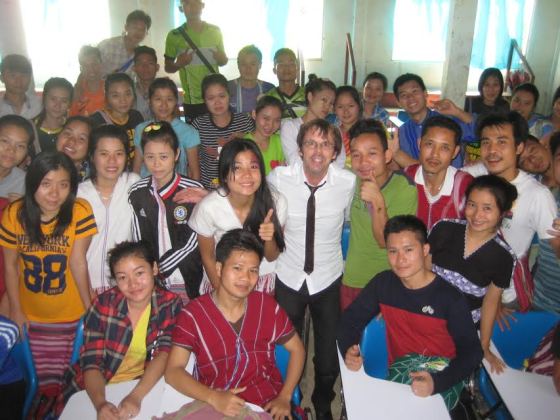
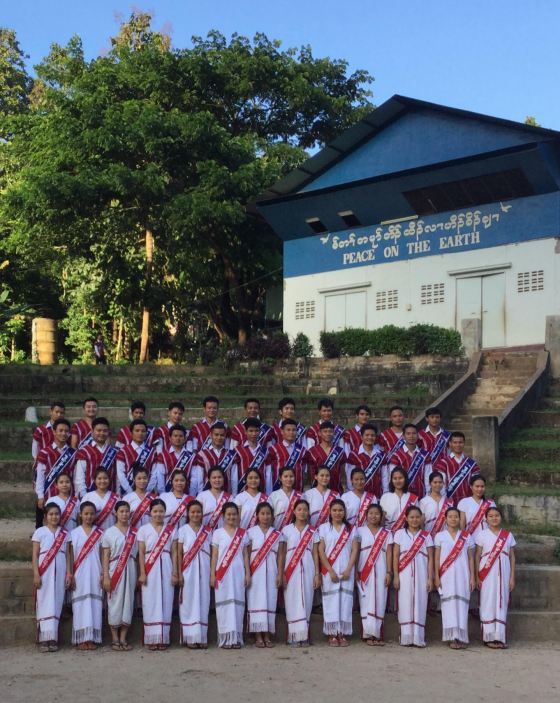
While Donald Trump was ascending to his glory, at the very moment the decisive count was being tabulated I was at the center of the universe, well that is a slight exaggeration, not the center of the universe but the world, our world – planet earth. Without question KKBBSC was for me, at that moment in time, the center of the world because since the world is round the center is wherever one is located. I was located at The Mae La Refugee Camp an hour and a half north into the mountains by the Line Bus from Mae Sot, western Thailand. I was in Section A in the camp, teaching a course on The Relation of the Christian Church to Political Power to junior and then senior students of The Kawthoolie Karen Baptist Bible School and College, one of the coolest schools on the planet!

When the score was finalized and the Electoral College votes tabulated it was midday the 9th of November and my afternoon class was approaching. To assuage my grief I held a memorial service to the campaign to become the 45th president of the United States. This memorial campaign, which had just exhaled its last gasp of fowl air before giving up the ghost, deserved in my judgment, to be eulogized. The nasty, nauseating, mud slinging, soul destroying, bellicose campaign, with all its wild and wooly claims, extending from little hands to a new great wall that will divide the Americas had come to an end. While something else was born the campaign was then and there, at that moment in time, over, finished, dead and gone. It seemed fitting therefore to immediately hold a memorial service in this tropical climate where everything rots quickly and disappears into the abyss of nature’s ferment.

Without reflection the only commentary on the life of this campaign could be none other than Bob Dylan’s refrain, or a close facsimile thereof, “something has happened here Mr. Jones but I don’t know what it is.” And this is what I did – I reflected out loud about what had happened. Setting my lecture notes aside I spoke extemporaneously for about 2 hours and mused over the campaign, sometimes using Christian and Biblical understandings as my tools, sometimes experience and reason. In fact, the truth be told, the students suborned me into this task, requiring me to say some final words for they too were confused.

The memorial service of sorts, which I did indeed publically name as such at the beginning of the class, came about sort of like a scene from an old western movie where a compatriot dies in a mountain shoot out. Instead of just riding off, someone in the gang with a conscience says “we cannot just leave ‘em lay here to rot we gotta bury ‘em”. And when they do cover the dead guy with a heap of rocks with a make shift stick cross wedged between them then they realize somebody has to say a word even if its ever so banal and terse. I was that guy. They forced it on me. The students made me do it. Their insistence however, it must be noted, was born mostly from a true affection for the USA. Karen students do not have a mere sentimental affection toward the USA born from rock and roll and the movies. More than any other country in the world it has been the USA who has welcomed Karen Refugees driven from their Burma/Myanmar homeland, held in camps inside the Thai border now for 25 years. Many students viewed the USA as their friend and a potential new homeland. Trump’s anti-immigrant Make America Great Again rhetoric echoed in these far off mountains and caused these students concern and confusion. “Will the real America we have believed in please stand up.” This is what many were saying during the campaign, and then November 9th arrived and by some luck of the draw I was there with them, and together before us the identity of the new America rose to its feet and it was a grim presentation. Not only were they confused and concerned – I was too! Here follows one of my reflections the best I can reclaim my words and thoughts.

Scripture tells us the struggle of human existence comes down to an outward versus and inward focus. Sin and agape love dual for the mastery. The primary sense of sin that comes to the fore in Scripture is that of a toxic propensity that temps us humans to turn inward to ourselves and our needs, our security and desires and to turn away from others especially others in real need. Over against this propensity there is a counter power – the Spirit from above, God’s Spirit, who pulls us out to embrace the way of love and the ethic of justice that agape love calls us to. Following this pull the self becomes downsized and ventures a turn outward where it finds it’s life in service to others in need to the glory, not of self, but of God. While the turn inward is supremely acquisitive, the turn outward is radically distributive because it turns its helps out to those in need in the posture of service and ministry. Curved in or turned out this is the struggle which Jesus and Paul made the explicit self-conscious struggle of every individual. And whilst this struggle is essentially a personal struggle carried by the individuals empowered by the Spirit and by the groups and congregations that body individuals, this struggle transcends individuals and their parochial groups and enters the worlds, cultures and polities that individuals and groups create.

While agape love cannot, and should not be directly translated to the affairs of the nation state, as if it were an ethical code that could be translated, the outward versus the inward voyage elemental to Agape is not lost. Its presence in the world does not belong to the realm of ‘good ideas’. Its presence in the world is not correlated to the life span of ephemeral spiritual ideas and pious virtues. This side of Easter it is the destiny of this outward turn to challenge and, if possible, penetrate every body and institution whether economic, familial, and political and upon penetrating its consciousness compromise, its consistent inward preoccupation. All individual and social realities must struggle with this revolution because the messiah has already come and given this revolution a historical career. It is the future of humanity, and this side of Easter it is not only coming, as in the age of the Prophets, it is present and coming to fulfillment. And while it cannot be instituted like a law or policy the power and genius of this turn outward can and must be discerned, and reflected in our bodies, not only body selves, but familial, economic, ecclesial, and national bodies the best we can. The self stands deep in these bodies, shapes and is shaped by them.

The inward focus centers all the attention on the explicit promotion and greatness of self. In this turn self narrows and becomes anxious. In fact it was Luther who wrote of this turn calling it the essence of sin. Sin he wrote in Latin is “Incurvatus in se“, “the self curved inward on itself.” From the lens of this inward focus every resource and person (or people) around it is seen in relation to the direct enhancement of oneself or threat against oneself. Self-focus, self-concern, self-protection, the security of self, as well as the promotion and preeminence of self, becomes studied, purified, streamlined into policies and baptized as a new ideology of strength. “Today on November 9,” (Asia is a day ahead in time) I told the students, “America officially and openly embraced a consistent inward focus whilst calling into open question and disparagement all of its outward, other centered endeavors. Like an immune system that becomes confused and attacks and destroys its own vitality, America turned against its own liberal magnanimity – the soul and secret of its vitality. The verve and nerve to turn outward toward needs and concerns beyond its own, to the extent such ex-centricity still existed, received a great wound. Jettisoning its outward focus and embracing a full throttle toxic inward focus the new leadership and their followers said “Let the world go to hell in a hand basket we must now shift all our attention explicitly on the nation self.” “From henceforth our platform will be about only those things that are explicitly, directly, simply, fusslessly, and immediately good for us.”

Never mind the deeper question that underlies everything else, namely whether this new ethic really attends to the subtly, complexity, liberality and humanitarian wisdom embedded in enhancing the greatness of oneself or one’s nation. Here it’s the explicit shift to make the national self’s greatness a simple, direct, unambiguous goal, as if that were possible to begin with. On the contrary, outward focus requires one to sit loose with one’s greatness, real or imagined, and to beware of the swelling and inflammation of self interest, and act out of a wide spectrum of interests where another’s good, need and plight enter into decision making and action.

Take justice for instance. Under the new Make America Great Again ethic the outward turn is viewed as an ultraistic ephemeral spirituality, fit for pious church people, but an ethic that has any business being woven deeply into the fabric of the nation state and its polity it is not. Justice – coming alongside the down and out in an effort to help restore the means of life – must now be interpreted as weakening the nation self. In fact almost every social benefit or relief can be viewed as a drain on the collective self’s economic strength. Embracing ethnic and religious differences, making room for them, and according them dignity and social space as a matter of principle, becomes interpreted as weakening the power of a more or less homogenous democratic majority (more or less – every year less). The mind set that believes that the funds from the public purse must not be used to put justice into play, in the myriad of ways it faces the nation is the opposite of greatness. It is anxiety driven and its driven by the ‘haves’  who fear their privilege will be compromised by the have nots. It is Incurvatus in Se, the national self curved in on itself.

America as a vanguard and sentinel for human rights and freedom in the world, a voice for exploited, abused and enslaved peoples, people without rights and a say in their future, is viewed as runaway liberalism, as elitist, as cultural imperialism. And most importantly it is seen as contributing nothing directly to making us great, muscularly great, nationally great and economically great and or militarily great, because it is in these measurements of greatness that the rubber meets the road in this ‘new ethic’.

November 8 decided it. The time had come for America to pull back, curve inward, and quit “saving the world” (the libel of its nay sayers). It is time, America said, to tend to our own needs and greatness. Its time to go back home and stay home and make America great again. Time to withdraw from the global struggle for rights and justice and freedom, except of course where our security is concerned. It is time to reign in the liberal notion that every difference is to be baptized and given free social commerce. These differences – do they not weaken us? This is what the majority of States ( not people/citizens) said on November 8 led as they were by one who was well qualified, perhaps qualified far above anyone else, to lead the revolt against the outward turn. For has anyone in America mastered incurvatus in se better than this new leader has, took it deeper and further than he has, practiced it with such awesome radical consistency as he. Is he not much more than merely president (one who is fit or unfit to preside over the affairs of state) but really far more the new man, exemplar man for all men and women where incurvatus in se is personified and the election of 47 percent, a collective act of erotic love.

By November 9 in the wee hours of the morning led by their new leader a sufficient majority of the states gained the mandate and said “we must now commence to circle the wagons and protect ourselves, the greatness of our country has come under many threats. We will now cease the outward venture and turn inward!” On November 9 the primacy of me, myself and I, the miserable ethic of Cain, morphed from the secret guilt of self -centered individual souls to a shameless boastful slogan of a new toxic nationalism.

Build a wall, a great wall and cast out all that weakens and threatens our greatness. Nothing captures what happened better than the great wall. It of course may never be built as it has been advertised but in my opinion it was never intended to be built as advertised. Real or imagined the wall was from the get go a metaphor for the new exclusivity that America was wrapping around itself. America had gone out as far as it was going to go and now it was time to turn inward, it was time to purge America of weakness and concentrate its strength and greatness and then protect it from contamination.

One must pause here, indulge a brief moment of reflective irony. Is not whatever greatness one person or nation approaches, sort of like the proverbial dog running up a shallow stream with a fish in his mouth. Upon seeing his reflection in the water the poor dog becomes mesmerized and confused and then thoroughly bemused, then suddenly drops the fish and lunges for the reflection losing both the fish and the reflection. I have already witnessed it, many here in the South East Asia have already realized the fish is gone from the dog’s mouth, the illusive mystery and wonder of America has gone flat! Even junior and senior college students wearing Karen ethnic wraps, living in thatch shelters made from leaves and branches perched under the cleft of a great desolate mountain out in nowhere in the rugged terrain in Tak Province in Northwest Thailand six miles from the Burma border know the mystery has gone flat – America has curved inward.

Hope is the key word all around. Hope here and now, means we Americans and friends of America renew hope that all of the peoples, agencies and religious organizations that have been turned out to the greater good, the common good, domestic and international, will not flinch but strengthen their resolve. Hope here and now means that the cries of oppressed peoples such as those in KKBBSC and the Mae La Camp, in Syria and the Syrian Refugee Diaspora and in Burma/Myanmar with the plight of the Rohingya Muslims and legends of other oppressed groups in South and Central America will be heard and real help will reach them. Hope here and now alas means that all in positions of power and wealth, including the 45th president elect and his suite of advisors and helpers, will be converted to true greatness – the greatness of turning away from swollen self interest and anxiety and out to those in need, the many real faces of need in search of friendly eyes.
unnamed-1

unnamed

The Ties That Bind: A Trilogy Forming and Renewing the Marriage Union

In a recent discussion with a friend here in New York City marriage and weddings came up. Both of us agreed that for many young people in the modern world choosing to get married seemed to be getting more difficult while staying happily united after married even more difficult. Inadvertently I mentioned to him that I was asked to perform a wedding on the 26th in Ithaca, New York for Lauren and Manuel. Upon hearing this news he urged me to shape my marriage homily out of the “Behold the Turtle” chapter in my new book. The suggestion stuck in my mind and with considerable revision and expansion I did just that. The following is a reworking of the words I spoke here reset within the Christian ethics setting that my blog is committed to.

Daniel Age, Schwartz-Pesqueira Wedding

The Ties That Bind: A Trilogy Forming and Renewing the Marriage Union

Humans are not made to be alone. No one is intended to be an island all to herself. But how to be together and stay together in a way that is mutually good this is the question and especially a pressing challenge when it comes to love and marriage. A phrase in the Lord’s Prayer provides the clue to the answer. “Thy will be done on earth as it is in heaven.” Find out what relationship “tools” God uses in his/her relationship with us humans and borrow them i.e. export them from “heaven” to “earth.”

According to the Christian teaching in the commerce between the human and the divine there are only three ways of relating that are significant faith, hope and love. Faith because God requires us to trust things unseen, hope because God makes promises to us and love because God bestows great love on us in and through Christ.

A final refrain in an early Christian poem concludes “Only three things remain (when all is said and done) faith, hope and love but the greatest of these is love.” (The Poem of Love found in Paul’s letter to the Corinthians 13:13)

Paraphrased into the modern vernacular and correlated to the subject of love and marriage this conclusion might be rendered as follows “If we take all the virtues, all the morality and all pedagogy about what is right and wrong, wise rather than foolish regarding how couples are to relate to each and throw them into the air, only three things will come down the rest will blow away.”

The ties that unite are three. Like a cord, one strand is weak, two strands are better but a cord with three strands is strong. “Faith, hope and love, these three alone remain but the greatest of these is love.”

FAITH

Faith does not have to be viewed as a religious idea for religious type people. Here I present faith to you as a very human way indispensible to healthy human relating and nowhere more than in the union formed in marriage.

Faith references unseen things, this is the very nature of faith (2 Corinthians 5:7) and in the relation between two much remains unseen that need not be proved or required to reveal itself. For instances one cannot always see the love in the heart of another, if and when it has been declared, but is important to believe that it is and wait for it to reveal itself in its own time and way. Love is a kind of freedom which when constrained to disclose itself either retreats or falters to find its truth. In this way faith protects love by waiting for it to reveal its charm and mystery whenever it wills.

The more one presses in on the other to see the affections hidden in his or her heart the more these hide and the more they become fettered and complicated. When the sun shines and the clamor and pressure subside the turtle’s head protrudes and so it is with love. When we want it the most there is no easy way out. In such times we are called to the restraint that comes from faith. In my recent book on faith and hope I have written “if we doubt what is there in another when we do not see it or discern it we weaken it and are in danger of eventually destroying it. Only a few know the radical mystery and power of trust, how it creates a positive force field in relationships. When it’s timing is right it helps call into existence the very thing it believes in.”

Faith references the unseen that is the essential nature of faith. Lodged in the other is unseen depth, mystery, uniqueness and difference – ‘otherness’. When we believe in the existence this unseen profundity and when we believe in our own fundamental short sightedness to discern it then it is we are prepared for reverence and respect for the other. Nothing is more banal than a “what you see is what you get” attitude toward life and another. Much remains hidden, much lies in subtly, beyond our grasp, understanding and comprehension.

If we form the grace of faith in our relations we will need less outward agreement in our communion, give more space for the other’s difference to manifest itself and we will suffer the abrasion this difference creates with humility. Where faith endures the mystery of the other endures. We can in the journey of life lose each other – lose the unique wonder and surprise that inhabits the other. But if we venture faith we will believe this profound difference obtains even when we do not see it shinning through. No doubt the abrasion of difference is not always appreciated but it is the freedom of difference in our relating that energizes growth, change and attraction. The dance of love begins to end just when we think we have comprehended the other.

Faith references things unseen and this includes our promises. The heart of a wedding rightly involves the exchange of promises and now and then one way or another pieces of these promises are restated. It is in the nature of a promise that it cannot be fully proved because it casts a line into the unfulfilled future. Anytime we make a promise and believe a promise we are a little beyond ourselves. Promise making and promise keeping are risky business but just so, for this very reason, there are potentially good dividends (returns) from the investment of promise making and keeping and the troth these require. Faith is the inner verve to believe and rest a measure of one’s happiness in life on making, receiving, keeping and believing promises.

Actions alone are not self-disclosing. Bob Dillon’s lyric comes to mind “something is happening here but I don’t know what it is.”  There comes a time in courtships and flirtations when we are subjected to another’s actions – actions that cause us to query “maybe this person loves me” or “still loves me”. But sooner or later actions await words without which the actions are not safely comprehended. Everybody knows how often actions have been employed in romance for subtle reasons less than honorable. In times of love we await words, and in time we give and receive words and these words name and clarify ours and the other’s actions and this exchange calls into existence our humanity in its essence. But once promises are given and received we arrive at a new place where the challenge becomes keeping and believing these words, embracing the restraint and freedom that accompanies this venture.

HOPE

Hope is the sturdiest of the three things alone that Paul the poet asserts abides, indeed not the greatest but the one that involves the most grit and strength. And this is so simply because it calls for patience and endurance. Waiting and working for ends and goods beyond one’s present reach is not easy. To weave common hopes into a couple’s relation, into their way of being together means that two become stretched toward a better future. And I submit that this better future is not merely or mainly the shape of the determination between the two united rather it is a three way conversation between (1) life’s possibilities and crookedness (2) the gifts and potentialities resident between the two united and their community and (3) the unseen power and purpose of us – God. Hopes that have a courageous rather than a presumptuous rooting emerge out of these three forces.

We go to meet these hopes but it is equally true in some way they come to meet us and bait us toward a bigger horizon of good. And this bigger horizon of good need not be conceived in merely the materialistic terms or in terms of the fulfillment of the quotient of happiness made ideally possible by a given marriage union. In this way hope, the good hopes born in any marriage union go out to meet bigger hopes for the world which Jesus Called the “Kingdom of Heaven.” We are not free till all are free. If our hopes in marriage for our own uplift do not really and truly intersect and play to the common uplift then marriage is merely a private party.

True hope expands outward breaking the parochial boundaries of solitary good to include others and greater needs. Hope is not only or primarily achieving an ideal realization of a couple’s own good and happiness drawn from their own common potentialities and dreams, its circumference must keep expanding outward to others and a needy world. Marriage is a vocation of hope carried on inside the added strength, comfort and encouragement of two united in and mutually supported by love.

But here follows the pinch of my point, the place where the rubber meets the road – the cash value and pragmatic truth about the presence and or absence of hope in our relations in general and in the marriage union in particular. Without hope we fall into the grip of the problems and pleasures of the present. And when this occurs then we either twist our lives away in anxiety or we rot and decay for these are the unavoidable consequences of the absence of hope and the presence of problems and pleasures.

Hope weaves into our relation tone, strength, verve, nerve endurance and it pulls us up and out of the morass of subjective fixation with ourselves and whether we are realizing romantic fulfillment. A quagmire awaits the couple focused on the fulfillment of their romantic subjective expectations and that communicated by popular culture. Hopes well formed give birth to objective things that must be tended to, real external things that require doing, tending and nurturing over the long haul. Hope is the mother of vocation, ethical existence and the sweat and toil of the forward pulling together of two yoked in love harnessing their differing strengths for greater goods and ends.

Dream dreams dear readers united in love – common dreams. Dream them quietly, wisely, prayerfully, daringly ever expanding their circumference.

LOVE

In this wise and poetic verse “faith, hope and love abide but the greatest of these is love” the Apostle is a sage and the sage an apostle, for here love’s supremacy is asserted without proof, its truth to be discovered by conviction and practice.

But before drawing up close to this assertion of love’s greatness I digress to ask what is this love here praised?

Is it philia – fraternal love – the love of which the French wrote of so eloquently, love of kin and kind, of shared likes and common dislikes – the fraternity created by similarity, the friendship formed by affinity? No it is not this kind of love but just because it is love and the unity of marriage under discussion here its fair game to wander as we travel toward the climax of this trilogy and for a moment inquire into the significance of philia. By taking the scenic route rather than the direct highway we afford ourselves the pleasure of a wider purview of the subject at hand. There is more than one kind of love, more than one meaning to our English word love but whilst phila is not the meaning of the Greek word love in our poem we pause to discriminate and query whether there is some fruit from this meaning that is right and good for the union entered, formed and forming in marriage? And the answer is unequivocally yes. Yes any time two or more people discover and develop common likes of whatever source or making their union strengthens. To share some common interests, beliefs, values, vocations and avocations, the ‘language’ embedded in culture strengthens a kind of unity that while not great can be a good thing. It is a generally a good thing for couples to discover and develop common ground. Friendships of this kind are not the natural or divine foundation for marriage but one should afford ever good support to support and strengthen the union marriage is and rests on. In short couples strengthen their union by developing friendships with each other and friendship results from shared likes and interests.

Is the love celebrated in this poem eros? Eros, the love of beauty and grace in the form and spirit discovered in the other not known in oneself? Is it the attraction of difference? Is it the incompleteness of self, overcome in the difference found desirable and fulfilling in another? No this love of which Apostle writes is not this kind of love. Nevertheless this eros love is real and present in our natures and is not without its significance and role in marriage. As already alluded to in the first discussion on faith the difference that eros is drawn to provoke abrasion and attraction at the same time. It is fire and ice and where it is preserved and guarded it births the challenge of community. Where this abrasion and difference is conquered unity may endure but not community – community preserves individuality inside a circle of togetherness. Nevertheless eros just because it is fire and ice, just because it is driven at such an instinctual level is subject to flux and change and does not possess within itself what is needed to build lasting healthy unions. Smart couples learn to keep eros alive without allowing it to destroy their union. This requires not only smarts but also the love of which the poem celebrates and elevates – Agape.

Agape love calls us above our root and base in nature to Spirit, beyond the drives and desires that propel the self to unite to another to the freedom to help the other, build up the other and care for the other for no reason or motivation except the good and need of the other. This love transcends self and the primacy of self-interest and in freedom serves another especially in times of need and suffering. This love forgets about self, goes beyond the myopic propensity of self’ need, want and will and finds freedom as well as emotional and psychological space to tend to another whether beautiful or ugly, deserving or undeserving, whether such costly loving is timely or untimely.

According to the Christian teaching this love comes from God because in God was in Christ incarnating servant love. “God is love,” John asserts and we learn something of this way of love by first receiving it from God and others. And we also learn something of this love’s power and freedom by practicing this way. When agape is brought into the marriage relation it fosters unity because people who serve each other and put each other’s needs above their own have no cause to divide.

But this kind of love is confusing to people. People get the wrong idea when another shows up to uplift them, serve and care for them. Pushing one’s own needs and wants to the periphery confuses people. From the outside, without spiritual discernment this kind of love concludes that weakness, the loss of individuality and self-esteem is present.

Love is about giving not getting (either subtly or explicitly).

Love unites because it prioritizes the need and good of the other.

Love is not afraid to bend under another and serve precisely because dignity and worth is grounded deeper and this ‘deeper’, Christian teaching asserts, is not merely deeper in one’s self but in God and God’s love who is Other.

Love cannot be commanded, controlled or ruled by another. It comes from Spirit, wisdom, maturity and the radical ethic of Christ to serve one another.

Love is not necessity it is freedom.

Love is not weakness it is power.

Love is not subordination it is the transformation of service drawn from the invisible wells of inner freedom.

The sum of my argument is this: Without the strand of faith woven into our relations we fall into the grip of what can only be seen, touched, felt and proved immediately and directly. When this occurs freedom and trust cease. Without hope woven into our relations we free fall into the grip of the pains, problems and pleasures of the present. Without love, agape love, woven into our relationships we fall into the grip our own self needs, plans, feelings, desires, wants and whims. These, gaining an inordinate magnitude, cause the unity of our relations to fray and tether

Faith, hope and love–these three abide but the greatest of these is love. Put these three ways of relating into play in your union, especially love, and it will become strong, enduring and it will yield much blessings and happiness near and far.

Here follows the Apostle sage’s poem of love in its entirety.

“1 If I speak in the tongues of men and of angels, but have not love, I am a noisy gong or a clanging cymbal. 2 And if I have prophetic powers, and understand all mysteries and all knowledge, and if I have all faith, so as to remove mountains, but have not love, I am nothing. 3 If I give away all I have, and if I deliver my body to be burned, but have not love, I gain nothing. 4 Love is patient and kind; love is not jealous or boastful; 5 it is not arrogant or rude. Love does not insist on its own way; it is not irritable or resentful; 6 it does not rejoice at wrong, but rejoices in the right. 7 Love bears all things, believes all things, hopes all things, endures all things. 8 Love never ends; as for prophecies, they will pass away; as for tongues, they will cease; as for knowledge, it will pass away. 9 For our knowledge is imperfect and our prophecy is imperfect; 10 but when the perfect comes, the imperfect will pass away. 11 When I was a child, I spoke like a child, I thought like a child, I reasoned like a child; when I became a man, I gave up childish ways. 12 For now we see in a mirror dimly, but then face to face. Now I know in part; then I shall understand fully, even as I have been fully understood. 13 So faith, hope, love abide, these three; but the greatest of these is love.”

I Corinthians 13:1-13 RSV