
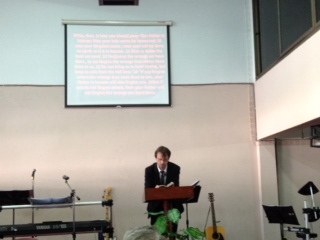
During February, by request from the principal Ben McClure, again I taught a course on Galatians this time at his fledgling school ICF (International Christian Fellowship & Bible School) in Udon Thani, Thailand (see photo below). Here follows a brief sketch of one of the main insights presented in the course. Asked, no challenged, to write something substantive about what I am teaching my students, I decided to provide the following digest. Beware it’s not a casual read. It contains some of my own arguments for and against the New Perspective on Paul.

Sanctification to God and From the World- The New Versus the Old Way:
A Key to Understanding Galatians
Reading between the lines it becomes evident that the new Gentile believers in Galatia were being succored into thinking that if they entered Abraham’s special ethnic religious family (via circumcision) and lived by the laws and ways of this family (i.e. the laws, codes and rules contained in the Torah – the first five books in the Bible) they would graduate to first class in the coach called ‘the people of God.’ A close reading of Galatians reveals that the Apostolic leadership from James the brother of Christ on down including Peter and Barnabas were still confused about the Gospel of Christ and the Law given through Moses; that is to state they had fused or joined these two. Galatians 2:11ff reveals that this confusion persisted after the circumcision decision was agreed upon in Jerusalem — but why?
I have come to conclude with other scholars that the problem is best understood by thinking about something that might be rightly dubbed sanctification — how God’s people are to live devoted to God and separate from the world. Maybe it was impossible for the primitive Church, all made up of Jews in its beginning (in Jerusalem in the early years still worshipping at the temple and frequenting the synagogue) to envision that following and believing in Jesus as the Christ/messiah also transformed the ways and means of the people of God’s sanctification from the world.
That the law would not survive intact as the way and means of living in and separate from the world as the people of God never crossed their minds. To state the matter bluntly, of course the Jewish people of God could not simply say to the world we are different, we are the children of Abraham the chosen people of God. They had to live differently and the script that guided them for living their righteous difference from the world was the Law of Moses. The law incarnated and ensured their ‘sanctification’ to God and from the world. Take the law away and they would meld into the world and lose all their difference. This equation was the unchallenged ABC’s of Jewish existence and the way they survived time and again over the centuries from the Babylonian captivity to the time of Christ and from the time of Christ through the centuries until the present time. The law circumscribed them and set them apart and living inside this circumscription according to the law’s dictates was the unchallenged foundation of Jewish people of God’s existence.
Agreeing the Gentile believers did not need to be circumcised to be saved (the so called Jerusalem Council –Acts 15 & Galatians 2:1-10) does not mean the leading Apostles, especially James the brother of Christ, had arrived at the post law, post Jewish ways and means of sanctification that Paul would pioneer. The no circumcision agreement for Gentiles was focused on circumcision as a condition for salvation for Gentiles. Out of necessity they had to deal with this question. Whether the circumcision law, which identified Jews as the Abrahamic people of God was required of Gentile believers was hotly debated (Acts 15:7) but with one accord all the leaders affirmed circumcision was not required of Gentiles to be saved. Here the Gospel logic holds strong. The primitive apostolic affirmation was simple – Jesus Christ is Lord and quoting the prophet Joel they preached “whosoever called on the name of the Lord will be saved.” This “whosoever” included Gentiles. In short at this meeting (Acts 15 and Galatians 2) it was concluded that Gentiles do not have to proselytize and become Jews via circumcision to be saved.
But there was evidently a blind spot that this agreement never focused. This was how Gentile believers were to live in the world as the people of God – this was never thought through. How were they to be sanctified to God and from the world? I remain convinced (with other scholars) that this blind spot is the substance of the problem between Peter and Paul in the incident in Galatians 2:11-16. Here Paul recounts how some came from James to Antioch and disrupted the freedom of Jew believer and Gentile believer to fellowship together even though the Gentiles had not proselytized and commenced living by the law. This is the Gentile side of the coin but it also involved a benign antinomianism on the part of Jewish believers. Jewish believers (in Antioch) had ceased to live consistently under the law thereby exercising a freedom the law forbade by fellowshipping and eating with uncircumcised Gentiles.
Here I repeat my thesis. Every red blooded Jew knew that they were sanctified to God and from the evil world by keeping the law – all of it, all 613 laws. By keeping the law they lived out the separation of their Abrahamic election. In time, considerable time, it would become clear to the church that the law as the Jews and early Jewish believers knew it and had lived under it had come to an end as the ways and means of sanctification of the people of God from the world. But only Paul got this transformation clear from the get go. He needed to in order to do his job – Apostle to the Gentiles. In Galatians for the first time in one mighty impassioned theological blow he drove a wedge between law and Gospel and pioneered a new doctrine of sanctification; that is to state, a new way for believers to live their lives in this world as the people of God. This is huge! After I completed this last class with ICF which included a survey of Romans my conclusion was that the heat from this one single but massive revolution glowed like radioactivity from a nuclear accident through the remainder of his writings, ministry and life and for years and years to come until such a time arrived that this revolution settled in as business as usual in the life of the church – but even then the church time and again all the way to the present would hedge on this revolution and the new sanctification dynamics it laid down. I invite the reader who is a weathered New Testament student to recall all the chapters in Paul’s epistles, Romans especially, where he develops the ways and means of Sanctification. What is Paul doing by what he is saying (writing) in these sections? The answer I have come to is that he is working out his new basis of sanctification to God and in distinction from the world after sacking the old basis. The onus is on him more than any other to do this because he was the guy that spear headed this revolution.
Essentially Paul is up to three main things in the little epistle to the Galatians. One he argues that the Law’s job administering righteousness for the people of God was dated from the get go and that date has arrived with the coming of the messiah. Two he begins to unpack what the new administration of righteousness for the people of God looks like – how it works. If not via Law, where does the sanctification of the people of God from the world come from? What is its modus operandi? Third he wants to show the Gentile Galatian believers, and the whole church listening to him, that this transition from under Law sanctification to his new way of sanctification for the people of God is freighted with importance. On this side of the coming of the messiah to continue to practice the law means of sanctification from the world, especially for the new Gentile believers coming on board, is to “Fall from Grace” (See Galatians 5:3,4) Here follows a brief on each of these.
(1) The Temporality of the Law as the Means of ‘Sanctification’
Despite the historical emergency (i.e. the influx of Greek culture and the ruling presence of the Romans in the Jews’ homeland) necessitating increased focus on the law to save the Jewish people of God from melding into the world that surrounded them Paul insists that the sanctification plan and purpose of the law was flawed and dated from the beginning and the time for its termination had arrived. The heart of his argument in a word is that the law was always destined to become a historical artifact when its time was up. The best the law could do during its term of office was act as a disciplinarian to God’s people until the way of faith came with the messiah. Basically he reasons the law was sort of like a type of baby sitter until the parents came home. This image of a baby sitter is close but not exact. The Law was a warden, a custodian, a “paidagogos” (3:24) – a person hired by rich people to supervise and discipline their children and instruct them in the right and proper way to live until they reached maturity. Such a relationship was necessary but not ideal or permanent. As a temporary measure it was empowered to discipline, exact righteous obligations, to curse and punish disobedience but not bless and give life (3:21). This synopsis is taken from Chapter three of Galatians. Later in his letters to the Romans and Corinthian believers he makes positive statements about the law. For instance in Romans 3:31 he makes it clear that the righteousness in the law is not swept away by faith but established and in Corinthians he writes that the commandments of God ( ostensibly those containing eternal righteousness) are to be obeyed. The two Corinthian statements I regard as peripheral statements and do not supplant the new way of sanctification he worked out in Galatians and went on to develop.
( 2) The New Administration of Sanctification According to Paul
The new way of sanctification ( the setting apart of the people from the world and to God) that replaced the old came by way of understanding (standing under) faith over against works of the law, living by and in the Spirit over against the flesh and the service of love to one’s neighbor over against existence centered on serving self. These three contrasts as brief, sleek and slender in substance as they might appear, compared to the 613 laws of the Torah, contain for the Paul of Galatians the sum and substance of the new sanctification of the people of God from the world. By the time he wrote Romans he has had sufficient time to more fully develop his new doctrine of sanctification. Reading and reflecting on this way over against the old way the first thing that is noticeable is that it is so much more spiritual rather than nomos powered ( the fruit of the Spirit is love, joy, peace…). Second it is much more ethically offensive (love as a mandate to serve one’s neighbor vs. thou shalt not) than one might expect. Most of all it is so much freer. Love takes all the rules of the law and reduces them to one way of being in the world that transcends and transforms righteous rules and asks only that one be true to love in all their relationships with others. Paul, following Jesus, is a moral magician of sorts. He throws 613 laws up into the air but only one comes down and that one inverts all the rules into a new way of being in the world. In this transformation of law into love of neighbor the robust ethical shape of righteousness is not lost but really gained. Love pushes righteousness into every nook and cranny of human relations. It takes righteousness to the deep places within the heart and motives and far beyond these to the inexhaustable varied complexity of life situations and circumstances, places that laws and rules if multiplied a million fold could never reach.
When it’s all said and done, Paul quipped, love fulfilled all the righteousness, the true and eternal righteousness that is contained in law (5:14 & 23). In fact it goes beyond it and transforms it. ‘Transformation’ indicates nothing is lost but is taken up in a new form. More must be discussed on these three categories – faith, Spirit and love – but an essential part of understanding what is invested in first of these comes to light in the following discussion.
(3) This Side of the Coming of the Christ – Messiah Practicing the Former Ways and Means of the Sanctification of the People of God from the World (Especially for the New Gentile Believers) is to “Fall from Grace”
In Galatians 5:4,5 Paul asserts all is lost if the new believers turn from freedom from the law and commence to live life under the law like Jewish Proselytes. The new and old ways of living in the world as the people of God are mutually exclusive. Freedom from the old way of Torah sanctification was real freedom not merely something spiritual and experiential – subjective.
This side of the coming of the messiah the People of God, Paul asserts, are no more under the Law that is to state they are no more obligated to live out their calling and identity as the people of God by conforming to and living by the dictates and details of the Mosiac Law. Why?
Paul’s primary argument circles around grace. The law way of living out one’s righteous separation from the world, in the context of Paul’s Galatians argument is antithetical to grace. Clearly the the context, the Galatian problem, was one in which believers came to entertain the possibility that entering Abraham’s special family and living by the family rules upgraded their religious standing ( see Galatians 3:1-5 which indicates the Galatians set about to go beyond faith to something higher). As such their move contained the seeds antithetical to standing 100% in and on grace. But Paul’s treatment of the law is more than contextual. Now that Christ has come and the Gospel is revealed he is taking the law to the wood shed once and for all. It maybe that the law – rule based way of living out one’s identity as belonging to the people of God, even when this living according to the law is deemed as the appointed way of incarnating and empowering one’s sanctification and election always contained a potential subtle antibody to grace.
In the middle of Chapter 3 at the height of his theological diatribe Paul as much as states that that keeping the law feels like such obedience can give life but in actual fact the law was only able to render a curse. Some Biblical scholars arguing for “The New Perspective on Paul” argue the Jews were birthed in grace election and the law was never antithetical to grace but merely their means of sanctification even up and through the New Testament period. This is without question true for Israel’s beginning but is it that easy? Consider the following argument. Historically if not existentially and collectively I believe the law possessed a subtle weakness which without constant celebration and worship of the gracious goodness of God, the likes of which are seen in David’s Psalms, obedience to the law crowds out grace.
Time and again the Jews forgot their election in grace and succumbed to pride. Their separation from the sinful world incarnated in their religio – ethnic difference before the exile (see Ezekiel 16 for instance) seduced them into national pride causing them to lose sight of their grace origin. Is not grace difficult to hold onto even in the messianic age and if so all the more so in its shadowy, penultimate, elementary and eschatological formulation given to the Jews in their Abraham – Sarah election and Egyptian Slave deliverance? Consider the well-known fact that after the Babylonian exile keeping of the law snow balled [commencing from the time of the return the 5th Century B C Babylonian exile onward] as a way of accentuating the Jews difference and separation in a time of ethnic and geographic pluralism. It had to. Whilst the law was never intended to become legalistic it always tempted a back door legalism. And this became all the more the case when the world encroached into the Jew’s land and cities after the exile. How were they to remain separate from the godless wicked world except by radicalizing law keeping especially the legal codes that prohibited any kind of intercourse between Jew and Gentile? But this was a damned if they did and damned if they didn’t emergency measure. Keeping the law with radical zeal surely empowered the difference they needed to remain separate but seduced them into a self (group) righteousness as it always does.
The more dramatic their difference and separation from the world, incarnated by their law keeping, the wider the door opened for the group to view itself as righteous over against the sinful evil hated world encroaching around them culturally and politically over them. That they disdained this encroachment is an under statement! The Hasidium originating several centuries before Christ was the parent of the Essenes and Pharisee both of whom incarnated a radical separation from the world, one, the Pharisees, while living in the midst of the evil world, the other, the Essenes by living apart from it. Both achieved this by radicalizing the claims of the law especially the clean and unclean mandates. This radical dualism contains within it a subtle fall from grace. The separation achieved by intensifying the righteousness prescribed in the law was drawn so tight that it finally split. An ontological rupture resulted creating a church (ecclesia) world dualism or antithesis. The good were on one side and the evil on the other, the righteous and the wicked / “sinners” (note the language in Galatians 2:15). Standing humbly in an election of grace ceases to obtain in such a climate.
Not attending to the law with radical zeal surely would have ended in the Jews absorption into the world that had moved into their national neighborhood but attending to it also had a potential down side –falling from their election in grace. In short they would have lost their distinctive Jewish people of God color. “Bad company spoils good manners”. Indeed it was a damned if you do damned if you don’t situation. And the latter damn was that there was a “new” disease in the cure. Despite the historical emergency necessitating increased focus on the law that persisted into the time of Christ and the birth of the Church I believe Paul proves that the sanctification plan and purpose of the law was flawed and dated from the beginning. The best the law could do was act as a disciplinarian to God’s people until the way of faith and grace came with the messiah. The worst it could do is blind its adherents to their origin and standing in grace. In principle the way of sanctification via the law I believe always contained the potential to compete with and polarize against grace?
Not theologians but many Biblical scholars of late seem in my judgment to have not reflected deeply on this question if they are able. Is it possible to have a law, any law that defines righteousness and set about to zealously keep it and not end up concluding either directly or indirectly that one collectively and individually is righteous in this keeping especially viewed over against those that do not keep it. Add to this scenario the effect that a weak realization that one’s origin derived from grace and one’s standing was maintained in grace? Even if a group, and here I am mainly referring to the Jews, at one point in time started from a belief that their election by God was in and by grace and not because they were in and of themselves special, what is this grace identity over time compared to the seeable, tangible, measurable, dictates of the law that tells them that they are righteous or not in their obedience or disobedience. And this righteousness need not be hyper individualistic to spoil grace. It maybe that, as recent scholarship has pointed out with regards to Paul and Galatians, more about getting into and living inside the special God blessed group and from the Jewish side of the problem being and incarnating their righteous separation from the world around them. Most likely the righteousness of the Pharisee was the tangible evidence that they belonged to the true remnant of God’s people and if so what sliver of distance is this perspective from looking inward to oneself and one’s groups righteous difference instead of outward to God’s mercy and grace election as the grounding basis of their existence- “God I thank Thee that I am not like other men” ( The Parable of the Pharisee and the Tax Collector, Luke 18:9ff).
Reading the New Perspective on ‘Covenantal Nomism” (something I started doing in the 1980’s) one would think that the human tension with grace, and here I am especially but not exclusively thinking of the first century Jews, was not subtle, deep pervasive. When did the human antipathy to grace become so banal, superficial as if it was a one size, one form fits all spiritual malady. All forms of specialness, above all religious specialness is vulnerable to pride and susceptible to grace antipathy. This is a fundamental Christian insight recaptured by Luther affirmed by the Protestant Churches in every generation since. That there was no exceptionalism and group self righteousness in fIrst century Judiasm seems total untenable. The law basis of Sanctification, especially under certain historical circumstances explicated above, I believe opened the door to attitudes of individual and group self righteousness. The mere doctrine and memory of the Jews birth in grace was not sufficient to ground their identity in grace without renewed experiences of God’s mercy and a continual pedgagogy instructing the people accordingly.The intense magnification and expansion of the law’s requirements as in the first century was a seed bed for self righteousness.
That the law means of sanctification lived on within the early Christian movement is evident. One, of course, must think kindly about Jewish believers living alongside Gentile believers in the early church in Rome who were born and bred keeping their law and in his letter to the Romans ( Chapter 14) Paul does go easy on certain Jewish believers continuing obedience to particular facets evidently derived from the law. But the Church Paul is building as Apostle to the Gentiles is on the move, headed out into the world where it must realize and incarnate a new kind of sanctification that draws its power and ethos from the Gospel not the law.
In this move in Galatians back sliding from a faith/Spirit/love basis of sanctification to a Torah basis of sanctification, Paul polemicizes as the loss of freedom. And this loss of freedom is first about the loss of faith. By faith in and through the messiah Jew and Gentile believers were already were 100% the true people of God (Galatians 3:26-29). When faith is lost only one thing remains – works (“works of the law” Galatians 2:16ff & 3:6ff). Where no faith is to be found there works of one kind or another exists. Paul is to be shammed or praised because he is an all or none theologian. If one has dropped the faith ball, perhaps unwittingly and unknowingly, it is because one has already picked up the works ball. There is no middle ground or third state of being for Paul. Faith transcends the inward appraisal of whether one is righteous in him or her self only because faith believes God’s word spoken to us through the gospel of Christ that we sinners are right with God by grace. This is the divine fiat spoken to us sinners. We humans, whether miserable or lovely (so called), are right with God only by virtue of costly grace given to all through the Christ who died on the cross (3:1 & 6:14). Faith frees us from the proclivity of looking to ourselves either individually or collectively to establish our right and favor with God and others. There is nakedness to faith. It refuses to look at what we humans might think makes us God’s darlings or God’s enemies.
Here there is spiritual freedom of the purest sort and highest value. No wonder Paul wrote “O foolish Galatians who has bewitched you.” Without faith there is works. As surely as moss grows heavy on the north side of the tree in a dark dank forest, pride (or despair) grows where evangelical faith is lost in the church (6:14). While it is helpful to know something about the first century and the language used within Judaism like the phrase “works of the law” here the meaning of “works” is clearly defined by its opposite. Faith and works are opposites (2:16ff and 3:1-14 & Romans 4:5). Faith stands free of self and lives by God’s grace via the cross (6:14) while works looks inward to self’s specialness no matter the crutches this specialness is supported on – collective incorporation into Abraham’s family and this family’s special identifying ways and rules (Paul’s context of JBF) or individual good works (Luther’s context of JBF). These two – faith and works – answer to freedom and bondage.





 existence and faith