My Name Is Nitayya And We Are Many

Both religious and secular bodies in the modern world are tuned in to human exploitation. Wherever exploitation of peoples is occurring in the world, in whatever form, there is to be found religious and secular ‘missionaries’. They show up like ants to honey and commence to run interference. Wherever human dignity, human rights, are being usurped reporters and missionaries gather in flocks mostly from European and American NGO type organizations and religious denominations. This is especially true in Southeast Asia. The modern world is ostensibly singing in harmony on this front. Human beings must not be used and exploited and stepped on. Their dignity must be protected, especially children, young women but also young boys. Included in this list are the poor as well as refugees. These and other categories of people are very vulnerable to exploitation. All mission endeavors attempting to head off exploitation are well and good to the extent their peoples, methods and motives are insightful and righteous.

When she first arrived in Bangkok from her farming village in Isan, she was full of hopes and dreams.......to make money for her 2 young children, her mother and father, help her brother buy a PU truck, to learn the ways of the Big City and the World, despite her 8th grade education.......her smile was magical, she was an astonishingly beautiful female, engaging, sexy, magnetic, no matter what she wore or didn't wear....over time the Bangkok Night gradually ground her down....and down and down....too many men, too many ladydrinks, too many hotel rooms, promises, broken hearts, human misery and desire on full display night after night after night...after almost 6 years working, she was finally consumed by the fire and heat until one day she was gone.....

Isan Girl Being Consumed by the Bangkok Night By Chris Coles

In a former teaching trek I was invited to a new seminary in Cambodia. I arrived in Phnom Penh a few days before my teaching assignment commenced in order to have a look about the city and also to work through my notes. Finding a Western breakfast spot I began to frequent it each morning and with coffee and food I went through my lessons spending several hours. One morning illustrates my ‘ants to honey’ point well. Twice during my breakfast study Western men showed up harem in tow for their coffee and toast. The first guy had two Cambodian girls about 16 and 18 then a second arrived with three gals following him like a mother duck with her ducklings in tow, the youngest no doubt could not have been older than 14. I am not a religious or secular policeman. No NGO blood courses through my veins. But he spied me off in the corner with my white shirt and black pants and brief case and became unnerved. Abruptly he corralled his teen harem and made a quick exit. Western do gooders have arrived in the bad boys playground and are spoiling the party. There are many playing fields where these skirmishes to protect the vulnerable occur. I have seen these at close range but as a spectator. My job is to think about what’s going on and seed my thoughts into my lessons. Insight and understanding are needed for reform.

In the following I point to one of the forces that I believe is driving a part of the exploitation occurring in the sex for money trade in Thailand. My language and conceptual grid is of course Western, those of whom I write are non-Western and their conceptual cultural grid would not name and explain the same realities I describe in the same way or with the same meaning. The window through which I look at and understand the problem discussed here is Christian and Western. If the reader has no tolerance for a little theology (actually theological anthropology) then there is no need to read further. Theology, as I am using it, allows for a different way of understanding the problem of exploitation of young women involved in a significant segment of the sex for money trade.

At the heart of religion and culture in Southeast Asia (especially Cambodia, Laos, Burma/Myanmar, and Thailand (Vietnam) is an ethic of reverence. Reverence to all authority is linked not merely to the cultural inertia of old traditions but merit. Merit is a, if not thee, engine propelling this ethic. Reverence as I am using it goes beyond respect and here is where my Judeo-Christian meaning grid comes into play.

Reverence in my tradition intersects the problem that the First Commandment in the Ten Commandments addresses. When the invisible but revealed Yahweh/God is not the primary loyalty humans always give their highest loyalty to a visible secondary power and/or person. This visible secondary power or person may be collective or individual, human or natural (nature). Here follows a praxis setting where this problem is discussed. It opens with a true story of a 25-year-old woman named Nittaya. I have taken care to be precise and not bend the details to my thesis.

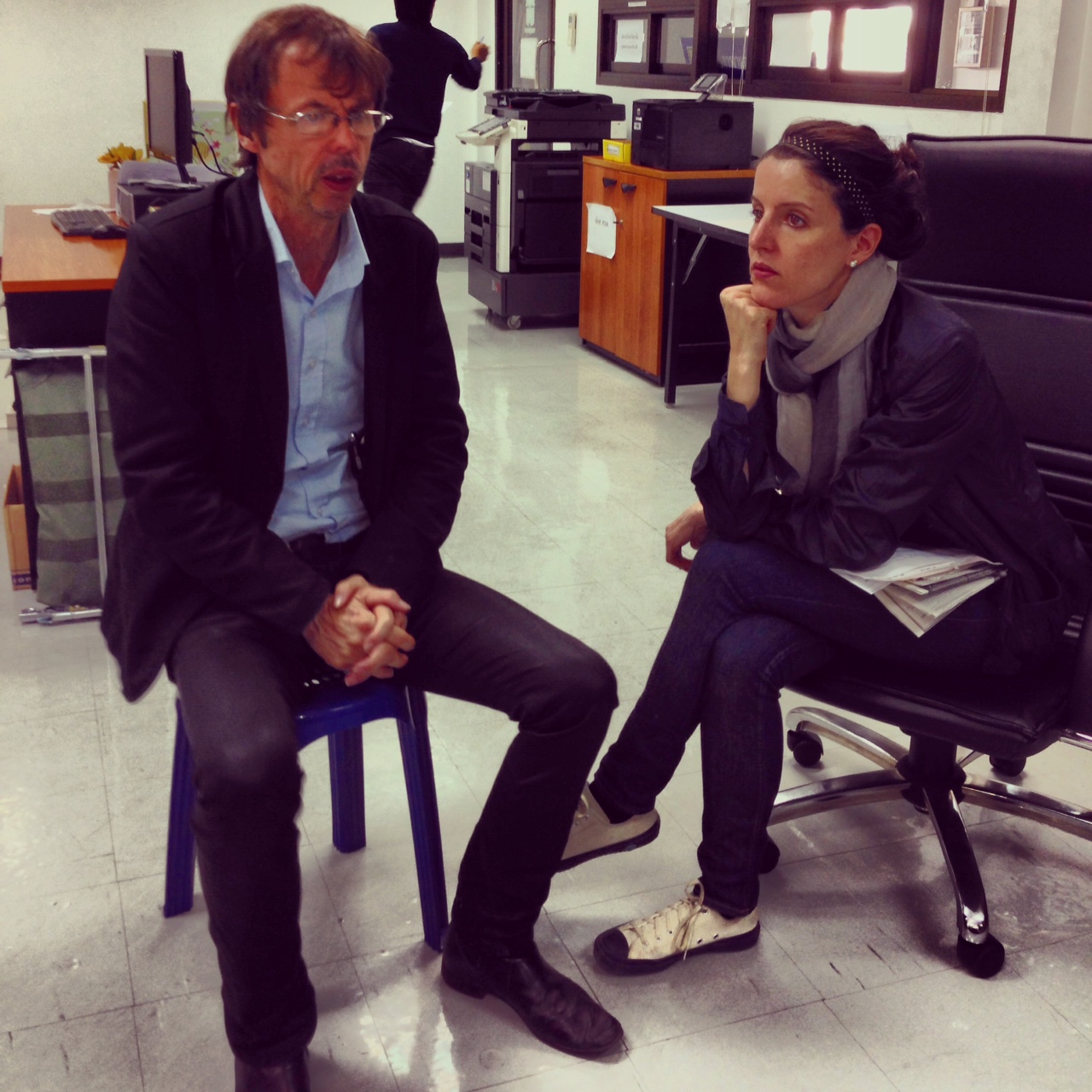
With purpose in mind, with a friend accompanying me, I went in search of a chat that might clarify some things. Success was easier than I thought. I met a young lady named Nittaya on a street in Bangkok and talked to her at length and then met with her several times again and corresponded with her. She is/was one of a few hundred thousand women working in the lucrative sex for money trade. Like many she did not chose this work it was chosen for her. She was not trafficked but merely obedient.

She is a college graduate. Her parents are middle class. Her father is a senior (i.e. tenured) teacher at the high school level, her brother holds a PhD and teaches in the university. All of her four siblings married and prospered within their middle class socio-economic standing. No economic deprivation existed but her parents picked her and arranged her future in the lucrative sex for money trade and of course they received a weekly dividend. She could leave this work if a suitor/husband rewarded the family accordingly. By her own confession she insisted that she disdained the work and wanted true love and romance and listened to western music which of course elevates romantic love.

Culturally and religiously Southeast Asia elevates the ethic of deference to the highest level, far beyond the western idea of respect to the level of reverence. The roots of this ethic come from the dominant religion, (Buddhism) which continues to inform and shape culture. Children at any age, young or older, will do anything their parents require and because it is for the parent that the deed or action is done, no matter what it is, save outright violence or robbery, the deed or action is not merely justified but becomes an act of righteousness and a maker of merit. Merit promises metaphysical benefits.

I have no mind to pick on Buddhism and ignore the problems inherent in culture and religion in the West. I would rather aim my critique at an opposite problem. If Buddhism in the East seeds an ethic of reverence and deference that can be abused, ‘human’ in the West conceived as an inviolable individual with near absolute rights and freedoms can also be abused. Lions hunt in pairs. No doubt devotees on each side of this divide view the other as the greater social menace. But here my focus is on trying to penetrate the roots of a particular problem in Southeast Asia.

Here in this ethic, benignly called deference or reverence, is a hidden player that I now believe combines with others and drives the exploitation of young women in the region. For good reason the West has elevated the idea of the innate rights of the individual and while this is catching on in Asia it founders when it comes up against traditions rooted deep in religion and culture that form in children an ethic of absolute loyalty to parents (and authority) and require children to advance the welfare of parents no matter how able and prosperous they are. This, I am convinced, is one of the invisible roots that often is a participant in the sex for money industry in Southeast Asian culture. Most often this factor, more precisely this force, behind a young woman’s involvement in this work is subtle and ‘benign’ i.e. not viewed as abusive or exploitative. Nor is it necessarily or predominately physically abusive.Mostly it occurs under a religiously engendered ethic of parental obedience and care and it does not rupture filial bonds. And it is viewed as generating merit.

Understanding this (or grasping this) I believe shines light on the weakness of secular NGO type antidotes to this problem. This is so both because their measurement of exploitation is limited to harsher more obvious transgressions of human dignity and because they often do not grasp the religio-cultural root that is in the mix. If my insight has merit, and I believe it does (not simply because of one encounter but many years living and working here in S E Asia thinking and reflecting about the culture) then simply importing a more robust aggressive human rights ethic with its premise of the inviolability of the individual has limited effectiveness. The Western dogma insists that every person is enfranchised by God and nature with life, liberty, self-determination and dignity that cannot be rightfully violated or trespassed. It is conceived as inviolable. I am suggesting that this doctrine and ethic does not and cannot travel with ease too far into many cultures in the East without coming up against another deeply rooted ethic and doctrine that weakens. if not. derails it within certain contexts. The ethic requiring children to exist in deference, reverence and obedience to their parents and to exist for their parents, because these are rooted deep in tradition, culture and religious metaphysics, easily resists the career of modern Western “values” into Southeast Asian cultures (i.e. inside the family /parent contexts discussed here).

This is why some of the roots of the problem under discussion here are deeper than economic deprivation or greed. To reduce the antidote of this problem simply to improving the economy for the poor,  better education and enlightenment about human rights and better law enforcement is not enough. The roots of the problem are deeper. Can we grasp that this problem does not vividly appear unrighteous within the cultures where it is found ? We see this movement of young women into the sex for money trade by parents as blatantly exploitative and unrighteous but many, if not most, people within these cultures see it differently. It is considered to be sort of like  ‘taking one for the team’. Or, as one looker observed, the prostituting of a daughter is like an obedient son required to lay down his freedom and become a soldier. But because necessity and deprivation may not be involved these illustrations fall short and we must look deeper into the religio-cultural dimension.

The First Commandment, while explicitly addressing God’s claim on our highest loyalty, implicitly points to the problem inherent in human nature. Where this higher invisible loyalty is missing, visible loyalties gain the highest place. Something in nature abhors a vacuum and this vacuum lies near the nub and root of the problem. The Church knows this and cannot simply merge its mission with the secular NGO type mission work, although the church no doubt should embrace common goals where they exist. The Christian Gospel is the evangelical friend of the First Commandment rooting in humans a higher invisible loyalty, which in doing so subtly makes relative (while not destroying) visible loyalties. In this relativism the real antidote, I believe, is to be found. It supports, empowers and transforms the individual ethic and it saves  mission work that is truly Christian from falling into ethical nomism and legalism that is rife in secular endeavors.

I lost contact with this young woman but she told me her story concluding with this phrase “my name is Nittaya and we are many…”

*Here follows a couple rhetorical and theological questions that I think are related to this discussion. Are we Western secular and religious missionaries simply assuming humans exist in Southeast Asia as ‘individuals’ by our definition, or a ‘universal’ definition, of what ‘humans’ are and what humanness is? And / or are we calling them to become ‘human’ by our definition. And if so can that be accomplished or fulfilled merely by an ethical campaign? Both the church and the secular world in the West and those enlightened in the East know that ‘individual’ is an imperfect conceptual construction of the human person. Even when ‘individual’ is balanced by concepts of community it fails to reach the Judeo-Christian Christian understanding of humanness. Secular definitions of human and of human rights and human freedom are not perfect, not without a serious downside. And they are not wholly synonymous with Christian understandings and solutions. I believe it is closer to the truth to state that ‘human’ is not something innate but something that is a project. And this project Christians believe involves us in a dialectic with an invisible higher loyalty. This distinction is not a novel one. Self viewed as complete in itself underpins the Enlightenment birth of this designation – individual. But many Jewish and Christian philosophers and theologians argue that human = human in relation to other/Other. I believe missions for justice, especially those that emerge from the Church must be chastened by this truth if they are not to lose their salt and become overly pedagogical, strident, judgmental and legalistic.

*Another distinction I think that is helpful in looking deeper into this problem and how it is met is to think about the difference between a rebellion and a revolution. All rebellions remain tied to that which they are rebelling against. Revolutions on the other hand discover a new truth that enables them to view the controlling party differently in their imagination. Looking at a controlling party through the lens that new truth provides serves to downsize the oppressor and open up freedom to reconceive the relationship on new terms. To rebel against parental ‘overreach’ (an overreach which I argue is one force behind this problem in Southeast Asia that we in the West call forced prostitution) is one possibility, one that I think is very rare and without a future. Another response would be for society to scold the parents and tell them they must shorten their reach and enfranchise children with more control over their own future. I am not saying this does not have merit. I think it does have some merit but it also possesses limitations and distortions because it would require a sea change in culture. What the church that is true to its Gospel brings to the table is a spiritual revolution that ‘accidentally’ undercuts the absoluteness of the position parents enjoy over their children especially as they mature into young adults.

*Another layer in this problem is the split between body and spirit inherent in prostitution, a split that is relatively compatible with much of Eastern thought but foreign to Judeo-Christian understanding. Even so this bifurcation has also infected the West coming into culture through the back door of an individualism and assertion of freedom and right that has lost its religious root. But this waits for a later discussion.
 

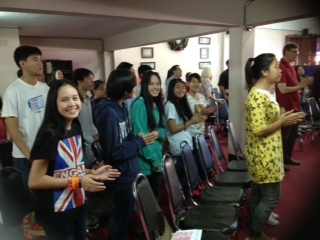
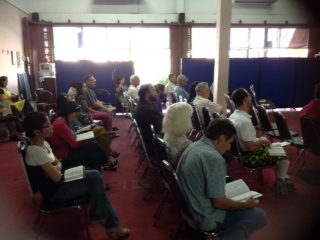
Among Hmong – For Two Weeks: Teaching Mission Report For September 2014.

On Tuesday September 2nd located in ICF, Udon Thani, Thailand 45 minutes south of the Laos –Thai border crossing at Nong Khai I commenced a two-week course on ethics.

After a bit of a shake up in Laos I had only seven students in total, four earning their BA. Most students were Hmong from hill tribes in Laos and all relatively new Christians seeking to prepare themselves for ministry. The subject I agreed to teach was on ministerial ethics. Since there are no separate ethics for any particular class of people, and because all are called to minster, I set about to apply the ethical insights I developed in my new book, “Suffering the Tension Between the Seen and the Unseen” to ministry. In total our discussion ran about 45 hours. During this time the students, using our very capable interpreter and the principle/founder of the school, Ben McClure, expressed themselves ensuring that communication was occurring. Their input and responses kept the class interesting but no time more than on the last day.

September 2014 Teaching Report

On the last day I asked the students to present their papers. Part of the assignment was to share some of their pre Christian religious experiences and reflect on them in light of the insights taught in the course. The Hmong people have practiced Spirit Worship for centuries, maybe millennia. All my Hmong students shared personal experiences about their involvement in these practices having participated in them growing up in their families and tribes before they became Christian. For this reason they resonated with one discussion more than others. In order to appreciate the students’ responses I indulge the reader in the lesson in question that I opened up during one of our classes. Understanding this lesson a little will help one appreciate the students’ response and the story retold below on the last day.

In my book I have a chapter entitled “Don’t Get Your Exercise Jumping to Conclusions.” In this chapter I show that from times eternal humans encountering events remarkably good or bad tended to jump to far-flung spiritual conclusions. For instance, Hitler having escaped an attempt on his life by underground conspirators, because a thick wooden table shielded the explosion of a bomb placed under a desk near him concluded that his survival proved God’s favor rested on his work. My argument is that faith imposes a form of blindness on us — we cannot look at events on earth (the things that are seen) and correlate them correctly and directly to the movements of the unseen God in heaven. Time to time life as we experience it directly and immediately ‘heats up’ and when this occurs we are more often then not, seduced into jumping to false conclusions.

‘Sight’ without faith, (faith that anchors one in the ‘hiddeness’ and mystery of God) tempts antimony. The physical is thought to mirror the metaphysical. True faith interferes with this ‘spiritual’ correlation. Faith respects God’s ‘hiddeness’ in the earthly sensual, physical realm not only in terms of the invisibility of God’s eternal being but God’s day-by-day activity, God’s doing. Later with faith glasses we can see a little and at least say that what has happened was made purposeful by God (Romans 8:24) but up close in the moment we surely cannot say for sure what is happening and where or how God is in what is happening. Faith means to respect the ‘hiddeness’ of God. If we don’t live by faith we trespass and get our exercise jumping to conclusions. Here the street value of faith, on account of the fact that it grounds us spiritually to a greater unseen reality and the spiritual truth of that reality, is that it prevents us from being sucked into and under our immediate experience. It gives us a measure of distance from the charm and terror of our experience.

The Apostles and Prophets via word and Spirit reveal the reality of God, the relation God has to us and the kind of life God is backing and promising. And precisely because this revelation is different than that which direct immediate experience suggests is true we can cool and minimize the impact direct experience has on us when it ‘heats up.’ Experience without faith renders us fully exposed to the emotional, psychological and ‘spiritual’ impact of the phenomena we are confronted with. Experience with faith intact downsizes and qualifies this impact and anchors the soul in something greater.

This lesson intersects with the students’ stories on the last day. At class time each Hmong student told a spirit worship story. I chose to include this one. My youngest student, 18 years old, told us about what happened when his brother died. Immediately his father offered a chicken on the family alter replete with chanting in a non-literate ‘language’ to appease angry spirits. Unsure whether this would suffice his parents went to the Hmong shaman. Because their religion teaches that death always comes in twos they wanted to be sure their sacrifice would avail. Confident that the spirits had turned against the family the shaman made his judgment. The premature death of their young son revealed that the spirit’s displeasure with their family was very great. The antidote he concluded must be commensurate with the gravity and severity of the spirit’s anger – the sacrifice of a cow! The sacrifice of a cow would likely protect them and appease the spirits’ anger.

Daniel Age September 2014 Teaching Report

The trouble with this prescription was that the family was not well enough off to sacrifice a cow. Offering a cow would ruin them financially. For this reason they turned to a friend who suggested another possible solution – go to a Christian minister in a near by village and seek help. Under financial duress they opened their mind to things they were heretofore closed. After hearing out the matter the pastor assured the parents that there was no link between the death of their son and malicious spirit activity. Essentially the pastor said “don’t get your exercise jumping to conclusions” illness and death are related to real life and health not spirits. Not convinced the parents brushed aside the pastor’s attempt to disentangle spirit activity with illness and pressed the pastor for protection from another death strike on their family. This is what he wanted and expected.

Because the belief that physical life is the playground of fickle spirits is so deep in the Hmong’s psyche he did not expend too much energy trying to convince them otherwise. He pointed them to the unseen God who was greater than all spiritual and earthly powers and introduced this God as benign, just, good, merciful and loving. This unseen God, alone above all and before all was their refuge. Worship and trust this God and your life will abide under his care.

This helped a little. The pastor was mixing spirit with truth, truth with and into the spiritual realm and engendering faith. He was painting and coloring the spiritual realm in such a way that it ultimately took on a new shape in their minds and they imagined things differently. The truth of the existence of one God, good, faithful, merciful and caring whose power was greater than all earthly and spiritual powers began to disenchant their minds and lower their anxiety.

This coloring of the Unseen metaphysical /spiritual realm differently indeed helped, but only when the pastor broke out of the language of pure metaphysics and began to tell them this worldly Gospel story about how an anointed one came from God, sent from God (i.e. messiah) to earth and triumphed over evil and death did the fear of spirits begin to loosen their grip on them. The Gospel’s flesh and blood history, portrayed in a drama of defeat and triumph on earth where a real person, in real time and events, occurred in a real place provided the crucial stepping stone out of the spirit world morass they were caught in. The ‘physicality’, simplicity of the story transpiring in real time, combined with its spiritual interpretation broke the charm of the seamless erratic spirit world they were caught in. No cow was sacrificed and in time they became Christian and with them their entire family became Christian. Conversions from spirit worship to Christ among the Hmong people are rarely individual. The whole family transitions together under the leadership of the father.

Daniel Age September 2014

The unseen of the spiritual shaped and informed by the gospel and the nebulous unseen of the world of spirit worship competed for their minds but the power of the former compelled faith and freedom while the power the latter, real or imagined, seduced them, making them fearful. Using the help of the other Hmong students and their stories I have taken the freedom to shape the pastor’s way of leading the parents to faith. The irony is that we are not really that different. A faith that is able to resist the seduction of awesome phenomena needs the word of the Gospel of Christ. In this world, this world reality, a victory has occurred. The gospel of Christ alone gives faith in the unseen teeth!

My next stop is Phenom Penh. In an up coming post I will share the details this project.

Kawthoolie Karen Baptist Bible School and College Spring 2014 Graduation

A First Hand Report With Reflections

KKBBSC Spring 2014 Graduation

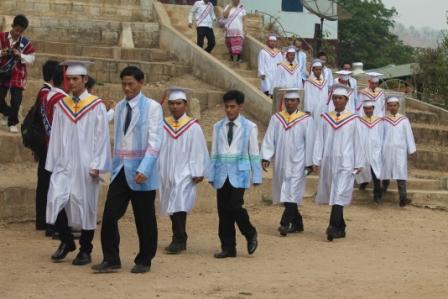
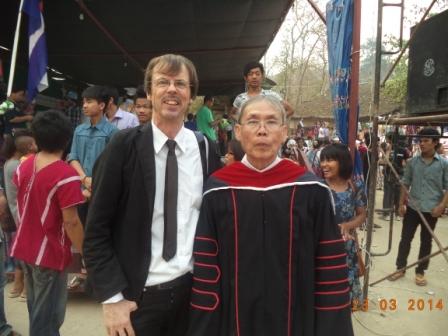
On Sunday March 22 leaving Chiang Mai I traveled 7 hrs by bus to Mae Sot, Thailand. The next morning Sunday the 23rd bright and early I boarded a pick up bus and traveled along the Burma border for an hour and half north to the Mae La Refugee Camp where I have taught many times since 2011. Kawthoolie Karen Baptist School and College (KKBBSC) was graduating their senior college students and I wanted to be present to encourage and congratulate them. The first service was at 10 AM and lasted till 1pm the second service started at 2 pm and lasted past 6pm. Seated in the congregation I was summoned to the platform where it was hotter but free bottled water was passed out. Three students spoke all toll and many adults – leader figures – honored guests from far and wide. On the platform there were VIPs so called, many seemed a cross between NGO and Church leader with a smattering of volunteer teachers and a couple preachers. These came from Germany, Denmark, Australia, Korea, Malaysia and the US as well as from Thailand and of course the Karen from Burma (most everyone present were already working in Thailand or Asia). I would estimate the entire count of persons present including students to be over 900. This being the case it was especially difficult for anyone with preacher blood coursing through his or her veins to sit down once he mounted the pulpit.

Here follows a few brief reflections taken from my 6 hrs on the platform on this auspicious day with its auspicious guest speakers and honored students.

KKBBSC Spring 2014 Graduation

1. First consider the setting. Mae La Refugee Camp is situated 65 kilo north of Mae Sot along the Thai- Burma border on the Thai side. It is nestled at the base of a great mountain with a sheer rock face and it is out in nowhere. There are no towns or villages even close. It is rugged mountainous terrain typical of the Tak province of Thailand. 50,000 refugees live in this camp their dwellings cut from the flora and fauna they inhabit. In this desolate outback approximately 70 seniors, all Karen save two or three, robed and polished, as the proverb states, “after the similitude of a palace” filled the outdoor pavilion. With all the pomp and ceremony one might find on graduation day in a great cathedral on 5th Avenue Manhattan the occasion went forward. The setting made me recall a chance casual conversation I had with a young lady sitting at the table next to me in Manhattan a few years back. She told me at long last she believed she now lived in the center of the planet – Hells Kitchen downtown Manhattan. This is where she believed culture peaked and she experienced herself on the cutting edge. I openly scoffed at her judgment but sitting on the platform the thought lit upon my mind like a butterfly delights a blossom – this, here and now, is the center of the planet. Here is why.

2. The Karen have many gifts but among their finest is music and especially singing. They not only love to sing and fill the valley with song from morning to night they have developed exceptional skill. At one point in the ceremony the entire student body rose and sang the Hallelujah Chorus. During the chorus I closed my eyes for a moment and saw the angels weeping. No words can describe the harmonic ecstasy and the sheer spiritual and aesthetic power of this moment. Where such worship occurs, I mused, then and there we find the center of the universe. This is so because in my humble judgment when such exquisite praise occurs in the midst of such hardship, there one has pushed trouble to the periphery and found the goodness of God to be the center of life.

KKBBSC Spring 2014 Graduation

3. Dr Simon the founder and director spoke of the origin of the school. Even though I had heard the story many times before it moved me again.  In 1990 having fled Myanmar for the terror of the military that was reaping violence on their land and having found sanctuary in this camp Dr Simon dreamed a dream. With three other teachers and 6 students he opened KKBBSC and now 24 years later it has 500 students. But what’s more, the military who were motivated by ethnic hatred to destroy the Karen will in the end be defeated. Because soon the Karen will return and instead of returning beaten, weakened and begging for land and a share of the means of life they will return stronger, educated their native talents and gifts developed more than anytime in the past and confident of their belonging and right. What is the saying “revenge is sweeter when served cold.” And here certainly no revenge is intended but in the dues of God, (“God laughs at the wicked” the good book tells us) what was chased out and under will reemerge more potent and resilient than before. When justice, dignity and right are violated then it is, if and when education, study and reflection are mixed with this experience, that these become stronger, more self–conscious and determined. From the black churches in America the greater church at large awoke to the Prophets and Christ’s vision of justice. The Kawthoolei Karen Baptist have a distinctive fabric of justice and dignity woven into their religion and from the church in their midst (if they will) other churches in Asia may also awakened to the cause of justice incorporating it into their evangelism. This leads me to my 4th reflection

4. Of all the distinguished and illustrious guests rich in experience and degrees no one in my humble opinion spoke with the poignancy and clarity as two senior Karen students. Each from his own perspective cast an eye upon their return to their homeland. They spoke of restoration of the land, the community and the work that needs to be done to replant and re-root their culture and nation again. These were at the same time concrete practical and visionary speeches. Never before visiting KKBBSC have I felt the imminence of the Karen hopes as with these seniors. It is as if many of them do indeed carry the burden for the return even more than the elders whose work is passing. “Young men grown up in their youth daughter polished after the similitude of a palace.”

KKBBSC Graduation 2014

5. Much was said during these speeches about the Karen nation and indeed a nation they were and a nation in exile they remain and a nation determined to be again in their homeland.  Sitting there on the platform I could not help but think of the Jewish nation and their Babylonian exile. The shape and form of their nation before and after it changed. National ‘restoration’ no doubt echoed during the seventy years in Babylonian captivity but when the time of restoration came what occurred was not simply a restoration of the way things were in the past but a transformation of it. Judaism did not go forward in the same shape it was before. ‘Restoration’ on the other side of all exiles, no matter their cause, whether personal or collective, is found and built in a new way. The old that was lost when it is reborn goes through a change and re-emerges in a new form. Judaism returned to new religious and ethnic pluralism and keeping their identity depended more upon piety and taking care of the law (Torah) and embodying the way of the law in life. From henceforth the synagogue and the teaching that occurred within it began to emerge and eventually became an important center to hold the people together. This piece of Jewish history is, I believe, very instructive to Karen people at this time in their history – perhaps even more instructive now than the Nehemiah text of rebuilding the wall – the Scripture reading for the graduation.

Add to this historic reflection and comparison the fact that when messiah Jesus came upon the Jewish 1st century scene he laid the groundwork so as to tie their ethnic identity as the historic people of God to ecclesia not nation perse. The future of nation was caught up by Jesus into the coming Kingdom of God something much bigger and broader than nation. And ecclesia i.e. the called or called out (church) became the gathering point this side of the kingdom and included all believers, Jew and Gentile and existed separate from state/nation. All confusion of church and state stand not only under the judgment of Christian history but also the ways and means of messiah Jesus. Nations do not cease to exist but they cease to be  ‘Christian bodies’. There is only one Christian body – “where two or three are gathered in my name there I am present”.  Nations who have within them genuine Christian communities (salty eccelsias) indeed benefit and are built up, strengthened and ennobled in a tangential accidental way. This side of the kingdom this is as close as ‘Christian’ comes to any institution whether it be a nation, marriage, political or social body.

KKBBSC Graduating Class

Epilogue

I was asked to speak and introduce myself in a 2-minute envelope of time. I may have by passed my name I am not sure. Having taught many of the graduating students some of my insights on faith and hope I wanted to remind them of their significance for the time at hand. So instead of an introduction I told them that if they were to fulfill their graduation commission to serve Christ they must venture what Peter did – walk on water, not literally but after a similitude. The key to walking on water I said was learning to walk by faith not by sight. With this rather abrupt cryptic message lasting 1 minute 43 seconds I sat down. Here follows my meaning that I trust will make it round robin to a few of the graduates.

Yesterday (March 22,2014 and before) you  (the graduates) were in the boat called KKBBSC. In this you were not much different than the 12 in the boat called GMS (Galilean Missionary School) under the head master Jesus. Today (March 23) you have gathered with family and friends in the presence of your teachers and elders to hear Christ bid you leave the boat and serve him in the world. In the boat you have each other close and you have the KKBBSC institution under your feet and in this boat you sing, study and play despite your refugee survival. You sing your dream song “row row row your boat gently down the stream merrily merrily merrily life is but a dream.” But now graduation has come and with it the definite word and time has come to arise and get out of the boat and get about your work. Times have and are changing for you. It is time to enlist your youth, zeal, time, strength and talents in service (with the exception of those of you who will post pone this calling and go on and study more).  Like Peter, Christ bids you to get out of the boat and serve him in the face of humanity.

The boat symbolizes a degree of security. It is under you and saves you from being submerged in the often troubled waters beneath you. Some of you when you grasp the degree of the challenge ahead will say Lord just let us stay together and row the boat where you want us to go, others will say “give me a bridge Lord.” “Lay up a bridge and I will walk over it and go where it leads and there serve you.” But in the call to serve Christ bids you like Peter to abandon the security of the boat and walk on water.

KKBBSC 2014 Graduation

If you are to get anything done for the Lord, if you are to make your way in service and be fruitful you must now graduate from life in the boat to life walking on water, that is to say you must forego the luxury of having a clear, strong, firm and secure foundation under your feet thereby upholding your journey. You must forego your predilection to first have in place all the material needs to get the job done; forgo having a firm foundation under your feet. No, to truly serve and obey his call you are and will be a little beyond the safe zone, beyond your means, beyond your native strength, beyond what hard logic and good common sense dictates and beyond the measure of competence that the preparations you have made heretofore equip you. And here in this place all that is solid melts into air and water and here you learn and relearn to trust something that cannot be seen, touched or felt. And when you venture forth without having all you need to hold you up then and then only have you graduated. Even so be sure all of us without exception fail and graduate over and over by the grace of God. We all hanker after a material foundation under us before we go forward, often demanding it in vain from God and others.  Yes where opportunity puts helps, better preparations and supports within your reach do not be foolish, avail yourself to these but know one thing for sure – again and again God calls us out of the boat onto the water to get us where He wants us to go, do what he wants us to do and become what He wants us to be.

Look straight at what is not there, what ‘should’ be there, look directly at your lack of good support and the lack of material economic subsistence under you and your lack of thorough preparations and this absence will gain a negative spiritual magnitude will subdue and overcome your faith and destroy it and you will retreat. Sooner or later in life we all must learn to walk on water else we will either sink into despair and retreat or we will become graspy, demanding and forceful, ways far from the Kingdom of God that Christ has sponsored.

“Underneath are the everlasting arms” so reads the good book but most often you and I cannot see, touch or feel these sturdy caring arms. Courage, duty and Christ call you beyond feeling and sight to go forward on by faith alone and lay up good work and efforts in service to Him and his kingdom.

Together with you in His service,

Daniel Age
Teacher of the Gospel of Christ and Way of Faith

KKBBSC Spring 2014 Graduation

Photo Essay: Dr. Dan’s Teaching Visit to Hill Light Seminary

From February 2nd through February 14th I was invited to teach the third year students at Hill Light Seminary. This was my first visit to Hill Light, a Karen Seminary, about 25 kilometers South of Mae Sot Thailand along the Burmese border. The school was recently established five years ago in the wake of the Karen diaspora. The school serves around 80 Karen Baptist Students from ages 18 to 24 all Myanmar refugees. By request I was asked to teach an ethics course based on my new book. What follows is a photo essay documenting my experiences at Hill Light.

1. These first two photos are from the Burmese Market a large open market dominated by Burmese immigrants, legal as well as undocumented, who have crossed the border into Thailand. Every morning almost before the roasters crow it is a teeming chaotic throng. My Bus to Hill Light Seminary left from this location.

At the Burma Market
At the Market-
2. The photo below is another shot at the Burmese market – the blue pick up with the cap is a bus, my bus which took me to a place called Ban Mae Kon Ken and from there I took a motor cycle taxi to the camp. Total Cost – 30 Baht per ride ($1.80)
Burmese Market Blue Line BUs

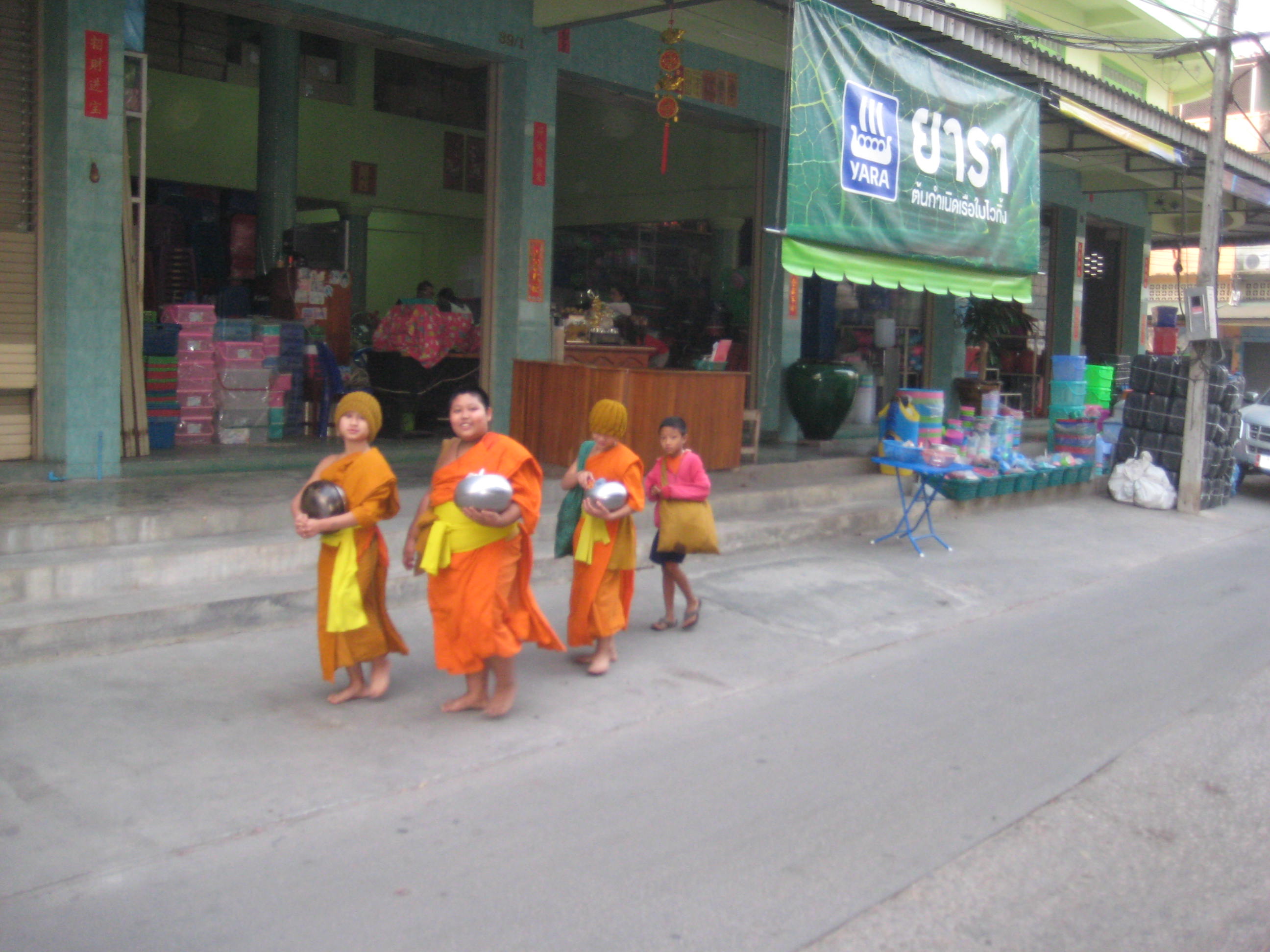
3. This next shot I took from my bus in route to the seminary as we were leaving the Burmese Market. It was about 6:30 AM and these young monks in training were out for to give the local Mae Sot citizens an opportunity to acquire some fresh merits by supplying them food stuffs – mainly rice. The big fellow, not yet fully groomed and cultured in the soulful monk decorum sported a wide gleeful smile for me.

On an earlier occasion walking on an empty stretch of road I passed two young monk candidates about 9 and 11 years of age. As I passed my phone rang but I had set the ring to a frog tone which in the early morning air sounded true to life. The eleven year old remained expressionless and didn’t blink but the nine-year was over come with amusement and burst out laughing.

On the way to Hill Light School
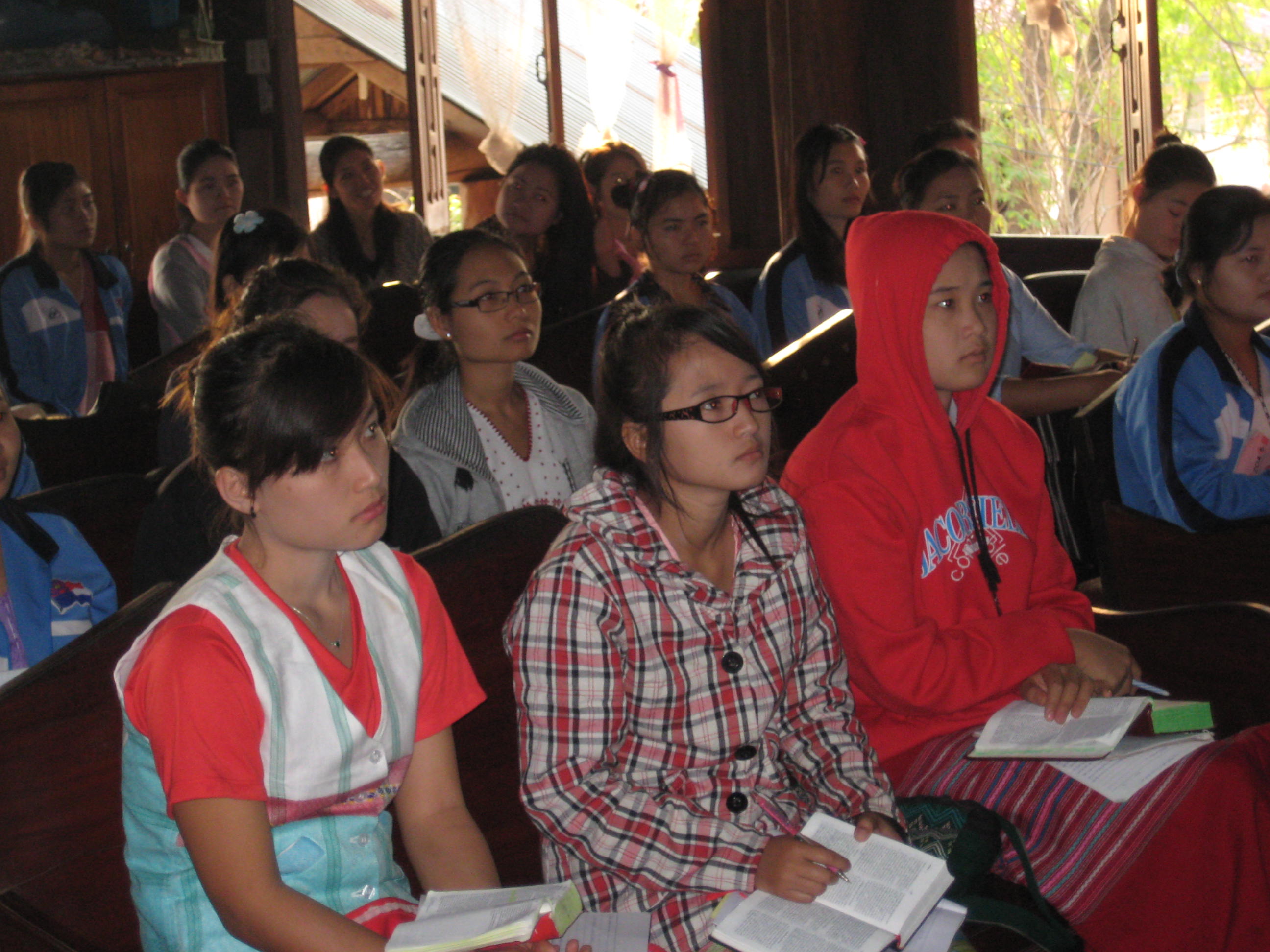
4. The next picture was taken at the general assembly which meets every Wednesday morning at 8 AM. In the early morning it is still cool this time of year in Northern, Thailand so many students come bundled up. I am speaking on a New Testament passage which the director requested. These are all 18 to 24-year-old Karen students from Burma who have come across into Northern Thailand seeking sanctuary from in the Myanmar military who invaded their villages killing, abusing and plundering. Myanmar is changing and hopes are high that a return from exile will soon come.

General Assembly Hill Light Seminary

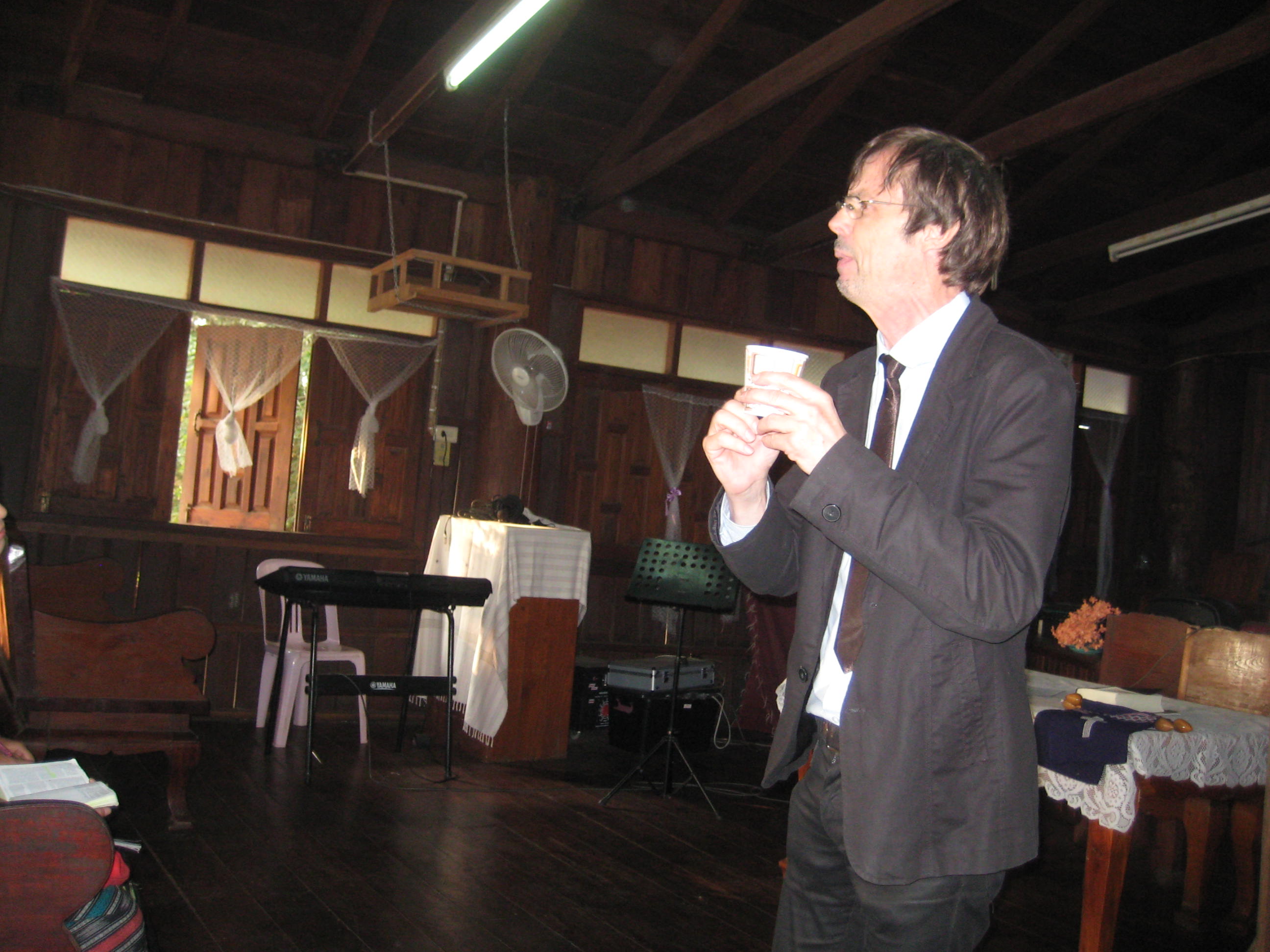
5. I was asked to preach at the Wednesday morning General Assembly on Colossians 1:15-23. Colossians is about fullness – “pleroma.” Holding a cup with water I opted to introduce the point by asking the proverbial question “is the cup half empty or half full?” After sorting out how many pessimist and optimists I was preaching to I proceeded to make my point. The Colossians were being suckered into a religion in which they were told that they could realize pleroma i.e. “fullness” here and now. But in this letter Paul’s testimony can be heard. Christ was indeed filled with all the fullness of God (2:10) but here and now we, on the other hand, suffer much emptiness and only enjoy a small measure of this fulness of the Spirit and life (just a taste of this promised fullness of Hebrews 6:5, Ephesians 1:12 & 13). By faith and hope in and through the Christ we are regarded as full (1:27 & 28)but when the fullness of time comes we will indeed enjoy this fullness in reality full and over flowing.

Now we suffer faith and hope – faith connects to unseen things as they exist by promise and by the word of the Gospel that declares the existence of unseen and even things not felt and experienced directly to be so. And hope lives with a measure of emptiness and suffering with courage waiting for this pleroma. We like the Colossians are tempted to break the tensions inherent in faith and hope and sucker after pseudo fulfillment, spiritual and secular.

Hill Light Seminary Daniel Age
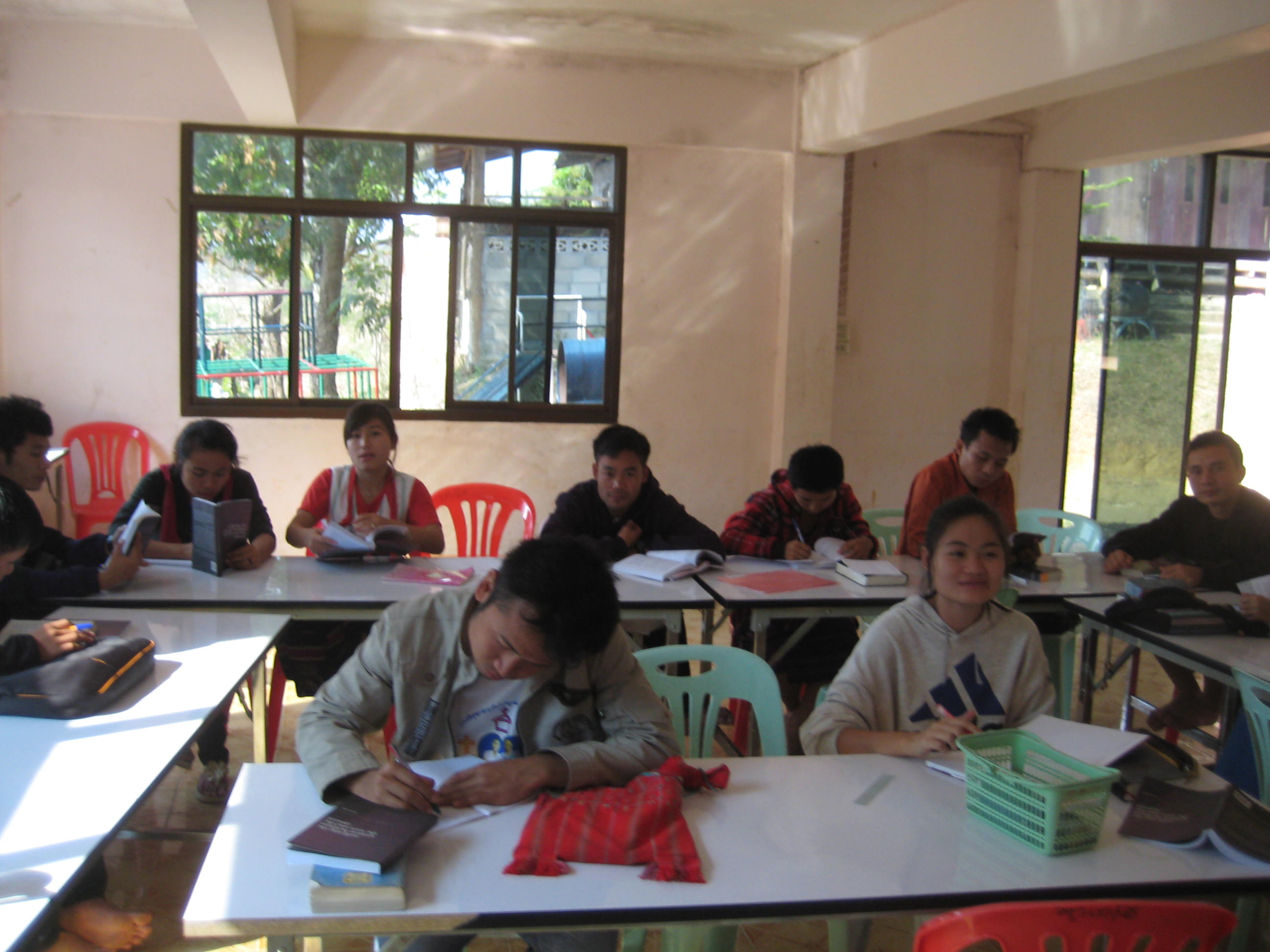
6. Here is a shot of my class of third year students. The actual campus is really very beautiful, sitting on a hill-top overlooking a fertile valley. The campus is situated inside an old Karen Thai village called Kway Nam Ku. The building housing this class room, one of seven rooms, was donated by Korean Christians who retain the title and a degree of control over its use.Note the young lady in the front. Before her lies a copy of my book – a gift to each one who came to class and did the assignments. Fifteen students received books (I am in search of donors to back the cost at the discounted student price of $15, please email me if interested).
Third Year Karen Students at Hill Light Seminary

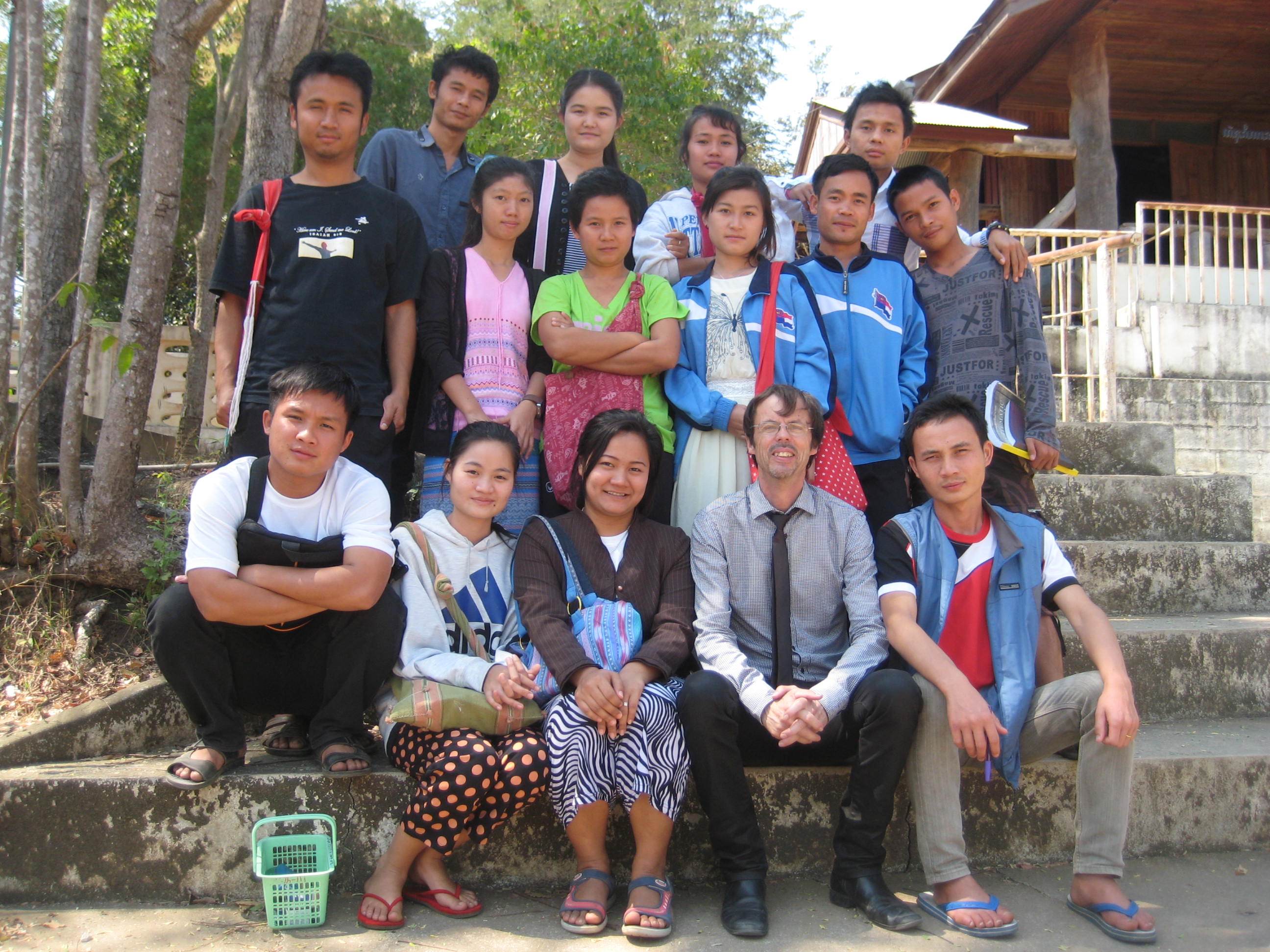
7. Below is a photo of my class and I on the last day of the seminar along with some of the feedback I received from the students on the lectures .

“I like this book very much because it provides many examples to understand. Jesus also used examples in His teaching.We don’t fully understand God and His ways, sometimes not even a little. But this book opened my eyes to walk by faith and not by sight (blindness is not a big deal).” Thit Sae

“I learned so many things from these lectures. Two weeks are too short of a time but we received an advantage from this time….This was strong spiritual food. It encouraged us to deal in God. It also encouraged us to steady our faith… Today we face many challenges and we know we can overcome these when we walk by faith not by sight…” Hsa Klay

“In this class I learned about faith and sight, faith and sight you explained very well and I understand more. I like this class so much because you tell us the teaching using short stories and then I read the chapter in your book which follows the lecture. I want to say thank you that you came and taught our class may the grace of the Lord be with you… the blessing of the Lord over flow you.” Naw Moo Christ

Daniel Age with Students at Hill Light Seminary

New Teaching Invitation at Hill Light Seminary

I have recently received and accepted an invitation to teach third year students at Hill Light Seminary at Klee Thoo Klo (Huay Nam Khun) village which is seventeen miles south from Mae Sot, Thailand. The appointment commences on February 2nd.

Hill Light is a new seminary that has been in existence for only a few years. It has an excellent reputation of being well run with good student teachers from Naga Land, India as well as local Karen teachers and excellent leadership. Hill Light trains Karen Baptists from the “Golden Triangle” many exiled from Burma.

Attached is a picture sent to me of last year’s students. This will be my first time teaching at Hill Light. I have been asked to bring my new book on faith and ethics and lecture from it. I will have 15 students. If any one would like to purchase a book for a student at the Southeast Asian student price of $15.00 per copy,  please email me at Daniel.Age@gmail.com for more information.

Hill Light Seminary 2013

Sunday’s Preach

On Sunday January 12, I preached on the Lord’s Prayer at the International Christian Fellowship in Udon Thani, Thailand. Here follows a small piece of that message and a few pictures. Following these thoughts are my notes on a new educational endeavor taken from a discussion with the Pastor Ben McClure, the director of the ICF and founder of their new Bible College.

Sunday Preach

7 “And in praying do not heap up empty phrases as the Gentiles do; for they think that they will be heard for their many words. 8 Do not be like them, for your Father knows what you need before you ask him. 9 Pray then like this: Our Father who art in heaven, Hallowed be thy name. 10 Thy kingdom come. Thy will be done, On earth as it is in heaven. 11 Give us this day our daily bread; 12 And forgive us our debts, As we also have forgiven our debtors; 13 And lead us not into temptation, But deliver us from evil. 14 For if you forgive men their trespasses, your heavenly Father also will forgive you; 15 but if you do not forgive men their trespasses, neither will your Father forgive your trespasses.” Matthew 6

Prayer forms us before God and others in a particular way. We are changed from the outside in as well as the inside out by prayer. Form changes spirit just as spirit changes form.

In Matthew 6: 7-14 Jesus is transforming prayer. In his hands prayer is undergoing a decided change. Of course Jesus didn’t invent prayer nor did his earthly progeny David the struggling suffering shepherd Psalmist in his perilous route to the throne. Both did a lot of praying and left their mark on prayer but prayer had been around from times eternal. Almost certainly prayer emerged in history arising from those experiences, times and intersections in the human journey when humans found themselves between a rock and a hard place beyond the measure of their puny resources. In these intractable circumstances humans have always turned to higher powers however they have conceived them. When the Jews emerged into existence under Yahweh prayer went through the monotheistic purification and thanks to David, became filled with great praise as well as great passion looking to and trusting in God for help in these times of need. Despite all that David did to prayer teaching us to mix praise and confidence into our prayers in the face of trouble Jesus does something even greater

Pray “Our Father”

God and father may seem as symmetrical and logical as a lame man and a cane, as a fireman and a red ladder truck, a glove and a hand but this linkage exists only because of Jesus. It is true faint roots of this father identity of God can be traced back to the Old Testament but in Jesus’ hands it is magnified, expanded and informed. Coming to God as father transforms the one praying. Inside this basic furnishing of Jesus prayer we discover ourselves before God as son and daughter. Inside of this identity we belong, we are included in God in a particular way and just so if we are true to this form we commence to embody the proprieties that come with being a son and daughter. These include confidence, a God given dignity and freedom and imbibing the fresh brisk air that we belong. We do not earn our merit our placement with God it is our God given dignity. In giving Himself to us as father he gives us free rightful access to him. We are included in God and the circle of God. We stand and kneel praying and living inside the circle of belonging because God has shown up in and through Jesus as our Father.

Like oil in one’s bones in times of trouble using all manner of spiritual, moral and religious devices humans attempt to get into the inside circle with God where his helps can be readily accessed? Prayer that is full of fret and fever, beset by anxiety of an orphan and driven beyond oneself to promise making (most often which are ropes of sand), prayer that seeks out the holy, person, place or thing through which to mediate one’s petition, prayer which enters into intense spiritual machinations and bodily sufferings and restrictions to bend the “reluctant” hand of the Almighty all betray that the ones praying are wearing the primitive pre-Christian prayer suit. In these two words “our father” Jesus is clothing us and our praying with confidence, freedom and the dignity of a son and daughter beloved and included in the Father’s care.

Do your and my prayers betray spiritual machinations to get inside the circle with the Almighty in order to gain some leverage with Him or do they reflect the freedom and confidence of one who is by the grace of God already inside that circle? Or maybe neither, maybe we stand outside looking in wishing we had a way to the Almighty’s care. Here follows my definitive word ‘You can’t get there from here’. We start from inside because that is where we find ourselves saint, sinners, the good, bad and ugly!

If the shoe fits wear it and if this prayer shapes and forms your humanity before God in a way that is right and good then go with it. It is Jesus’ gift to you. Not because of our own righteousness nor by natural birthright, but by grace in and through the Christ – messiah, God made his way to us as Father. “Father” is costly grace, an adoption maneuver and just so when we, wandering nomads and orphans, utter this appellation it is our doxology and praise and the frame and prelude to all our petitions. Instantly we are no more alone – God is our father and we, looking out through this prism of truth, begin to see many brothers and sisters all around us.

“Our father” is the big deal in this prayer…

photo 2_2

photo 2

photo 4


A New Christian Bible College Comes Into Existence In Udon Thani, Thailand

The following is taken from my discussion with Ben McClure director of  International Christian Fellowship (ICF) and founder of ICF’s new Bible College.

Pastor Ben started working in Laos 20 years ago. Christianity is limited to three official expressions in Laos, Catholic, a branch of the Evangelical spectrum of Protestantism and the Seventh day Adventists. Any other Christian group was and still is not allowed the rights of assembly. These three groups persisted from an earlier period by virtue of their pre-existing establishment before Laos became communist. Working under an NGO status doing teaching and beneficent work by day and meeting and teaching Laotians the way of Christ by night had its limitations – there was no good way to build believing communities. Their NGO status was closely monitored. Just across the border in Thailand religious liberty existed. This led to pastor McClure’s call to ICF in Udon Thani in the northeastern sector of the country and building the multicultural congregation that exists today. But part of Ben’s heart remained in Laos and this affection led him to start the Bible College. Now with about 10 students, many from Laos he has commenced classes. He has a vision and a fine partner and many native helpers to see it forward. He has his eye on purchasing land and piece by piece, the Lord willing, developing a school where students can become bi-vocational missionaries, going out with the ability and training necessary to plant churches leaving their training period with both a BA degree and the ability to support themselves and support their mission work. It is his hope as well that in time and in a rural location the school will be self-sustaining by developing agricultural horticultural endeavors. I assured him that from time to time I would bring my short-term intensive courses to help him as I have to other fledgling educational endeavors in Southeast Asia.

Photo: Pastor Ben McClure with members of the International Christian Fellowship

Image

The Bengali Angel and the Miraculous Acquisition of the Book.

Image

Bangkok, Thailand

Suffering the Tension Between the Seen and the Unseen, the elusive book I have made claim to writing is now in my possession! Via Air Asia it made its way from Malaysia to Thailand on the 21st of December but rather than arriving at Udon Thani as planned, it was mistakenly routed to Bangkok. But I could not reach Bangkok until after Christmas. Truth is stranger than fiction. Here follows the story of the Bengali Angel and the acquisition of the books.

Image

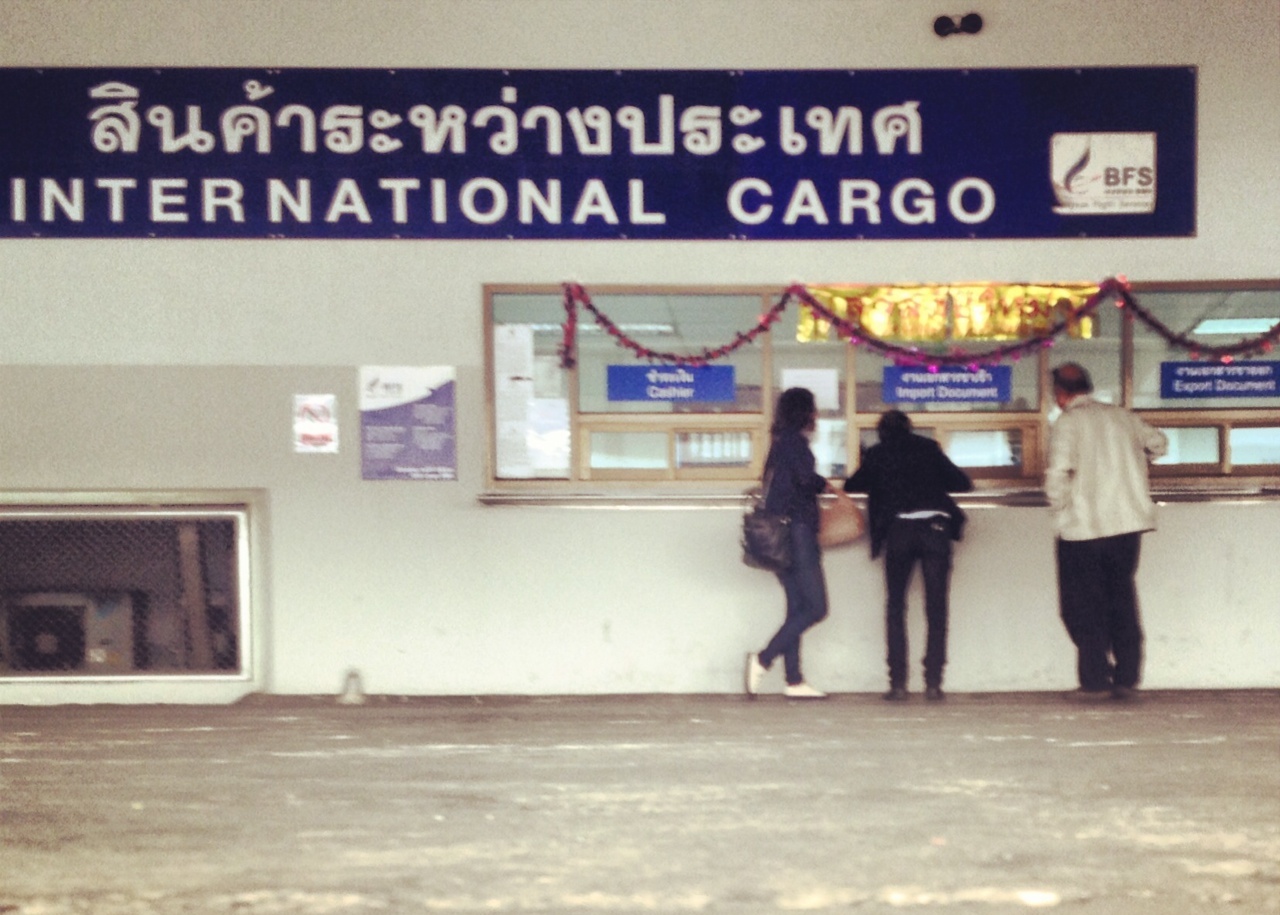
The Lord used my new friend the Bengali Angel to move the hearts of Thai Customs. Anything I write about the difficulty gaining possession of these books is an understatement. We arrived on the 29th at International Cargo and after four calls to our absentee interpreter Nurse Rittiwong to interpret we left with instructions to return tomorrow. Bright and early we arrived the next morning only to be told that sometime between the time we left the day before and the present moment Thai Customs had decided to add an additional day to their New Year holiday calendar. “Please come back January 2” They said. “No one is here to process your books through customs.” We met a wall of resistance.

My pleas and Pearl’s (daughter) were met with “we are sorry, no way possible, today is now a holiday,” and with this epitaph the man who had come out to meet us from behind the window walked around a corner to disappear into an office deeper into the warehouse. At this moment the Bengali Angel mounted wings and barely touching the ground flew after him and lighting upon him smothered him with gentle pleas insisting that his professor Dr. Age had only one day left to receive the books before proceeding to his next post of duty.

Meanwhile I was pacing the loading deck in incoherent circles muttering insulting prayers to God. Since the shipment, bad luck had followed hard on my heels.  By now my bad luck in obtaining the books had cascaded into a domino effect of ill luck. Chiayee and Dr. Ong from MBTS seminary had pulled out all stops to insure the books would reach me by Christmas and they delivered and they arrived on time! But whilst they arrived in Thailand on time for no fault of theirs they arrived at the wrong cargo depot in the wrong city.  By the time I caught up with them they had been in storage 8 days. Events had side swiped all possibilities of receiving them before Christmas.

Soon Som, the Bengali Angel, came flying back around the corner and seized my computer where the shipping manifest was and disappeared again. He had managed to insert a little wedge in their determination to send us packing without even a chunk of coal in our bags. There were a few customs release agents preparing to depart yet in the office but the big boss had left. The authority to proceed was missing – what to do? Perhaps he could be reached by cell phone, Som reasoned.  Soon he came whipping around the corner again and secured my passport and disappeared. We began to sense that a small window of possibility may be materializing, but we had no free confidence.

Image

Reckoning the passing of time, the matter easily remained suspended in an indeterminate state of being for several hours. The first serious evidence of which way the wind was blowing was that Som returned to fetch me for an interview about who I was and what I was doing in Thailand and the nature of the writing. Debriefing me on the short walk to the lead assistant we integrated our stories that was basically true. By now they had studied my international movements recorded on my passport. The first question was “What was I doing here in Thailand and whether I was selling the books here in Thailand?” Evidently my answer seemed relatively benign so they proceeded to inquire about the books and their content. Casting about for a response I remembered a line from Luther when he was asked by Charles the 5th at the Diet of Worms about what was in his books and he said, “Well these books help people live better lives.” So I said, “My book is about helping people be good people and it is about ethics and faith.”

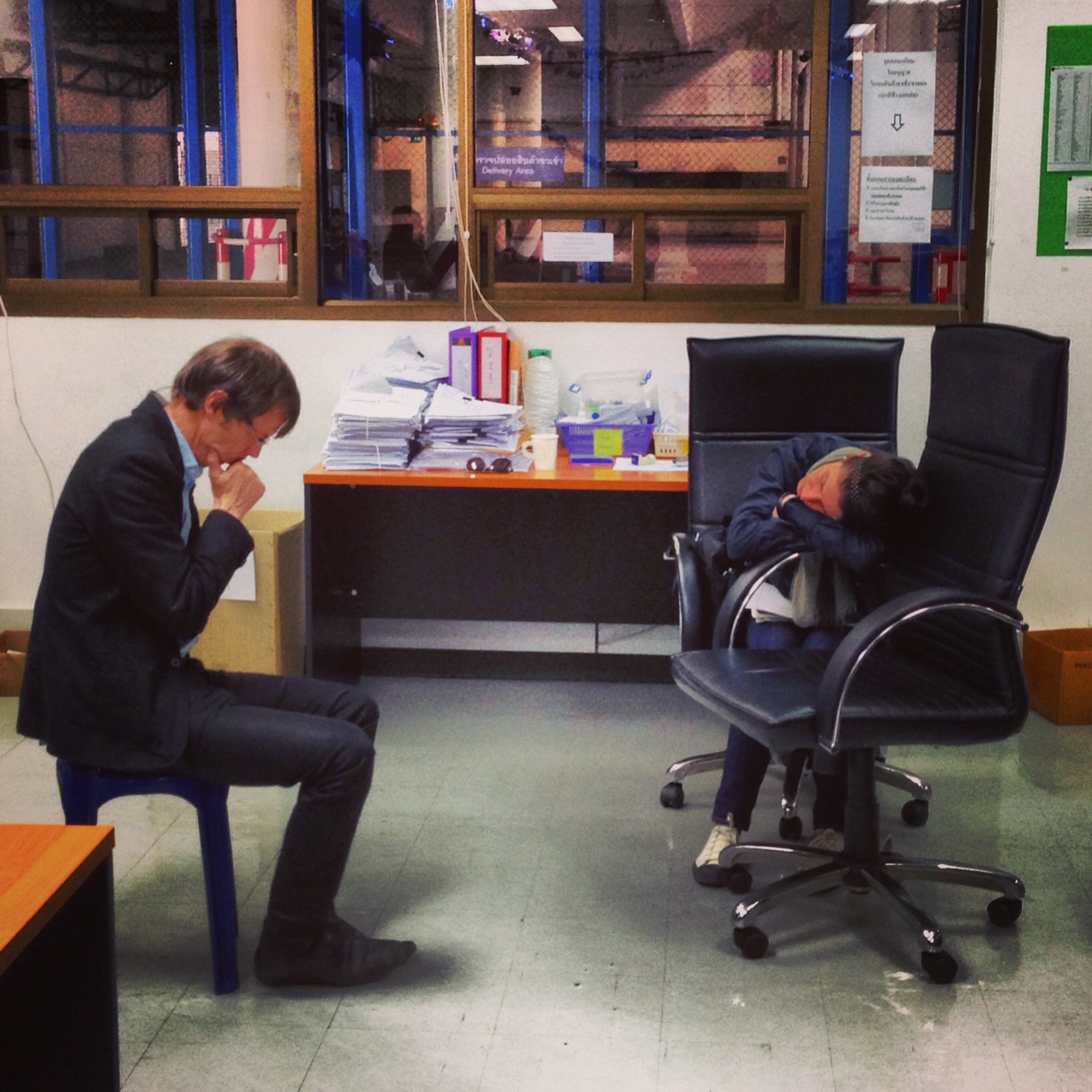
By this time Pearl, Som and I had taken up residence inside the Customs office where four female assistants were being ostensibly detained from their holiday. If one were writing this tale as fiction almost surely one would compose a climax at this point in the story. But in truth no climax occurred for 5 hours. Evidently some phone calls were made and we noticed two assistants were conferring frequently and then the forms starting materializing and signatures were requested. Then we had to determine the value of the 17 boxes (500 books) for a tax we would pay if they released them. Pearl was bold ­– she said were weren’t selling them in Thailand and had not paid to have them published so the only measurement of value had to turn not by market sales but how much it cost the publishers to print and ship one copy. Using this we put forth a ridiculously low value of 50 cents per copy.

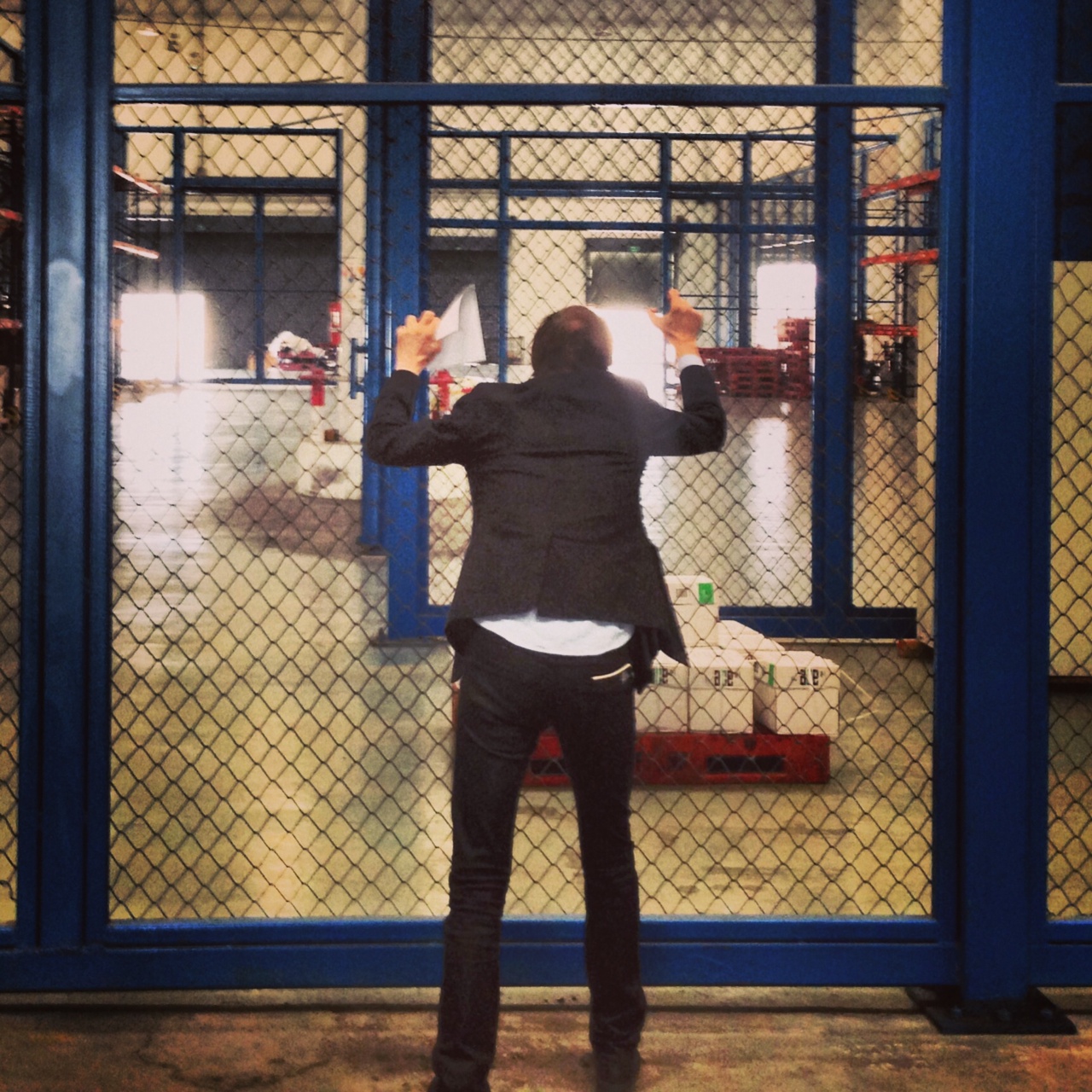
Time was passing and by now we had been in the Customs office for 3-1/2 hours. Recently in Bangkok and all over Thailand, political protests have been roaring. They are almost surely on the verge of their 12th coup since trying democracy. Was I bringing politically charged material into Bangkok to fuel the fires of protest under the guise of a “spiritual, be a better person” glove? The lead assistant that emerged to broker the release process was a young pleasant Thai woman but sensing the buck would stop at her desk if she allowed the divisive material into Thailand she made a call to the for the boxes to be brought from deep inside the warehouse for a physical examination of the book and its contents. I had not seen the printed copy up to this point so we all walked to the fenced in warehousing section, a button was pushed and the gate went up and out came all my books on a pallet carried by a lift truck.

Image

She opened a box and began to examine a copy. Pearl, Som and I had our first gander. I had a little rush but it was still too early for jubilation. The assistant studied the title and looked at the table of contents and then replaced the copy and walked toward the warehouse. Pearl who was doing a quick review was told to replace her copy. I also put my copy back into the box. I studied her face to see which way the wind was blowing. On my word I must report she had a very weird look on her face. I knew what she was thinking, “whatever this book is it is not what I had thought it was.” She seemed a little out of joint, not in her attitude but in her understanding about the book and of me. Thailand is 99% Buddhist and my subtitle has the phrase “The Doing and Undoing of Christian Faith, Religion, Ethics…” It was if she had swallowed an awkward shaped bite of food without chewing it and we did not know whether it was going to go down or come up. The forklift wheeled the books back behind the high-gated fence. Now there they were visible but out of reach.

Image

We regrouped back in the office. And slowing we could sense the tide was not going out but coming in – the tide began to turn in our favor. Forms were delivered to us.  Som, true to form, acting as an intermediary moving back and forth, brokered our questions about how to fill out the forms. They liked dealing with him. He had a tenacious disarming way with them that was far more compatible to Thai social decorum. So called falangs (Westerners) are often subtle as a train smash, but Som was cut from a different cloth and his Bengali accent and wry smile teased their charm. By the end I believe they were leaving many gaps in the process just to enjoy his mediation.

At this point I was summoned to the elder woman’s desk to sign and pay the first of four fees. At the elder woman’s side was the younger assistant. It was at this moment she glanced at me and nodded affirmatively “the process will be completed today” she smiled. With this news we took a walk to the main terminal and ate a 2 pm breakfast with zest.

In all toll I signed my name 37 times and we collectively emptied our pockets of over 5000 Bhat. When the books came through the gate to the loading dock the Thai assistants openly shined on us. In truth, they all blessed us with grace and warmth. When all was said and done, it must be said every single person in the whole process, about nine in total from both departments, was warm and gracious and rejoiced that they had succeeded in releasing the books to us.

Now we knew the “gods” of resistance had been defeated and that whatever challenges remained could not stop us. We had two simple tasks left – get 17 boxes of books from Air Cargo Don Muang Airport to a place of temporary storage. Pearl flagged down a four by four taxi with just enough room for three people, 17 boxes and the driver who we suborned with money into our service. Securing temporary storage was less a miracle, maybe on a scale of 1 to 10, it was a 2 compared to the Bengali maneuver.

One of the lessons in the book is that if we walk by true faith we must endure resistance and contradiction and we must hang in there daring to expect things to work out in the long run while suffering feelings and emotions that tempt one to conclude God has left us in the lurch and is not interested in our plight or frankly opposed to the matter at hand. Ironically, I found myself caught in these polar opposites at the terminus. Maybe I need not only to write this book but read it and well. Perhaps some of you might need it also.

 Photo documentation of our epic retrieval by Som

Image

Image

Image