
“7 Thou shalt not take the name of the Lord your God in vain; for the Lord will not hold him guiltless that takes his name in vain. KJV* Exodus 20:7
“Something is happening here Mr Jones but I don’t know what it is”.
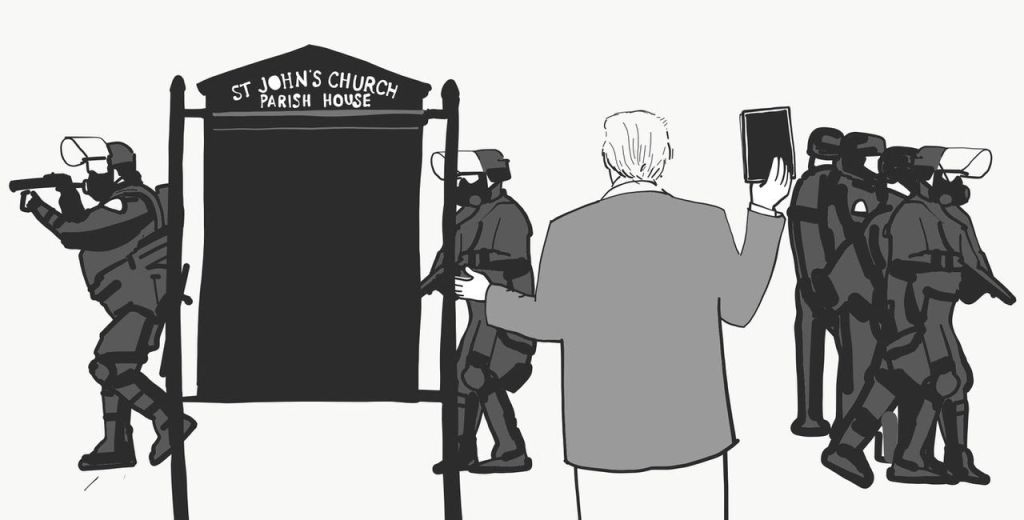
(In reading this posting please do not get your exercise jumping to conclusions – this article has not been written to align Left or Right. Christian truth can and must be freed from Right – Left captivity . When Jesus spoke in his day he often offended the Zealots, the Pharisees, and the Sadducees but called the humble of heart to open to the light truth and way of faith).
One of the pastors connected to St John’s Episcopal Church (nicknamed The Presidents’ Church ) a woman, nailed it. Bob Dylan whined blending his harmonica and voice “something is happening here Mr Jones but I don’t know what it is”. But she did. When our president staged a photo op in front of the church holding the Bible, unwittingly, he incurred the condemnation of the third commandment of Ten Commandments.
Most comments about what was going down in front of St. John’s fell wide of the mark but this pastor (a Bishop) cut through the haze and named it. She said something to the effect that he had wrapped himself in the religious symbols of the church and the Bible for political purposes. I agree with her. I think one way to clarify what was going down in that photo op can be summarized by the third commandment ( of the Ten Commandments) Thou shalt not take the name of the Lord your God in vain”. While she did not reference the third commandment, (I have lost the reference of her statement), without mentioning it, I believe she caught wind of the meaning of the profanity it addresses and applied it to what went down in front of St John Episcopal.
What is the Meaning of the Third Commandment?
What does it mean to “take my name in vain”? I once bought a piece of business property in upstate New York. I remember the first time I swung open the garage door I was greeted with a printed 8×10 inch sign posted on the inside that read “Jesus Christ is the Lord of humanity not a word of profanity :thou shalt not take the Lord your God in vain“. For the most part I think this understanding of the 3rd commandment dominated American culture in the 19th Century well into the 20th Century. And I do not actually fault that application, although in a post Christian America of today few who carelessly use God’s name in vain, making judgments, calling down curses, do so without any thought that that the language they employ is holy, or that this language actually adds any divine weight to their curse on another or on a thing (if that were even possible). I think such curses are largely spoken for their emotive effect. Regardless, either way, I believe the 3rd commandment is weighing in on a more serious issue.
The Seedbed Out of Which the Transgression of the Third Commandment Grows: The Blindness of Power and the Desperation that Derives from Weakness
The essence of the meaning of this commandment is captured in one simple idea. God is saying in this commandment “do not appropriate or use my name for any personal or collective purpose. My name has ultimate power and integrity and these belong to me and me alone. There are times when you will wish that you could connect my name and its power to your cause or need or threat. Don’t do it. If you do it I will punish you.”
The Third commandment is about minding the gap!’. God is in heaven we are on earth. “My thoughts are not your thoughts, neither your ways my ways says the Lord, as far as heaven is above the earth so are my thoughts higher than your thoughts and my ways your ways” (Isaiah 55:8-9).
The profanity addressed in this commandment lies in human beings propensity and presumption to align God with their cause, plan, purpose or mission rather than the other way around. God’s word to us requires that we organize ourselves around God’s will to the best of our understanding and ability. The posture of a person’s alignment with God’s will is one of humble obedience. Or to quote the Bible verse that the great Christian thinker and writer Soren Kierkegaard quoted more than any other, not mere simple obedience but an obedience marked by inner weakness and dread is called forth. “Work out your salvation with fear and trembling for it is God who works in you both to will and do according to his good pleasure” (Philippians 2:12&13). Any act of bold showmanship of one’s alliance with God’s truth and will embodied in the book is antithetical to a real alliance with God’s truth and will embodied in the book, communicated through the Spirit creating uncomfortable conviction within us. Such showmanship smacks of the profanity that the third commandment addresses.
“Do not take my name…” but I believe our President in this instance did. This is not a political attack . It is meant to shine light on the propensity almost every leader, at one time or another, is overcome by when his or her integrity or power with the people comes up short. There is a proverb that states “one must swing hard with a dull ax”. The Third Commandment addresses the phenomena betrayed in this proverb, only the aggression or transgression crosses a line because it is a desperate attempts to align oneself with a power and integrity that belongs only to God. The president may have done what he did in front of St John’s Episcopal church in order to strengthen his standing with Christians and buttress his authority and actions in a politically turbulent and polarized climate. He may have been feeling a strong social head wind blowing against himself. But by positioning himself for a photo op in front of St John’s Episcopal church our president brazenly and publicly imported the symbols of Christian truth (the Bible as the word of God) and the church (as his agent of God’s truth) to his leadership. Was this an attempt to buttress his leadership in general and his law and order response to shut down the Black Lives Matter protest movement in particular?
But my motive here is not political but ethical and religious. No matter whether leaders in the church lean Right or Left they are called on to speak not only truth to power, as is often heard in political discourse today, but God’s truth to power.
This photo op at Lafayette Square very well may have been a ‘Hail Mary’ pass. Here we might learn something about the temptation that propels us humans to transgress this 3rd commandment and to ignore the push back that is embedded within it, for the commandment contains a blunt push back aimed at warding off the temptation to profane God’s name. And this prohibition is backed up with a unwelcome promise – “I will not hold anyone guiltless who takes my name in vain”. These days in America this commandment is most often forgotten and ignored. But its relevance is timeless and this push back is there for a reason. It predicts a peculiar kind of transgression that keeps coming back around from antiquity, when the Ten Commandments were codified, to the present. The threat attached to the prohibition excites the imagination – God’s name, just like your name or my name is not something anyone has the right to latch hold of and identify one’s speaking and acting with, it belongs to oneself. This is a boundary issue and if and when one crosses over this boundary or trespasses it she or he will be punished.
Most often it is a particular situation or climate which tempts one to trespass this commandment. There are moments when the integrity of one’s life is under a threat of one kind or another, and this threat or challenge, whether explicit or subtle, is always a public threat even if the ‘public’ here is 2 people or 350 million people. Most importantly it is the means to supply what is wanting in one’s integrity, wanting vis a vis one’s name, i.e. one’s ability to meet the particular challenge that that is under the magnifying glass. It is at such intersections in life men and women are tempted to reach beyond themselves; reach all the way from earth to heaven and presume to identify God, God’s good and holy name and God’s truth and authority with their name and their way that can no more stand on its own. (‘Holy” signifying its a name we cannot domesticate but must revere).
What is in this taking of the Lord’s name in vain (profanity) that requires it be attached to a stern warning? Why does the commandment warn us that if we trespass this commandment God will not hold us guiltless, that there will be consequences? I believe it is because transgressing this commandment involves us in a serious offense. It addresses a bold presumption that often stems from the intoxicating influence inordinate power has on one’s minds and spirit . Or just the opposite, an action driven by the desperation created by extremities that impinge upon a person, extremities that a person cannot of his own resources extricate himself. The strength of God’s name must be understood vis a vis the weakness of a person’s name under duress in a particular situation.
This is the kind of sin that king David recognized was especially serious and therefore prayed that he would never fall into (Psalm 19:13). It is essentially a form of robbery, and the theft is not a mere Mars Bar taken from the corner grocery but a quick grab to steal the integrity of God’s name and identify it with one’s own public accounting before others. It involves us in direct violence against God because it attempts to violate God’s ‘holy’ name and use it by taking it and publicly identifying it with our name, our life, our actions, our projects and missions. It is an attempt to involve God in, and align him with, our folly. If God allowed this his name would soon be worth nothing. It would not be holy it would be common.
The climate that this temptation grows out of derives from both a false strength, i.e. presumption, and also real weakness. Presumption blinds one to the existence of a gap. Those who possess power are easily blinded to the gaps, the deep differences between themselves and others and also God. People in power often think and act as if they are above the law that the ‘commoners’ are under and here in this context it is not only human laws but God’s laws (Where are the John Knoxs’ of the church today? Knox stood eye ball to eye to Mary Queen of Scots, called ‘Bloody Mary’ and called her to repentance risking her wrath and his life).
On the other hand it is not only power, and the blindness that is endemic to it, that makes women and men of power vulnerable to the temptation to breach this commandment, but also public weakness of one’s good name. This is the heart of my argument and lesson at hand. I repeat when the integrity of one’s name falls short to carry the moment one faces, when one’s bank account that stores and measures one’s moral authority is in the red, when one’s public power to effect one’s will and passion is wanting, it is then that one is vulnerable to the temptation to reach beyond oneself for a better higher name that could buttress and enhance one’s name and actions.
The third commandment addresses the oldest trick in the book. In times of extremity when one’s power comes up short and a person is not able to win those he or she leads then it is that religion’s holy symbols embodying a higher authority are imported by the leader. The leader need simply identify himself with God’s good and righteous name, his will and authority. What harm could there be in making a little transfer from God’s moral bank account and put it into one’s own account ? after all the end justifies the means.
What happened on Lafayette Square?
In my reading herein lies the pinch of the point regarding the public events that took place in Lafayette Park in Washington D C this week (June 5, 2020) between our nation’s president and the peaceful protest occurring there. Again and again over the course of history God’s name and God’s will have been imported by Ecclesial and political leaders’ to maintain civil and social control so as to resist needed change. Add the leverage of heaven to one’s earthly endeavors and people are more likely to heel. Some things are easier if divine leverage is introduced into the mix. This is the intersection that this commandment addresses. Jurgen Moltmann’s work on hope shows that religion has all too often farmed out God’s name, and the sanctity of the church’s religions influence, and authority that derives from it, to political leaders’, princes and prelates, kings and queens’ to help them silence the cries of people seeking redress and change on the side of justice.
Was this another attempt by the state to join itself to religion to legitimize its resistance to a movement by the people calling for needed change and redress to a systemic abuse of power that has persisted for a long long time? At Lafayette Square did the state again do as it has done off and on for not merely 2000 years but from antiquity – attempt to wed itself to a higher transcendent power – God’s name and God’s truth, in order to legitimize its resistance to change and justice?
Time will tell. In God’s economy as long as life remains hope endures. It is never too late for repentance to take hold of the people of this country far and wide and also take hold of its leaders Right as well as Left, and also that portion of the police force needing reform (re formation or new formation), to effect a just an equitable transformation of police power.
It should be noted that trespassing this 3rd commandment entangles not only individual persons, but the church and its leaders, and the state and its leaders, in one of God’s unwanted promises. “I will not hold him guiltless who takes my name in vain” ”(Exodus 20). God, the good book assures us, is “no respecter of persons”(Acts 10:34) therefore wisdom is called for and “the fear of God is the beginning of wisdom” (Proverbs 9:10).
The imprisoned Apostle Paul said to King Agrippa “ do you believe the Prophets ?…I know that you do” And so it should be asked of both our church and political leaders, Right and Left, today “do you believe the Prophets and if so then open that good book so dandily show cased on Lafayette Square and begin reading the Prophets passionate call to give justice to oppressed peoples, read the very verses about delivering justice Jesus quoted from the Prophets when he inaugurated his earthly ministry (Luke 4:16-19). There is a foundation here to transcend the Right – Left divide, and, as Micah asserts, “this is what God requires of you – do justice, love kindness and walk humbly with your God”.
Herein lies the pinch of the point regarding the public events that took place in Lafayette Park in Washington D C this week ( June 5/20) between our nation’s president and the peaceful protest occurring there. Again and again over the course of history God’s name and will have been used by Ecclesial and political leaders’ to maintain civil and social control so as to resist needed change. Add the leverage of heaven to one’s earthly endeavors and people are more likely to heel. Some things are easier if divine leverage is introduced into the mix. This is the intersection that this commandment addresses. Jurgen Moltmann’s work on hope shows that religion has all too often farmed out God’s name, and the sanctity of their religions influence, and authority that derives from it, to political leaders’, princes and prelates, kings and queens’ to help them push back in the name of law and order and silence forces seeking redress and change on the side of justice.
Was this another attempt by the state to join itself to religion to legitimize its resistance to a movement by the people calling for needed change and redress to a systemic abuse of power that has persisted for a long long time. At Lafayette Square did the state again do as it has done off and on for nearly 2000 years – attempt to wed itself to a higher transcendent power – God’s name and God’s truth, in order to legitimize its resistance to change and justice?
Time will tell. In God’s economy as long as life remains hope endures. It is never too late for repentance to take hold of the people of this country far and wide and also take hold of its leaders Right as well as Left, and also that portion of the police force needing reform (re formation or new formation), to effect a just an equitable transformation of police power.
It should be noted that trespassing this 3rd commandment entangles not only individual persons, but the church and its leaders, and the state and its leaders, in one of God’s unwanted promises. “I will not hold him guiltless who takes my name in vain” ”(Exodus 20). God, the good book assures us is “no respecter of persons”(Acts 10:34) therefore wisdom is called for and “the fear of God is the beginning of wisdom” (Proverbs 9:10).
The imprisoned Apostle Paul said to King Agrippa “ do you believe the Prophets ?…I know that you do” And so it should be asked of both our church and political leaders, Right and Left, today “do you believe the Prophets and if so then open that good book you so dandily show case and begin reading the Prophets passionate call to give justice to oppressed peoples, read the very verses about delivering justice Jesus quoted from the Prophets when he inaugurated his earthly ministry (Luke 4:16-19). There is a foundation here to transcend the Right – Left divide and as Micah asserts – “this is what God requires of you – do justice, love kindness and walk humbly with your God”.
The 3rd Commandment and the Gospel
There are always two choices, two roads. The one is captured by the Pharisee who went to the temple to pray and said “God I thank you that I am not like other men“. In these words, almost explicitly, and surely spoken with confidence, the Pharisee presumed to identify himself as existing inside a special fraternity with God because he basically spoke for God.. The Pharisee failed to mind the gap. In a word he assumed that he could safely identify himself with God. His morality and God’s were the same A to Zed. Thinking about his words we picture the two (the Pharisee and God) wrapped in happy comradery in the Pharisee’s mind .
Or there is a second way, one captured by an old Protestant hymn, “Naked I come to thee for dress”. This latter refrain expresses why we go to church and open the book, namely that by some grace God will speak to us and show us our distance from him and his way per adventure we can find the way again and soldier on best we can. And this is also what Jesus Christ is about. The Jesus Christ that is presented and preached to us in the Gospel prevents the unfounded identification of any person’s life, way and mission with God, whether high or low, a king or a popper. All one can say is “I believe x y z actions and words are according to God’s will, I hope and pray that they are, God help me so that my short fall will cause no harm, may God’s forgiveness and grace rest upon my words and actions”.
Before we “sing nearer my God to thee” we best learn to find our distance and how and where we can bridge this distance without destroying it and then draw near. The Tax Collector felt the distance and went to the temple to pray “God be merciful to me a sinner”. This distance is in everyone more or less. The Pharisee presumed there was no fundamental moral difference between himself and God. There was and there is in all of us, whether pope or friar, pastor of thousands or the Sunday School teach of a mere six in the class a profound gap between her or him and God.
Jesus Christ for Christians is the name of this God – human meeting place and rightly understood the antidote to ill-founded identification between oneself and God – i.e. profanity. There can be no fusion, no identification between God’s name and our way and our name. There can only be a provision of costly grace that God provides thereby making it possible for saints (so called) and sinners to be able to draw near to God and find comfort and correction.
In ourselves we enjoy no direct identification with God no matter how good or great or moral, or necessary or God blessed we believe our purpose to be. God has chosen to come near to us in a way that preserves God’s unbridgeable otherness and difference and this is the meaning of Jesus Christ. The fraternity with God that grace empowers does not mean our way and God’s way are perfectly aligned, it means that despite the fact they never are perfectly aligned through Christ we live inside God’s kindness and love and suffer the correcting abrasion of his holy difference without it destroying or hardening us.
Heeding this commandment means to mind the gap. It means to reverence the gap between God and God’s way and ours. It means we should resist all attempts to suggest that God endorses our ways and identifies with our actions and words, that the stamp of his authority rests on our actions and words. The third commandment is smack dab in the opening phrases of the Lord’s prayer – “Our father who are in heaven hallowed be your name. The holiness of God’s name marks a boundary. Fools rush in where angels fear to tread.

